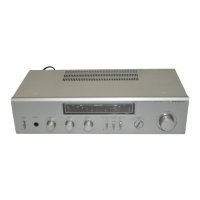
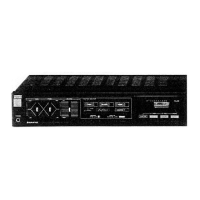
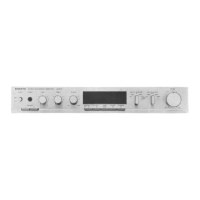
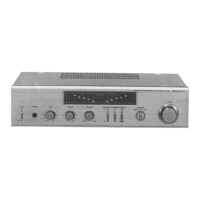
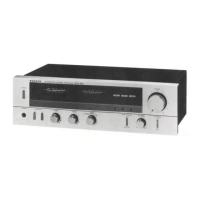
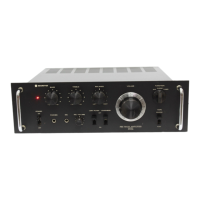
This document describes the Sanyo JA 477 (Europe) AH10 Power Amplifier, a service manual providing detailed information for maintenance and repair.
Function Description
The Sanyo JA 477 is a power amplifier designed to amplify audio signals for playback through speakers. It features multiple input options, including PHONO, CD/VIDEO, and TAPE, allowing connection to various audio sources. The amplifier includes tone controls for BASS and TREBLE, enabling users to adjust the sound to their preference. It also incorporates a monitor switch, a loudness function, and a headphone socket for private listening. The internal design consists of several printed circuit boards (PCBs) for different functions: a Main Amp PCB, P.T. Secondary PCB, Power SW PCB, Headphone Socket PCB, Bal/Tone PCB, LED PCB, Volume PCB, DC Tuner PCB, and DC Deck PCB. These PCBs are interconnected to manage power distribution, signal processing, and user interface controls.
Important Technical Specifications
The specifications provided are based on IHF measurements and may not be directly comparable to DIN or other standards.
- Continuous Output Power: 35 W x 2 (at 8 ohms, 0.9% distortion).
- Input Sensitivity and Impedance:
- PHONO: 2.5 mV/47 kohms
- CD/VIDEO: 150 mV/47 kohms
- Frequency Response: 20 Hz - 20 kHz (CD/VIDEO).
- Tone Control Response:
- BASS: ±8 dB (at 100 Hz)
- TREBLE: ±8 dB (at 10 kHz)
- Signal to Noise Ratio: 95 dB (CD/VIDEO).
- Power Requirements: AC: 220 V, 50 Hz.
- Power Consumption: 190 W.
- Dimensions (W x D x H): Approx. 420 x 200 x 85 mm (16-1/2" x 7-7/8" x 3-3/8″).
- Weight: Approx. 4 kg (9 lbs.).
Usage Features
The amplifier offers a straightforward user interface with various controls for audio playback.
- Input Selection: A function switch allows users to select between PHONO, CD/VIDEO, and TAPE inputs.
- Tone Controls: Separate slide knobs are provided for BASS and TREBLE adjustments, offering ±8 dB control at 100 Hz and 10 kHz, respectively.
- Volume Control: A main volume knob allows for overall output level adjustment.
- Balance Control: A balance control is available to adjust the relative volume between the left and right channels.
- Speaker/Loudness: Push buttons are included for speaker control and activating the loudness function, which enhances bass and treble frequencies at low listening levels.
- Tape Monitor: A tape monitor button allows for monitoring signals from a connected tape deck.
- Headphone Output: A dedicated headphone socket is provided for private listening.
- Power Switch: A power switch controls the main power to the unit.
Maintenance Features
The service manual provides comprehensive instructions and diagrams for disassembling, troubleshooting, and repairing the amplifier.
- Disassembly Instructions: Detailed diagrams illustrate the disassembly process for the cabinet, front panel, back lid, and various PCBs, including the Main Amp PCB, P.T. Secondary PCB, Power SW PCB, Headphone Socket PCB, Bal/Tone PCB, LED PCB, Volume PCB, DC Tuner PCB, and DC Deck PCB.
- Parts List: An extensive parts list categorizes components by their function and location (e.g., Packing & Accessories, Cabinet & Chassis, Electrical Parts, Main Amp PCB Assy, P.T. Secondary PCB Assy, Volume PCB Assy, LED PCB Assy, Headphone Socket PCB Assy, Power Switch PCB Assy, DC Tuner PCB Assy, DC Deck PCB Assy, Bal/Tone PCB Assy). Each entry includes a reference number, part number, and description. Components critical for safety are marked with the IEC symbol (▲).
- Schematic Diagram: A detailed schematic diagram illustrates the electrical connections and components within the amplifier, aiding in troubleshooting and repair.
- Ring Diagram: A ring diagram provides an overview of the PCB interconnections, useful for understanding signal flow and identifying connection points.
- Bias Current Adjustment: Specific instructions are provided for adjusting the bias current using SVR703 and SVR803, ensuring optimal performance and stability of the output stage. This adjustment should be performed after the power switch has been on for more than 3 minutes, measuring DC voltage between specified points on R788/R789 and R888/R889.
- AC Voltage Conversion: Instructions are given for converting the unit from 220V AC to 110V AC operation, involving remounting the power transformer's primary terminals and changing the main fuse.
- Product Safety Notice: A critical safety notice emphasizes the importance of using designated replacement parts for components marked with the IEC symbol and performing leakage-current or resistance measurements to ensure safety before returning the product to the customer.
- Component Abbreviations: A list of abbreviations for materials of capacitors and resistors (e.g., AL ELECT for Aluminum Electrolytic, BC CON for Semiconductor Ceramic) and tolerance symbols (e.g., J for ±5%, K for ±10%) is provided for clarity in the parts list.

 Need help?

 To Next Page
 General