Need help?
Do you have a question about the Satel AQUA and is the answer not in the manual?
Describes LED behavior for actuation and prealarm status, and sensor response to low voltage.
Details on indoor installation, mounting the detector housing, and protecting the pyro element.
Lists available lenses with their range, beam angle, and suitability for different monitoring scenarios.
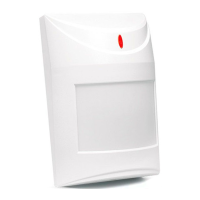
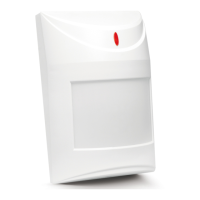
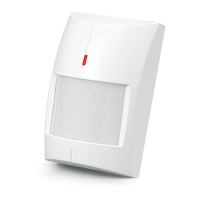
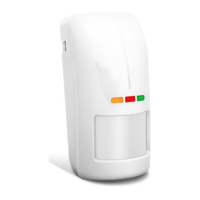
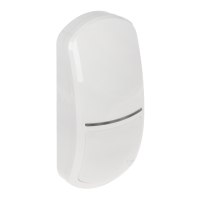
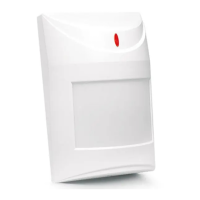
The Satel AQUA and AQUA Pro are digital passive infrared detectors designed for indoor installation, offering high sensitivity and resistance to interference. These devices utilize microprocessor-based technology for advanced performance. The AQUA model incorporates a dual pyroelectric element, while the AQUA Pro features a quad element, enhancing their detection capabilities.
The primary function of these detectors is to sense motion within a protected area using passive infrared technology. When the detector is actuated, a red LED lights up for approximately 2 seconds, providing a visual indication of its operation and allowing installers to verify correct functioning and to delineate the protected zone.
A key feature is the prealarm function, which provides an early warning without triggering the main alarm relay. This prealarm is indicated by a short LED flash, lasting about 120ms, and activates when ambient disturbances do not yet meet the full alarm criteria. The prealarm sensitivity operates independently of the main detector sensitivity, which can be adjusted by the user.
Upon power-up, the detector enters a starting state for 30 seconds, signaled by rapid LED blinking. After this initial period, it transitions into its operational readiness state, ready to monitor the environment.
The device also incorporates a supply voltage monitoring feature. Should the voltage drop below 9V (±5%) for more than 2 seconds, the detector will signal a violation state. This alert persists until the voltage is restored to a minimum of 9V (±5%), ensuring reliable operation within specified power parameters.
The AQUA and AQUA Pro detectors offer customizable settings to adapt to various environmental conditions and security requirements. Three pairs of pins on the electronics board are used to configure the detector's working parameters. Users can select between low, medium, or high sensitivity settings for optimal performance in different environments. Additionally, the LED indicator can be toggled ON or OFF, providing flexibility for discreet operation or visual feedback during setup and testing.
The detectors are equipped with various contacts for integration into security systems:
The device's electronics board includes a positioning scale, which is crucial for properly aligning the pyroelectric element with the lens installed in the housing. For an installation height of 2.1 meters, the board should be set so that its midline aligns with a specific mark on the housing to achieve the manufacturer's specified range. If the detector is installed at a different height, the board needs to be adjusted accordingly – moved up if installed higher than 2.1m, or down if lower – to maintain optimal detection performance.
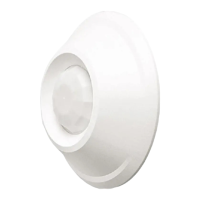
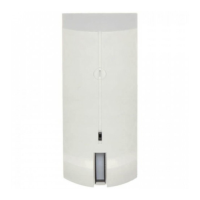
The detectors come with a wide-angle lens as standard, but this can be replaced with other lenses offering different characteristics such as range, number of beams, and angle of view. Available lens types include extra wide angle, long-range with access zone monitoring, and vertical barrier lenses, allowing for tailored coverage of the protected space. It is important to select a lens that matches the size and configuration of the area to be monitored, ensuring that the space along the main direction of detector positioning is not less than one-third of the detector's nominal range. Improper lens selection can lead to excessive sensitivity and false alarms.
During installation, particular care must be taken to prevent the pyroelectric element from getting dirty or damaged, as this can impair the detector's performance. The electronics board should be removed from the housing to make adequate openings for screws and cables in the rear panel, facilitating a clean and secure installation.
The detector's ability to monitor its supply voltage contributes to its reliability. By signaling a violation state when the voltage drops below a critical threshold, it alerts users to potential power issues that could affect its operation, allowing for timely intervention.
The design of the device, with its accessible electronics board and configurable settings, simplifies maintenance and troubleshooting. The visual LED indicator, which lights up during actuation and blinks during the starting state, provides immediate feedback on the detector's status, aiding in diagnostics. The prealarm function also helps in identifying potential issues or environmental factors that might trigger false alarms before they escalate into full alarm events.
 General
| Detection range | 12 m |
|---|---|
| Detection angle | 90° |
| Tamper protection | Yes |
| Detection method | PIR |
| Battery | CR123A |
| Radio frequency | 868 MHz |
| Operating voltage | 3 V |
| Output type | Wireless |
| Power supply | Battery |

 To Next Page