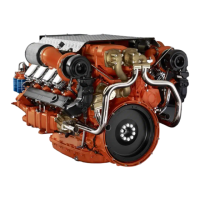
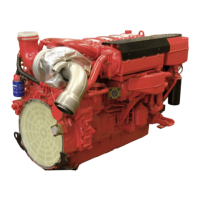
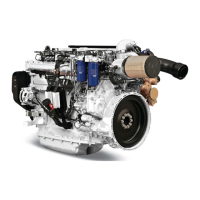
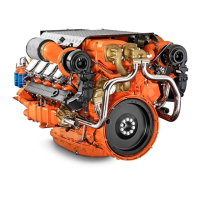
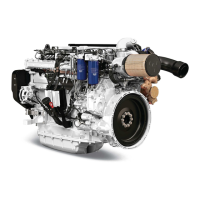
This document is an Operator's Manual for the Scania DI09 PDE Marine engine, providing comprehensive information on its operation, maintenance, and technical specifications. The engine is described as a direct-injection, liquid-cooled, four-stroke diesel engine with turbochargers, available with various output and engine speed settings.
Function Description
The Scania DI09 PDE Marine engine is designed for marine applications, offering reliable power and performance. It operates on a four-stroke diesel cycle, utilizing direct injection for efficient fuel combustion. The engine's liquid-cooling system and turbocharger contribute to its performance and durability. The engine management system (EMS) plays a crucial role in monitoring and controlling various parameters, including oil pressure and coolant temperature, to ensure optimal operation and prevent damage.
Important Technical Specifications
The manual provides detailed technical data for the DI09 PDE Marine engine:
- Number of cylinders and configuration: 5, straight
- Working principle: 4-stroke engine
- Firing order: 1-2-4-5-3
- Compression ratio: 18:1
- Displacement: 9.3 dm³ (567.5 in³)
- Engine direction of rotation viewed from rear: Anticlockwise
- Fan direction of rotation viewed from front: Clockwise
- Cooling: Coolant
- Valve clearances (cold engine):
- Intake valve: 0.45 mm (0.018 in)
- Outlet valve: 0.70 mm (0.028 in)
- Number of teeth on the flywheel: 158
- Low idling speed: 500-1,050 rpm
- Maximum full-load speed: 1,800-2,100 rpm
- Fuel: Diesel
- Approximate weight (without coolant and oil):
- With heat exchanger: 1,150 kg (2,535 lb)
- With keel cooling: 1,044 kg (2,302 lb)
- Without heat exchanger and liquid-cooled charge air cooler: 1,032 kg (2,275 lb)
- Lubrication system:
- Oil capacity max/min: 38/32 liters
- Oil cleaning: Centrifugal oil cleaning
- Oil cooler: Coolant cooled, full flow
- Oil filter: Paper filter, full flow
- Interval between oil changes: 500 hours
- Oil grade: ACEA E5 or E7 (for low-sulphur fuel); Total Base Number (TBN) > 12 (ASTM D2896) for non-low-sulphur fuel.
- Oil pressure (normal operating): 3-6 bar (43.5-87 psi)
- Minimum permitted oil pressure at idling speed: 0.7 bar (10.2 psi)
- Crankcase pressure with closed crankcase ventilation: -5.4 to 2.0 mbar (-0.08 to 0.03 psi)
- Intake system:
- Permissible pressure drop with cleaned/new filter: 30 mbar (0.44 psi)
- Permissible pressure drop with blocked/dirty filter: 65 mbar (0.94 psi)
- Cooling system:
- Coolant volume (excluding radiator):
- With heat exchanger: 30 dm³ (7.9 US gallons)
- With keel cooling: 18 dm³ (4.8 US gallons)
- Without heat exchanger and liquid-cooled charge air cooler: 18 dm³ (4.8 US gallons)
- Coolant temperature:
- With heat exchanger: 90-95°C (194-203°F)
- With keel cooling: 83-88°C (181-190°F)
- Without heat exchanger and liquid-cooled charge air cooler: 83-88°C (181-190°F)
- Number of thermostats: 1
- Thermostat opening temperature:
- With heat exchanger: 80°C (176°F) and 87°C (187°F)
- With keel cooling: 75°C (167°F)
- Without heat exchanger and liquid-cooled charge air cooler: 75°C (167°F)
- Fuel system:
- Injection system: PDE (unit injector)
- Engine management system: EMS
- Fuel filter: Paper filter from Scania
- Water separating prefilter: Paper filter from Scania
- Electrical system:
- Starter motor (standard equipment): 1-pin, 24 V, 6 kW
- Alternator (standard equipment): 1-pin, 28 V, 100 A
The engine data plate, located on the cylinder block, provides the engine type, size, application, power, nominal engine speed, and EU type approval for exhaust emissions.
Usage Features
The manual outlines several important usage features and considerations:
- Power Classes: Scania engines are supplied in three power classes:
- ICFN (Continuous service): For continuous use, unlimited operational hours, 100% total load factor.
- IFN (Intermittent service): For periodic use, rated power available for 1 hour per 3-hour period, accumulated load factor not exceeding 80% of rated power, unlimited operational hours.
- PRP (Prime Power): For continuous use, unlimited operational hours with varying loads, max. average load factor of 70% during 24 hours, 1 hour/12 hour period over 100% load, max. 25 hours accumulated service time over 100% load per year (for single-speed engines).
- Starting and Driving:
- Checks before first start/driving: Includes oil level, coolant, fuel level, battery fluid level and state of charge, and drive belt condition.
- Starting the engine: Requires opening fuel cocks, disengaging the engine, switching on battery master switch (if fitted), and starting the motor. Bleeding the fuel system is necessary if the tank has run dry or after long periods of inactivity.
- Starting at low temperatures: Use a fuel heater and engine heater if temperatures are below -10°C (14°F). Avoid prolonged idling when cold.
- Engine speed range: Between low idling (500-1,050 rpm) and nominal engine speed (indicated on data plate).
- Driving at high altitude: Engine power is automatically reduced. ICFN and PRP engines up to 2,000 meters; IFN engines up to 1,000 meters.
- Limp home operation: An emergency mode if throttle or CAN communication faults occur, allowing the engine to run at normal or fixed raised idling speed (800 rpm).
- Engine Shutdown: Requires running the engine without load for a few minutes after heavy load operation to prevent post-boiling and turbocharger damage. The power should not be switched off until the engine has stopped.
- Fuel Quality: Strict requirements for diesel (EN590, specific viscosity, density, ignitability, flashpoint, particulate level). Biodiesel (FAME), Renewable diesel (HVO), and Gas-to-liquids (GTL) are approved under specific standards and conditions.
- Storage: For long-term storage, the engine should be protected against rust, stored indoors in a temperature-controlled room, and packed in VCI plastic. Special preservative fuel, oil, and coolant are required.
Maintenance Features
The manual emphasizes regular maintenance for optimal performance, extended service life, emission compliance, and operating economy. Maintenance items are categorized into R (one event when taken into service), S (minimum basic), M (more extensive), L (nearly all items), and XL (all items), following a sequence of S-M-S-L-S-M-S-L-S-M-S-XL.
- Safety Precautions:
- Serious risk of injury: Always block the starting device or disconnect a battery cable when working on the engine to prevent unexpected starts.
- Hot surfaces and fluids: Risk of burns from hot parts (branch pipes, turbochargers, oil sumps) and hot coolant/oil.
- Chemicals: Glycol, anti-corrosive agents, preservative oils, degreasing agents are hazardous. Follow packaging instructions and store safely.
- Fuel and lubricating oil: Flammable. Work on a cold engine. Store used rags safely.
- Batteries: Contain highly corrosive sulphuric acid and form oxyhydrogen gas (flammable and explosive). No smoking, naked flames, or sparks near batteries.
- Starter gas: Never use to start the engine due to explosion risk.
- Hazardous gases: Only start in well-ventilated areas; exhaust gases are toxic.
- Electric welding: Disconnect battery, alternator, and engine control unit leads. Connect welding clamp close to the component being welded.
- Lubrication System:
- Checking oil level: After at least 7 minutes of engine off, check dipstick; level should be between min and max marks.
- Changing oil: Drain hot oil, clean magnet on oil plug, renew gasket, refit plug, fill with specified oil, check level.
- Cleaning centrifugal oil cleaner: Remove cover, unscrew nut, drain oil, lift rotor, loosen rotor nut, remove rotor cover and strainer, clean parts, check nozzles and bearings, fit new paper insert, refit strainer and O-ring, screw rotor nut, refit rotor and cover, tighten lock nut (20 Nm/15 lb-ft).
- Renewing oil filter: Remove old filter, oil new gasket, tighten by hand, start engine and check for leaks.
- Renewing reversible oil filter (option): Turn rotary control, clean filter, unscrew, apply oil to gasket, fill with oil, screw into place, turn screw further, turn rotary control to direct flow through other filter, renew second filter.
- Air Cleaner:
- Reading vacuum indicator: Renew filter element if red plunger is fully visible.
- Renewing filter element and safety cartridge: Remove cover, renew filter element (and safety cartridge if present), check filter paper for damage, renew O-ring, assemble, reset vacuum indicator. Filter elements must not be cleaned with water or compressed air.
- Cooling System:
- Coolant: Mixture of water, antifreeze (ethylene glycol), and corrosion protection. Change every 6,000 hours or 5 years. Use pure fresh water or Scania ready-mixed coolants.
- Antifreeze and corrosion protection: Minimum 35% by volume for corrosion protection. Too high a concentration can cause sludge; too low can lead to corrosion or freezing. Measure with a refractometer.
- Risk of freezing: No damage if antifreeze content is at least 35%. Minimal ice formation can cause disruptions.
- Topping up: Only use pre-mixed coolant.
- Checking coolant level: Check sight glass on expansion tank. Top up as necessary. Do not open cap when hot. Avoid topping up large amounts via expansion tank to prevent air locks.
- Checking sacrificial anodes: Check every three months during the first year or when changing operating environment. Drain sea water circuit, remove anodes, scrape off loose material, renew if less than 3/4 remains. Renew gasket.
- Checking sea water pump impeller: Drain sea water circuit, remove pump cover, check vanes for damage. Renew if necessary.
- Changing coolant and cleaning cooling system: Drain coolant, remove thermostat, fill with hot water and detergent, run engine, drain, repeat if necessary, clean expansion tank, fit new thermostat, fill with new coolant.
- Draining sea water circuit: Close bottom valve, remove connection pipe and pump cover.
- Removing/Cleaning/Fitting charge air cooler and heat exchanger: Involves removing covers, cleaning cooler cores with acidic detergent (not caustic soda), renewing O-rings, and reassembling with specific tightening torques (M8 screws to 15 Nm/11 lb-ft for covers, M6 to 10 Nm/7 lb-ft, M8 to 26 Nm/19 lb-ft, M10 to 50 Nm/37 lb-ft for brackets).
- Fuel System:
- Cleanliness requirements: The fuel system is highly sensitive to dirt. Maintain extreme cleanliness during work. Use lint-free cloths and clean tools.
- Checking fuel level: Check and fill as necessary.
- Draining/Renewing single water separating prefilter (option): Detach sensor cable, open drain tap, unscrew filter cover and filter, discard old filter, lubricate O-rings, fill with fuel, screw into place, open shut-off cock, screw sensor cable, bleed fuel system.
- Draining/Renewing reversible water separating prefilters (option): Switch off filter, clean housing, remove cover, undo drain plug, fill with fuel, fit cover.
- Renewing fuel filter: Clean exterior, unscrew, oil gasket, screw into place, screw further, bleed fuel system.
- Bleeding fuel system: Use suction tool or hand pump to remove air bubbles from the fuel manifold.
- Other:
- Checking drive belt: Check for deep cracks (small, shallow cracks are normal). Renew if many deep cracks or parts are coming off.
- Checking for leakage: Inspect for oil, coolant, fuel, air, or exhaust leaks. Tighten/renew connections.
- Checking and adjusting valve clearance and unit injectors: Requires special tools (turning tool, setting tool) and other tools (torque wrench, feeler gauges, flashlight, mirror). Engine must be cold. Follow workflow table for specific cylinder adjustments. Tighten lock nut for valves to 35 Nm (26 lb-ft) and for unit injectors to 39 Nm (29 lb-ft).
- Hose clamps: Specifications for tightening torque when tightening by hand. Maximum tightening torque for a new unfitted hose clamp is 1 Nm (0.7 lb-ft).
- Environmental Considerations: The manual consistently highlights the importance of disposing of used oil, coolant, fuel, chemicals, and batteries according to national and international laws and regulations.

 Need help?

 To Next Page
 General