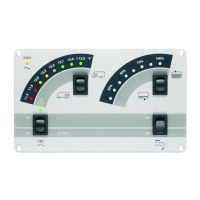
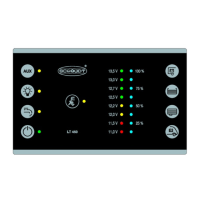
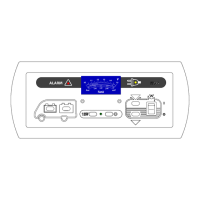
Instruction Manual for LT 52 Control Panel
6
Date: 01.03.2018 8310027 BA / EN
The values specified above apply for running operation, not for the off-load voltage (see be-
low).
Apart from displaying the battery capacity (see section 3.3.2), measuring the off-load voltage
is a simple and effective method of checking the condition of the battery. Off-load voltage is
understood to be the voltage of the charged battery in a passive state, with no current being
supplied or drawn.
Take the measurement several hours after the last charging. No significant load should have
been placed on the battery in the interim period, meaning no current should have been
drawn from it. If the off-load voltage of the battery is less than 12.0V, there is a risk of total
discharge.
The following table shows the correct interpretation of the off-load voltage displayed. The
values specified apply for Gel batteries.
Values for off-load voltage Charge state of the battery
Less than 12V Totally discharged
12.2V Approx. 25%
12.3V Approx. 50%
More than 12.8V Full
3.3.3 Tank fill levels
The 12V supply for the leisure area must be switched on for the display (see section 3.1).
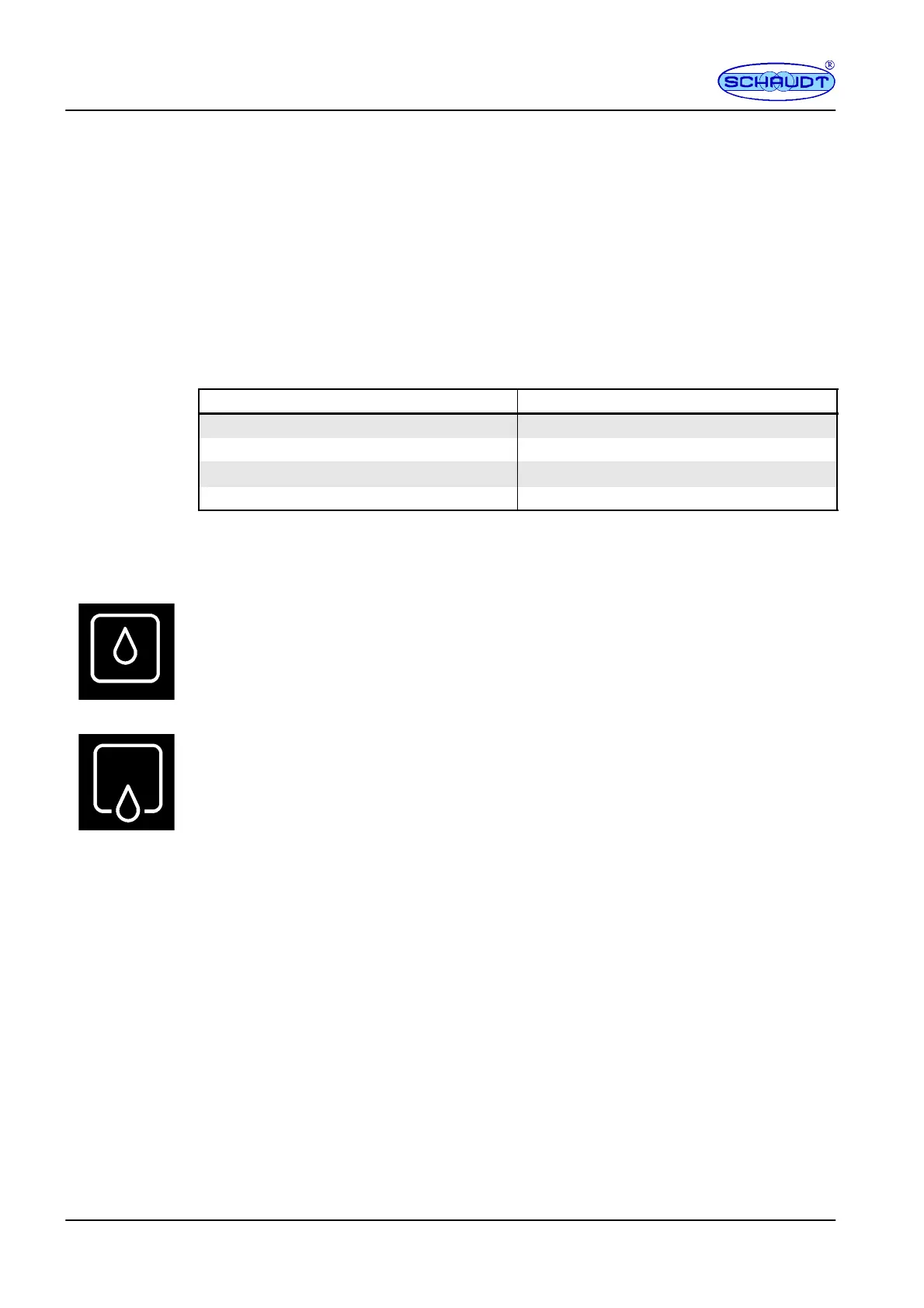
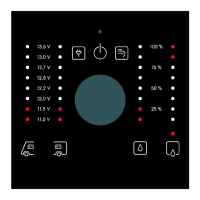
T urn the encoder until the ”Water Tank” symbol lights up.
F The ”%” scale lettering lights up.
F The ”Water Tank” symbol lights up (or flashes).
F The fill level of the water tank is displayed on the LED scale for approx. 20 seconds.
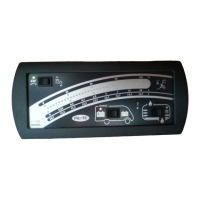
T urn the encoder until the ”Waste Water Tank” symbol lights up.
F The ”%” scale lettering lights up.
F The ”Waste Water Tank” symbol lights up (or flashes).
F The fill level of the waste water tank is displayed on the LED scale for approx. 20 se-
conds.
If the relevant symbol flashes when the fill level of a tank is being displayed, the water tank
is empty (or the waste water tank full).
If the LEDs flash, there is a sensor fault on the relevant tank (see section 4.1).
Off-load
voltage


 To Next Page