7
Class–A High Voltage Preamp / No Integrated Circuits / No NFB
SWISS
MADE
1 3
INSTRUMENT IN STEREO IN
2
10V GAIN WARM LOW MID HIGH REV VOLUME
GAIN RESON LOW MID HIGH REV VOLUME
flat
INSERT REVERB
master
LINE OUT
INSTRUMENT INMIC IN P24 10V
DAVID X
1 2 0 W A T T
A C O U S TIC
A M PLI F I E R
SERI AL NUMBER
WWW . S C H E R T L E R . C O M
M
A
D
E
+
S
W
I
S
S
8 0 W A T T P O W E R C O N S U M P TIO NX S E R I E S
CAUTION
RISK OF ELECTRIC
SHOCK
DO NOT OPEN
TO REDUCE RISK OF FIRE,
DO NOT EXPOSE THIS
EQUIPMENT TO RAIN
OR MOISTURE. FOR
CONTINUED PROTECTION
AGAINST RISK OF FIRE,
REPLACE ONLY WITH THE
SAME TYPE AND RATING
OF FUSE.
240 Hz
150 Hz
CONTROLS
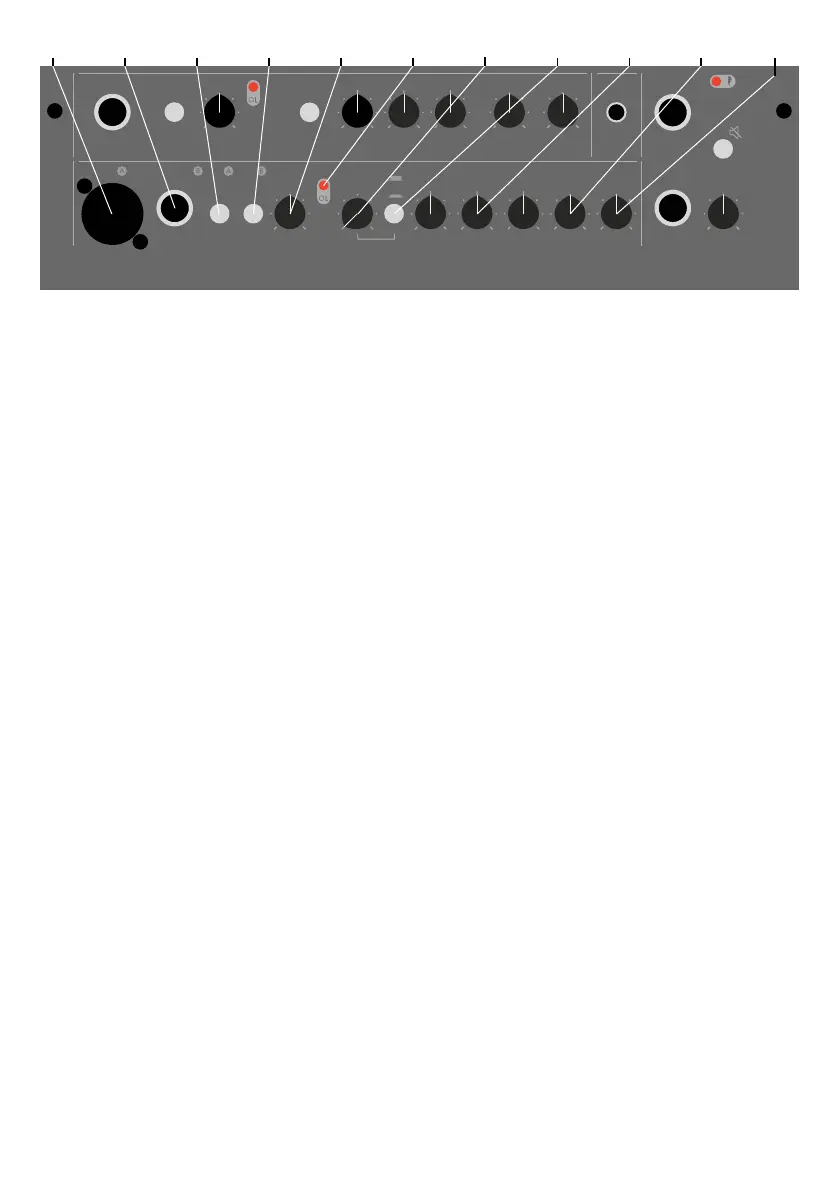
2.1 2.2 2.3 2.4 2.5 2.6 2.7 2.8 2.9 2.10 2.11
2.1. MIC INPUT (XLR): This input is electronically balanced for XLR-type connections. The channel is
designed for any kind of microphone source e.g. dynamic and condenser mics.
2.2. INSTRUMENT IN: An unbalanced input for the connection of 1/4” jacks, with optimal sensitivity
for high level signals. The electronics will adapt to any situation - no special action is required.
2.3. P24: Phantom power supplies the XLR connector with 24 VDC for powering condenser
microphones. Most condenser (and dynamic) mics, and some preamps, can be safely phantom
powered. In certain cases however, phantom power can cause damage. This tends to happen with
unbalanced microphones, preamps, or stompboxes that have been modied for balanced XLR use.
If in doubt, please contact the manufacturer to check the compatibility of your audio device before
using the amplier.
2.4. 10V: This supplies the jack connector with 10 VDC for powering electret microphones.
2.5. GAIN: This variable gain preamplier adjusts the sensitivity level to ensure the best possible
processing of the mic/instrument signal through the channel. It is important that this input level is
set and optimized in the best way to achieve the cleanest sound possible. (See “Practical tip”, 1.4.)
2.6. OVERLOAD: This LED (when lit) indicates that the level of the input signal is too high and it
might therefore introduce distortion. (See “Practical tip”, 1.4.)
2.7. RESON: The RESONANCE (notch) lter cuts the frequency of 150 Hz/240 Hz, to reduce low-
frequency feedback. Left: no attenuation (at), Right: maximum attenuation.
2.8. RESON button: Use the RESON button to select the resonant frequency of the instrument
(240 Hz/150 Hz).
2.9. HIGH, MID, LOW (EQ): These controls are for high, mid and low frequency regulation. Offering
cut and boost of ±15 dB, they allow a wide range of tonal variations to be explored.
When the controls are positioned centrally there is no cut or boost of the selected frequency band.
2.10. REVERB: This rotary control sets the level of the digital reverb on the channel.
2.11. VOLUME: This rotary control regulates the channel volume.



 To Next Page