Schweitzer Engineering Laboratories, Inc. SEL-487V Data Sheet
15
Eliminate RTU-to-bay wiring with 32 remote control
points. Set, clear, or pulse remote control points via serial
port commands. Incorporate the remote control points
into your control scheme via SEL
OGIC control equations.
Remote control points can be applied to SCADA-type
control operations (e.g., trip, close, settings group selection).
Replace traditional latching relays for such functions as
remote control enable with 32 latching control points.
Program latch set and latch reset conditions with
SEL
OGIC control equations. Set or reset the latch control
points via control inputs, remote control points, local
control points, or any programmable logic condition. The
latch control points retain states when the relay loses
power.
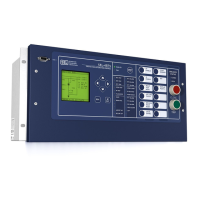
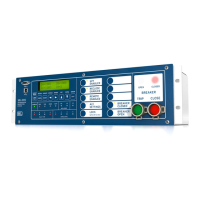
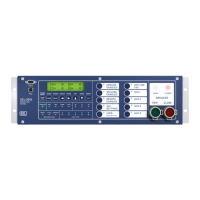
Replace traditional indicating panel lights and switches
with 24 latching target LEDs and 12 programmable
pushbuttons with LEDs. Define custom messages (i.e.,
BREAKER OPEN, BREAKER CLOSED, CONTROL
ENABLED) to report power system or relay conditions
on the large format LCD. Control which messages are
displayed via SEL
OGIC control equations by driving the
LCD display via any logic point in the relay.
Perform real-time control logic using synchrophasor data
by using local or remote synchrophasor data that is
available as analog quantities to SEL
OGIC. Local
synchrophasor data provided by the host relay, or remote
data received as C37.118 serial data are accessible.
Voltage and current magnitudes and angles, frequency,
and rate-of-change of frequency (df/dt) are provided.
Open Communications Protocols
The SEL-487V does not require special communications
software. ASCII terminals, printing terminals, or a
computer supplied with terminal emulation and a serial
communications port are all that is required. Tabl e 6 lists
a brief description of the terminal protocols.
SELOGIC Control Equations With
Expanded Capabilities and Aliases
Expanded SELOGIC control equations put advanced logic
in the hands of the engineer. Assign the relay’s contact
inputs to suit your application, logically combine
selected elements for various control functions, and
assign outputs to your logic functions.
Programming SEL
OGIC control equations consists of
combining relay elements, inputs, and outputs with
SEL
OGIC control equation operators (Table 7 ). Any
element in the Relay Word can be used in these
equations. The SEL-487V is factory set for use without
additional logic in most situations. For complex or
unique applications, these expanded SEL
OGIC functions
allow superior flexibility.
The alias capability assigns more meaningful SEL
OGIC
variable names to relay Word Bits and analog quantities.
This improves the readability of customized
programming. As many as 200 aliases are provided to
rename any digital or analog quantity. The following is
an example of possible applications of SEL
OGIC control
equations using aliases:
Table 6 Open Communications Protocols
Type Description
ASCII Plain-language commands for human and simple machine communications. Use for metering, setting, self-test
status, event reporting, and other functions.
Compressed ASCII Comma-delimited ASCII data reports. Allows external devices to obtain bay data in an appropriate format for
direct import into spreadsheets and database programs. Data are checksum protected.
Extended Fast Meter, Fast
Operate, and Fast SER
Binary protocol for machine-to-machine communication. Quickly updates SEL-2032 Communications Proces-
sors, RTUs, and other substation devices with metering information, bay element, I/O status, time-tags, open
and close commands, and summary event reports. Data are checksum protected. Binary and ASCII protocols
operate simultaneously over the same communications lines so that control operator metering information is
not lost while a technician is transferring an event report.
Ymodem Support for reading event, settings, and oscillography files.
Optional DNP3 Level 2
Outstation
Distributed Network Protocol with point remapping. Includes access to metering data, protection elements,
contact I/O, targets, SER, relay summary event reports, and settings groups
IEEE C37.118 Phasor measurement protocol.
IEC 61850 Ethernet-based international standard for interoperability between intelligent devices in a substation.
PRP Parallel Redundancy Protocol provides redundant Ethernet network capabilities for seamless operation in the
event of loss to one network.
SNTP Ethernet-based simple network time protocol for time synchronization among relays.


 To Next Page
 Loading...