EasyManua.ls Logo

Sea Tel 9711 C - User Manual

Sea Tel 9711 C
160 pages
Print Icon
To Next Page IconTo Next Page
Loading...
Sea Tel, Inc.
4030 Nelson Avenue
Concord, CA 94520
Tel: (925) 798-7979
Fax: (925) 798-7986
Web: http://www.cobham.com/seatel
Sea Tel Europe
Unit 1, Orion Industrial Centre
Wide Lane, Swaythling
Southampton, UK S0 18 2HJ
Tel: 44 (0)23 80 671155
Fax: 44 (0)23 80 671166
Web: http://www.cobham.com/seatel
Sea Tel Inc is also doing business as Cobham SATCOM - Maritime
October 18, 2013 Document. No. 139941 Revision A
INSTALLATION AND OPERATION MANUAL
FOR SEA TEL MODEL
9711 C & KU-BAND TX/RX ANTENNA
WARNING: RF RADIATION HAZARD
This stabilized antenna system is designed to be used with transmit/receive equipment
manufactured by others. Refer to the documentation supplied by the manufacturer which
will describe potential hazards, including exposure to RF radiation, associated with the
improper use of the transmit/receive equipment. Note that the transmit/receive
equipment will operate independently of the stabilized antenna system. Prior to work on
the stabilized antenna system, the power to the transmit/receive system must be locked
out and tagged.
When the transmit/receive system is in operation, no one should be allowed anywhere
within the radiated beam being emitted from the reflector.
The ultimate responsibility for safety rests with the facility operator and the
individuals who work on the system.

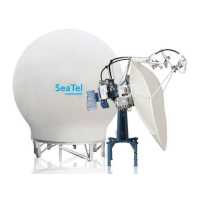
Table of Contents

Questions and Answers

Summary

Installation and Operation Manual

Warning: RF Radiation Hazard

Alerts users about potential RF radiation hazards and safety responsibilities.

Introduction

General System Description

Overview of the system's reliable, easy to maintain, and simple to operate nature.

Purpose

Explains the system's function in providing two-way satellite voice/data communications.

Other Inputs to the System

Details the external inputs like Gyro Compass, GPS, phone, and computer.

System Components

Breaks down the system into Above-Decks Equipment (ADE) and Below-Decks Equipment.

Site Survey

Site Selection Aboard The Ship

Guidelines for selecting an optimal mounting location for the antenna system.

Antenna Shadowing and RF Interference

Discusses potential signal degradation due to structures and RF interference.

Mounting Foundation

Details considerations for mounting foundations, including deck/deckhouse and mast types.

Mounting Height and Fore-Aft Location

Explains the impact of mounting height and ship motion on antenna performance.

Mast Configurations

Describes various mast designs (Vertical, Raked, Girder, Truss) for antenna mounting.

Installation

General Cautions & Warnings

Provides critical safety warnings and torque specifications for installation.

Unpacking the Base Frame and Reflector Crate

Instructions for safely unpacking the antenna system components from the crate.

Assembling the ADE

Detailed steps for assembling the Antenna Pedestal and Radome components.

Installing the Marine Air Conditioner

Procedure for installing an optional marine air conditioner.

Installing the Ku-Band Co-Pol;Cross-Pol Feed Assembly

Instructions for installing the Ku-Band feed assembly onto the reflector.

Sub-assemble the Antenna Pedestal

Steps for assembling the antenna pedestal structure and components.

Close the 144” Radome Assembly

Procedure for closing and sealing the radome assembly.

Prepare the 144” Radome ADE for Lift

Instructions on preparing the assembled ADE for lifting and transport.

Installing The ADE

Guidance on lifting and installing the complete ADE onto the ship.

Installing the Below Decks Equipment

Instructions for installing and connecting the below-decks components.

Connecting the Below Decks Equipment

Detailed steps for connecting various below-decks equipment to the MXP.

Final Checks

Final visual and electrical inspections to ensure proper installation.

Setup - Media Xchange Point (MXP)

Steps for configuring, calibrating, and commissioning the MXP.

Cable Terminations

Procedures for terminating various cables at the radome and BDE.

Configuring a Computer for the MXP

Connecting the Computer

Step-by-step guide to connect and configure the computer for MXP access.

Configuring Network Settings

Instructions for setting up IP addresses and network properties.

Accessing the MXP Interface

Guide on accessing the MXP interface via a web browser and logging in.

Setup - Ship’s Gyro Compass

Setting the Gyro Type

Procedure for selecting the correct gyro compass interface signal type.

No Ships Gyro Compass

Guidance on system operation without gyro compass input.

Setup - Tracking Receiver - VSAT

Determining the IF Tracking Frequency (MHz)

Explains how to determine and enter the IF tracking frequency for satellite tracking.

SAT SKEW

Instructions on optimizing feed polarization using the SAT SKEW setting.

Setup - Home Flag Offset (IMA Software 1.04 or lesser)

Calibrating Relative Antenna Position

Procedure for calibrating antenna's relative position using Home Flag Offset.

Entering a large value as Home Flag Offset

Guide for entering large offsets (> +/-5 degrees) as Home Flag Offset.

Entering a small value as AZ TRIM

Guidance for entering small offsets (+/-5 degrees) using AZ TRIM.

Setup - Azimuth Trim (IMA Ver 1.05 or greater)

Calibrating Antenna Targeting

Explains how Azimuth Trim simplifies targeting calibration with gyro input.

Setup - Blockage & RF Radiation Hazard Zones

Radiation Hazard and Blockage Mapping

Describes setting up zones to inhibit transmission in hazardous areas.

Programming Instructions

Steps for programming blockage zones using MXP software.

Configuring The Satellite Modem Interface

Satellite Modem Interface

Overview of configuring the satellite modem via the MXP interface.

Reflector setting

Defines which reflector the modem configuration applies to in dual systems.

Modem Type setting

Selects the manufacturer of the satellite modem for system integration.

Modem I;O setting

Defines the communication interface between MXP and satellite modem.

Modem I;O - Custom Settings

Allows manual definition of driver/detector circuits and positive satellite ID.

Modem I;O - Lock ON;OFF

Enables or disables positive satellite ID functionality using network lock.

Modem I;O - Lock Input - Polarity

Defines logic level (high/low) for positive satellite ID indication.

Modem I;O - Lock Input - Voltage

Sets the nominal voltage range for the positive satellite ID input.

Modem I;O - Lock Input - 12 V Pull Up

Determines whether to use a built-in 12VDC pull-up resistor for satellite ID.

Modem I;O - Block Output - Polarity

Defines logic level for TX Mute functionality (muting IF transmission).

Modem I;O - Block Output - 12 V Pull Up

Determines use of a built-in 12VDC pull-up resistor for blockage output.

Setup - Targeting

AUTO TRIM

Automatically calculates and sets Azimuth/Elevation trim offsets for calibration.

Manually Optimizing Targeting

Procedure for manual optimization of antenna targeting and trim values.

Setup - Satellite Configuration

Searching Patterns

Configures search patterns (Spiral, Inclined Orbit, Sky Search) for satellite acquisition.

TX Pol select

Selects the transmit polarity for C-Band or Ku-Band feeds.

Band select

Controls band selection for Ku-Band linear feed LNBs.

X-Pol; Co-Pol select

Selects the desired X-Pol or Co-Pol for Ku-Band linear feed.

Selecting;Configuring Your Satellite Configuration

Guides users through selecting or creating satellite configurations.

Quick Start Operation

If satellite signal is found AND network lock is achieved

Describes automatic satellite acquisition and tracking when signal is present.

If no signal is found

Troubleshooting steps when the system fails to find a satellite signal.

If satellite signal is found but network lock is NOT achieved

Steps to take when satellite signal is found but network lock is not established.

To Target a different satellite

Procedure for targeting a different satellite from the system's auto screen.

Optimizing Cross-Pol Isolation

Optimizing Cross-Pol Isolation

Procedure for optimizing cross-pol isolation, typically with NOC assistance.

Installation Troubleshooting

Troubleshooting Ships Gyro Compass problems

Diagnosing and resolving issues with ship's gyro compass input.

STEP-BY-STEP

Step-by-step troubleshooting for Step-By-Step gyro compass signals.

1:1 SYNCHRO

Troubleshooting specific issues with 1:1 Synchro gyro compass connections.

360:1 Synchro

Troubleshooting specific issues with 360:1 Synchro gyro compass connections.

Maintenance

Warranty Information

Details the Sea Tel Limited Warranty coverage for the antenna system.

Torque and Loctite Specifications

Provides torque values and Loctite recommendations for fasteners.

General Maintenance

General maintenance procedures, including antenna balancing.

Balancing the Antenna

Procedure for balancing the antenna for optimal performance.

Fine Balance and Monitoring Motor Drive Torque

Using the DISPTC graph to monitor motor drive torque and verify balance.

Stowing the Antenna

Installing the Stow Restraints

Instructions for installing stow restraints to secure the antenna during transit.

9711 Technical Specifications

Above Decks Equipment

Detailed specifications for the Above-Decks Equipment (ADE).

Below Decks Equipment

Detailed specifications for the Below-Decks Equipment (BDE).

Regulatory Compliance

Lists compliance standards for shock, vibration, EMI/EMC, and safety.

Cables

Specifications and recommendations for various system cables.

Drawings

9711 Model Specific Drawings

List of specific drawings for the 9711 model.

9711 General Drawings

List of general schematic drawings for the system.

Sea Tel 9711 C Specifications

General IconGeneral
BrandSea Tel
Model9711 C
CategoryAntenna
LanguageEnglish

Related product manuals