DOCS-001 Manual, SeaBotix Inc. Users, 150 – 200 Series - Rev B – 27 Jan 10 - Page 45 of 64
Section 5: Troubleshooting
5.1 Introduction
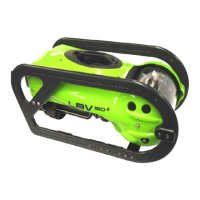
The typical LBV system consists of the LBV, a tether (50, 75, 100, 150 or 175 meters in
length) an Operator Control Unit, and a Surface Power Supply to which the OCU, tether
and video cable connect.
Typically, video monitoring and recording equipment is not included with the LBV
system. Systems that include an Integrated Control Console are an exception to this
rule. Troubleshooting for these LBVs (where they differ) is covered later in this guide.
Furthermore, some LBVs use fiber optics for the transmission of video and others use
fiber optics for the transmission of both video and communications.
5.2 Brief Theory of Operation
The LBV system is designed to operate within certain parameters. Though based on the
same design, each LBV is configured for the end user’s requirements.
The primary considerations: Power available for the LBV (120 VAC or 240 VAC) and
desired video format (PAL or NTSC).
Please be aware of your available power since plugging into the wrong supply could
damage your LBV. Whenever the LBV system is used, the Surface Power Supply must
be plugged into a grounded outlet! Failure to use a grounded outlet will disable the GFI
circuitry, as well as cause possible communication and LBV control problems. On most
LBVs (PAL or NTSC), the video output is broadcast channel 3. This means that your
video monitoring device must be equipped with a demodulator tunable to CH3.
There are three main areas of discussion with regards to troubleshooting the LBV:
Power Transmission
, Communications Transmission and Video Transmission.
The LBV system works as follows:
Input power is rectified inside the Surface Power Supply becoming 360 VDC for
transmission via the tether to the LBV. At the LBV, the 360 VDC is converted to 28 VDC
inside the Vehicle Power Supply (VPS).
There, two distinct 28 VDC bus lines have been created.
One 28 VDC supply (Motherboard power) runs directly to the Motherboard where it is
used to service the internal electronics. The other (backplane power) services the
thrusters, grabber, external lighting and other auxiliary equipment. The latter 28 VDC
supply is monitored by an over current protection circuit, which (in the event of a short in


 To Next Page