OPERATION
MANUAL
Product: Document #: Rev: Page:
SEAKEEPER 3 90379 1 1 of 4
Section 3: POWER FAILURES, ALARMS, AND TROUBLESHOOTING
3.0 Power Failures
There are two sources of power to the Seakeeper 3:
12 Volts DC low current powers the Seakeeper for all the control electronics.
12 Volts DC high current powers the Motor Drive Box to drive the motor inside the
Seakeeper.
These are supplied on Conductors 1 and 2 and Cable 7 which are shown on Seakeeper drawing
90377, Cable Block Diagram.
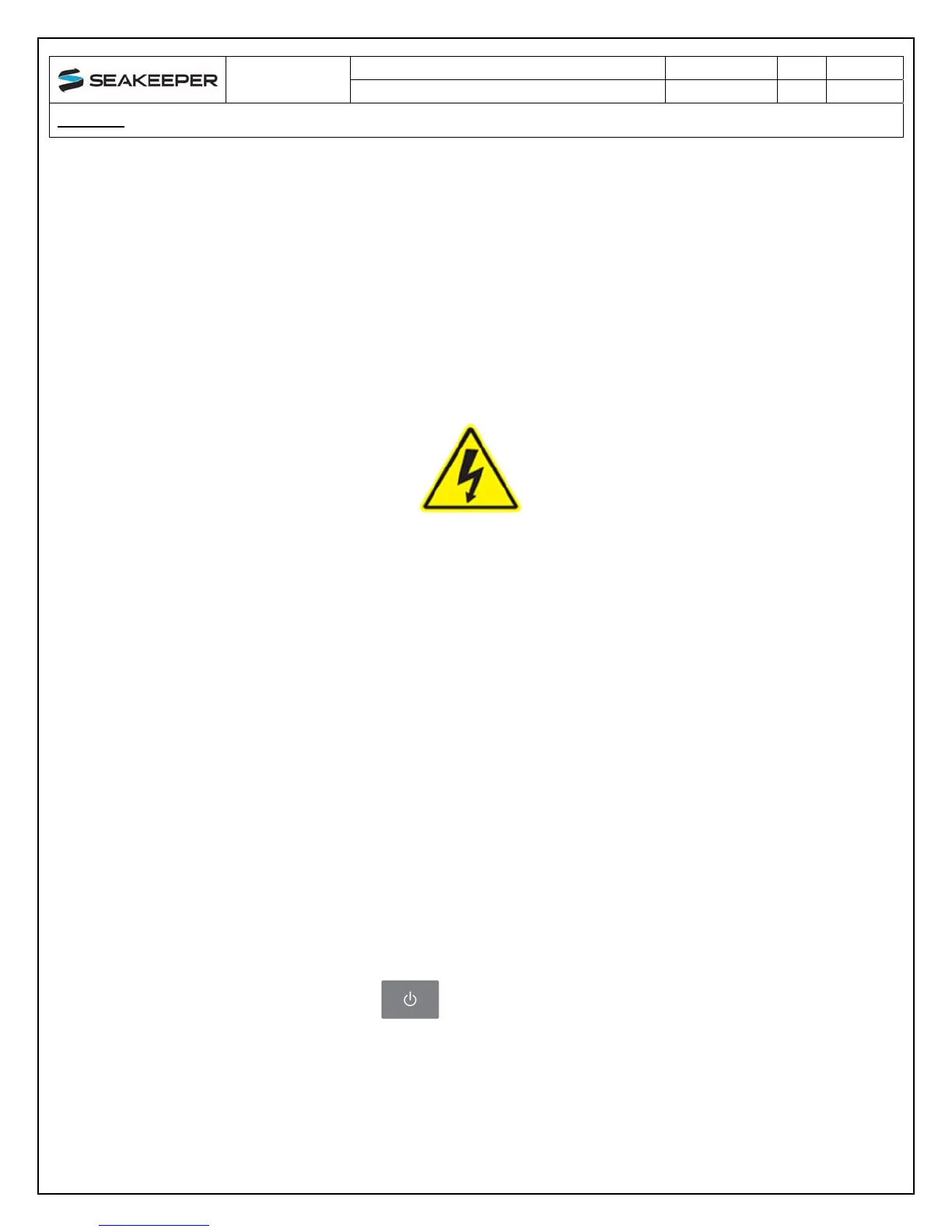
The Motor Drive Box contains a voltage hazard and the cover
should not be removed while the flywheel is spinning or the
DC input voltage is present. This voltage hazard exists even if
the flywheel is coasting down and the supply voltage has been
shut off. The flywheel must be at Zero (0) RPM and DC input
power disconnected for at least 10 minutes prior to any service
work on the Motor Drive Box.
3.1 12 VDC Low Current Failure
If the 12 VDC low current is disconnected, the display will be blank. Flywheel speed will decrease.
The Seakeeper will be turned off (no stabilization).
Verify the boat’s circuit breaker or fuse supplying +12 VDC low current has not tripped or
blown.
When +12 VDC low current is restored, the display will power up, the Splash Screen will
appear, and then the Home Screen will appear.
Press Power On/Off button
The progress bar will appear and indicate flywheel speed. When the flywheel is at
minimum operating speed, the stabilize button will appear so stabilization can be turned
on. This may take up to 30 minutes, depending on the speed of the flywheel when the +12
VDC low current is turned back on.


 To Next Page