
 Need help?
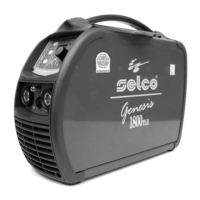
Do you have a question about the Selco Genesis 1800 TLH and is the answer not in the manual?
Ensures proper operating conditions and safety in the work area.
Protects users and bystanders from arc radiation, sparks, heat, and gas.
Safe procedures for moving and handling the equipment.
Recommendations for placing the equipment in a suitable location.
How to connect the equipment to the mains power supply.
General installation steps and requirements for the unit.
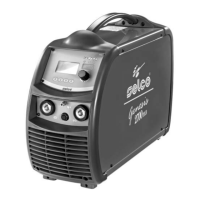
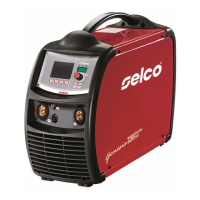
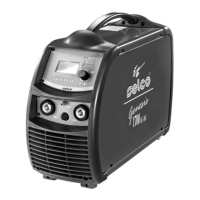
Overview of the constant current inverter power sources.
Description of controls and indicators on the front panel.
Details of connections and ports on the rear of the unit.
Identification and function of various sockets on the panel.
Explanation of 2-step, 4-step, and BILEVEL welding process modes.
Adjusting and utilizing pulsed current for welding.
Discussion of medium frequency current in welding.
Using the main adjustment handle for parameter selection.
Understanding the information displayed on the 7-segment display.
Setting and adjusting welding parameters like current and voltage.
Adjusting the basic current for pulsed and fast pulse modes.
Regulating the pulse frequency for better welding results.
Saving changes and exiting the setup menu.
Resetting TIG setup parameters to default values.
Setting gas flow prior to arc striking for TIG welding.
Regulating the weld starting current for TIG welding.
Setting gradual current transition from initial to welding current.
How remote controls are activated when connected to power sources.
Description of the RC 100 remote control unit for adjustments.
Using the pedal remote control for output current adjustment.
Changing output current without interrupting the welding process.
Performing periodic checks on the power source for optimal performance.
Procedures for maintaining or replacing torch, electrode holders, and earth cables.
Diagnosing and resolving issues when the system does not power on.
Troubleshooting when the system does not provide welding output.
Resolving problems related to incorrect output power.
Identifying and fixing causes of unstable welding arcs.
Addressing and reducing excessive spatter during welding.
Diagnosing and correcting issues with weld penetration.
Preventing and fixing slag inclusions in welds.
Principles and techniques for MMA welding.
Advising on preparing clean parts for good welding joints.
Guidance on selecting electrodes based on material thickness and joint type.
Information on welding current ranges specified by manufacturers.
Techniques for striking and maintaining a stable welding arc.
Methods for carrying out welding, including electrode movement.
Careful cleaning and preparation for steel TIG welding.
Advice on selecting and preparing tungsten electrodes for steel.
Choosing filler rods with comparable mechanical characteristics.
Typical shielding gas used for TIG welding (pure argon).
Specifications for power supply voltage and tolerances.
Requirement for maximum permissible mains impedance at the connection point.
Details on the slow blow line fuse used in the system.
Specification of the communication bus used by the system.
The maximum apparent power the equipment can draw.
The maximum real power the equipment can draw.
Specification of the power factor of the equipment.
The efficiency rating of the power source.
The cosine of the power factor.
The maximum input current the system can draw.
The effective input current drawn by the system.
Welding current values at 40°C duty cycles.
Welding current values at 25°C duty cycles.
The range of adjustment for the welding current.
The voltage of the system when no load is applied.
The peak voltage of the system.
The IP rating of the equipment.
The insulation class of the equipment.
Standards to which the equipment is manufactured.
Physical dimensions of the welding equipment.
The weight of the welding equipment.
Details of the power supply cable used.
The length of the power supply cable.
 General
| Brand | Selco |
|---|---|
| Model | Genesis 1800 TLH |
| Category | Welding System |
| Language | English |



 To Next Page