The provided document is a multi-language user manual for a welding machine, the Selco Quasar 270 TLH. This description focuses on the English section of the manual to provide an overview of the device's functions, specifications, and maintenance.
Function Description
The Selco Quasar 270 TLH is a constant current inverter power source designed for Manual Metal Arc (MMA) and TIG DC (direct current) welding. It is intended for professional use in industrial environments.
The front control panel features a main adjustment handle (5) for continuous welding current adjustment, a 7-segment display (4) for showing parameters, current, voltage, and alarm codes, and a section for welding parameters (6) that allows selection and adjustment of various settings.
MMA Welding Features:
- Hot Start (3): Adjusts the initial current during arc striking to facilitate starting.
- Arc Force (8): Adjusts the dynamic response of the arc to prevent electrode sticking.
- Dynamic Power Control (DPC) (204): Allows selection of desired V/I characteristics (Constant Current, Falling Characteristic with adjustable slope, Constant Power) to suit different electrode types (Basic, Rutile, Acid, Steel, Cast Iron, Cellulose, Aluminium).
- Arc Detachment Voltage (312): Sets the voltage at which the electric arc is forced to switch off, useful for managing various operating conditions like spot welding to reduce spatter and oxidation.
- MMA Synergy (205): Optimizes arc dynamics based on the selected electrode type.
TIG Welding Features:
- Pre-gas (2): Adjusts gas flow before arc striking to prepare the torch and welding environment.
- Initial Current (3, 4): Regulates the welding start current for a hotter or cooler welding pool.
- Initial Current Time (5): Sets the duration for which the initial current is maintained.
- Slope-up (6): Provides a gradual transition from initial current to welding current.
- Welding Current (7): Main adjustment for the welding current.
- Bilevel Current (8, 9): Allows adjustment of a secondary current in bilevel welding mode, enabling easy switching between two preset currents.
- Basic Current (10, 11): Regulates the basic current in pulsed and fast pulse modes.
- Pulsed Frequency (12): Activates and adjusts the pulse mode frequency for better results on thin materials and improved bead aesthetics.
- Pulsed Duty Cycle (13): Regulates the duration of peak current in pulse welding.
- Fast Pulse Frequency (14): Adjusts pulse frequency for focused action and arc stability.
- Pulsed Slopes (15): Sets a slope time during pulse operation for a smoother transition between peak and basic current.
- Slope-down (16): Provides a gradual transition from welding current to final current.
- Final Current (17, 18): Adjusts the final welding current.
- Final Current Time (19): Sets the duration for which the final current is maintained.
- Post-gas (20): Adjusts gas flow at the end of welding.
- TIG Start (HF) (203): Selects arc striking mode (HF Start or Lift Start).
- Spot Welding (204): Enables and sets the time for spot welding.
- Restart (205): Activates the restart function for immediate arc extinguishing or restarting the welding cycle.
- Easy Joining (TIG DC) (206): Allows pulsed current arc striking and timing before automatic restoration of preset welding conditions, enhancing speed and accuracy for tack welding.
The device also supports various remote controls (RC 100, RC 120 pedal, RC 180, RC 200) and U/D series digital TIG torches for controlling welding parameters remotely.
Important Technical Specifications
- Power Supply Voltage (U1): 3x400Vac ±15% (50/60 Hz)
- Slow Blow Line Fuse: 16A
- Communication Bus Type: DIGITAL
- Maximum Input Power (kVA): 14 kVA
- Maximum Input Power (kW): 9.72 kW
- Power Factor (PF): 0.70
- Efficiency (μ): 85%
- Cosϕ: 0.99
- Max. Input Current (I1max): 20.2A
- Effective Current (I1eff): 12.8A
- Duty Factor (40°C):
- MMA: 270A (at 40%)
- TIG: 270A (at 60%), 250A (at 100%)
- Duty Factor (25°C):
- MMA: 270A (at 100%)
- TIG: 270A (at 100%)
- Adjustment Range (I2): 3-270A
- MMA Open Circuit Voltage (Uo): 70Vdc
- TIG HF Open Circuit Voltage (Uo): 70Vdc
- TIG LIFT Open Circuit Voltage (Uo): 30Vdc
- Peak Voltage (Up): 11.8 kV
- IP Protection Rating: IP23S (protected against access by fingers and solid foreign bodies >12.5mm, protected against rain at 60°, protected against water ingress when moving parts are not operating)
- Insulation Class: H
- Dimensions (lxdxh): 500x190x400 mm
- Weight: 16.1 kg
- Manufacturing Standards: EN 60974-1/EN 60974-3/EN 60974-10
- Power Supply Cable: 4x2.5 mm2
- Length of Power Supply Cable: 5m
Usage Features
The Quasar 270 TLH is designed for ease of use with its intuitive front control panel and remote control options. The 7-segment display provides real-time feedback on welding parameters, making it easy for the operator to monitor and adjust settings.
MMA Welding Usage:
- Electrode Selection: The manual provides guidance on selecting electrode diameter based on material thickness, joint type, and chamfer preparation. It also lists common electrode types (Rutile, Acid, Basic) and their properties/applications.
- Arc Striking and Maintenance: Explains how to strike the arc by scratching the electrode and maintaining it at the normal welding distance. Features like "Hot Start" and "Arc Force" assist in arc ignition and stability.
- Slag Removal: Emphasizes removing slag after each pass using a hammer or brush.
TIG Welding Usage:
- Polarity: Primarily uses Direct Current Straight Polarity (DCSP) for most materials (except aluminum and magnesium), concentrating 70% of heat on the workpiece for narrow, deep welds. Reverse Polarity (DCRP) is used for alloys with refractory oxide layers. Pulsed DCSP is available for better control on thin materials, reducing deformation, hot cracks, and gas inclusions.
- Electrode Preparation: Recommends thorium tungsten electrodes (2% thoriated) or cerium/lanthanum electrodes, sharpened as shown in the manual.
- Shielding Gas: Pure argon (99.99%) is typically used, with recommended flow rates based on welding current and nozzle size.
- Material-Specific Welding: Provides specific instructions for TIG welding of steel and copper, highlighting the suitability of TIG for high thermal conductivity materials like copper.
General Usage:
- Environmental Conditions: The device should be used in industrial environments, free from dust, acids, gases, or corrosive substances, within a temperature range of -10°C to +40°C, and relative humidity below 50% at 40°C (90% at 20°C).
- Safety: Emphasizes personal protective equipment (PPE) including fire-retardant clothing, safety shoes, gloves, masks with appropriate filters, and hearing protection if noise levels are high. It also warns against electromagnetic fields and electrical shock.
- Generator Compatibility: Can be powered by a generating set, provided it ensures a stable power supply within ±15% of the rated voltage.
Maintenance Features
The manual outlines routine maintenance procedures that must be performed by qualified personnel only.
- Periodic Checks:
- Internal Cleaning: Clean the generator interior using low-pressure compressed air and soft bristle brushes.
- Electrical Connections: Check all electrical connections and cables.
- Component Temperature: For torch components, electrode holders, and earth cables, check their temperature to ensure they are not overheated.
- Power Disconnection: Always disconnect the power supply before any maintenance operation.
- No Unauthorized Modifications: Any unauthorized changes or repairs will invalidate the warranty.
- Dust Accumulation: Prevent conductive metallic dust from accumulating near ventilation louvers.
The troubleshooting section provides solutions for common issues such as:
- System failure to power on: Check mains voltage, fuses, and electrical connections.
- No output power: Check torch trigger, overheating, earth connection, and mains voltage.
- Incorrect output power: Verify welding process selection and parameter settings.
- Arc instability: Check shielding gas flow, torch components, and welding parameters.
- Excessive spatter: Adjust arc length, welding current, gas protection, and torch angle.
- Insufficient penetration: Adjust welding speed, current, electrode diameter, and edge preparation.
- Slag inclusions: Ensure proper cleaning of workpieces and correct welding mode.
- Tungsten inclusions: Adjust welding parameters, electrode diameter, and ensure proper electrode sharpening.
- Blowholes/Porosity: Check shielding gas, workpiece cleanliness, and filler material condition.
- Undercuts: Adjust welding parameters, arc length, and welding speed.
- Hot cracks/Cold cracks: Adjust welding parameters, pre-heating/post-heating, and filler material quality.
- Excessive dross/Nozzle overheating: Check air pressure, gas flow, and nozzle/electrode condition.
The manual stresses that adherence to these instructions is vital for warranty validity and that the manufacturer disclaims liability for misuse or non-application of the directions.

 Need help?
 General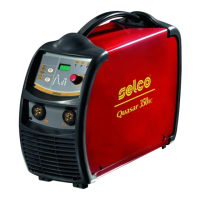



 To Next Page