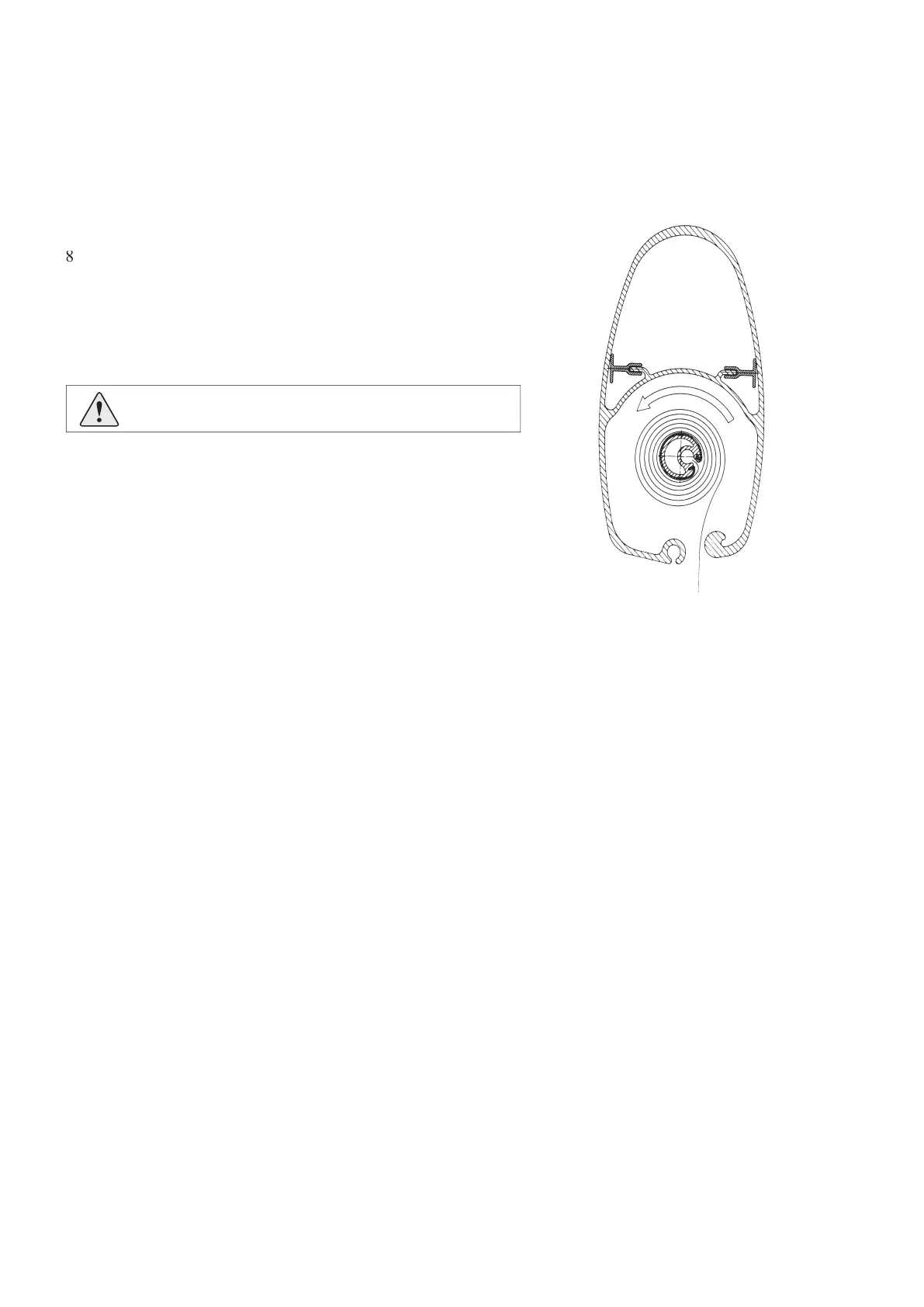
Anti-vibration strip
Vibration can occur in any aluminium mast of normal design. With wind coming from approximately abeam at
speeds of 4–12 Knots the mast oscillates longitudinally at a rate of 3–6 cycles per second. Every Seldén Mast
in-mast furling mast is supplied with an ”anti-vibration strip” for hoisting in the integral sail groove to prevent
vibration starting. It will also reduce wind noise.
Port
Fig. 9.1
Starboard
Before sailing
1. Check that the sail is correctly furled on the luff extrusion: i.e. to its starboard side. (See fig. 9.1).
2. Whilst still on the mooring furl and unfurl the sail a couple of times to ensure that the system works as it
should, and to familiarise yourself with its operation, and also to check that the sail is correct size.
3. Adjust the topping lift to achieve the desired sail shape. The topping lift determines sail twist; its effect
being comparable to chan
ging foresail sheeting angles.
Note. Turn the reefing winch clockwise for correct
furling.
. Hoist the mainsail whilst simultaneously ensuring that it is feeding correctly into the luff extrusion.
6. Set the halyard and cleat it with the rope stopper. The halyard tail can be stowed in the mast by
feeding it through the hole just below the halyard winch.
. Furl the sail until the clew is exposed. The luff extrusion is asymmetrical to facilitate rolling in one direc-
tion, and the sail should always be rolled onto the starboard side of the luff extrusion. The reefi ng winch
should be turned clockwise. See fi g. 9.1.
. Attach the clew to the outhaul car.
The integral luff-groove on the after face of the mast can med used for hoisting a spare sail. A foresail made to fi t
the Furlex luff foul can be used. The luff groove dimensions are the same as those for the roller extrusion, as shown
If the spare sail is fi tted with slides, then Aquabatten No. A032 or Rutgerson 101 are recommended.



 To Next Page