Need help?
Do you have a question about the Sencor SFD 6600BK and is the answer not in the manual?
General safety guidelines for users, covering supervision, cord damage, and surface contact with food.
Precautions for connecting the appliance, handling the power cord, and avoiding electrical hazards.
Guidelines for safe operation, placement, supervision, and handling of the appliance and its parts.
Details components like the control panel, cabinet, trays, and transparent door.
Explains the intended use, drying area, heating, motor, fan, and horizontal air flow technology.
Highlights benefits of dehydration, retaining nutrients, and preventing spoilage compared to other methods.
Instructions for initial cleaning of trays and the dehydrator cabinet.
Guidance on selecting location, foods, and preparing ingredients for dehydration.
Details on using preset modes for different food types like jerky, apples, mushrooms, etc.
Instructions for manually setting time and temperature for the dehydration process.
Lists common problems, possible causes, and solutions for the food dehydrator.
Procedures for cleaning the appliance, trays, and ensuring proper airflow.
Recommendations for storing the dehydrator when not in use and proper food storage.
Details electrical ratings, dimensions, weight, power input, and noise level.
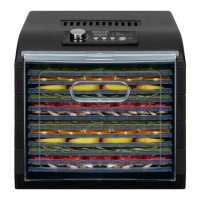
The SENCOR SFD 6600BK is a food dehydrator designed for preserving various food items such as fruits, vegetables, forest fruits, meat, seeds, beans, nuts, and mushrooms. It is also suitable for drying herbs, medicinals, spices, or even flowers for decorative purposes or for creating aromatic mixtures.
The food dehydrator operates on the principle of horizontal air flow technology, which ensures even heat distribution across all levels of the drying area. This design eliminates the need to rotate the trays during the dehydration process, providing consistent results. The appliance features a cabinet with a drying area comprising twelve removable trays. The heating element, motor with fan, and thermostat are strategically located at the back of the cabinet to facilitate efficient and uniform drying.
Drying, or dehydration, is an ancient method of food preservation that involves heating food to evaporate its moisture content. Unlike traditional long-term storage methods like canning or freezing, gentle dehydration with this appliance helps retain up to 80% of vitamins, minerals, and trace elements. This process also concentrates aromatic compounds, enhancing the flavor of dehydrated foods. Proper storage of dehydrated foods allows them to be used throughout the year.
The SENCOR SFD 6600BK is designed to maintain a sufficiently low temperature to preserve food enzymes, which are crucial for the body's digestive processes. Simultaneously, it generates enough hot air for fast dehydration, preventing the development of molds and bacteria.
Before first use, it is essential to thoroughly wash the removable trays in hot water with neutral kitchen detergent, rinse them with clean water, and dry them with a fine wiping cloth. The inside of the cabinet should be cleaned with a lightly dampened wiping cloth and then wiped dry, taking care not to wet the heating elements or the fan. The cabinet should never be submerged in water or any other liquid. It is recommended to run the dehydrator empty for at least four hours before its first use to allow it and its accessories to cool down and air out, removing any potential odors.
For operation, the food dehydrator should be placed in a well-ventilated, warm, and dry room with minimal dustiness, ensuring at least 15 cm of clearance around it for proper air circulation. The surface must be stable, heat-resistant, and sufficiently far from other heat sources. The appliance should not be moved while running.
The dehydrator offers both preset modes and manual time and temperature settings. To use a preset mode, users can press the "P" button (B5) to cycle through options like Jerky, Apples, Mushrooms, Herbs/Spices, and Pasta, each with a predefined time and temperature. For manual settings, users can adjust the dehydration time using the increase (+) and decrease (-) buttons (B6 and B7) in 30-minute increments, and select the desired temperature with the temperature control knob (B1). The START/STOP button (B4) initiates the dehydration process, with its backlight changing from blue to red, and the display showing a countdown. Time and temperature can be adjusted at any point during the process, and the "P" button can be pressed to check the current temperature setting.
During dehydration, the transparent door (A4) allows for visual monitoring of the food. Trays can be slid out to check the food's condition, using kitchen gloves due to internal heat. If the START/STOP button is pressed during dehydration, the process will end, and it cannot be resumed without restarting and resetting the time and temperature. To turn off the dehydrator, press the START/STOP button, and a 9-second countdown will appear before it completely shuts down. The power cord should then be disconnected.
For optimal results, selecting and preparing foods correctly is crucial. Ripe, unbruised, and mold-free fruits and vegetables are recommended. Meat should be fresh and lean. Fruits and vegetables should be thoroughly washed and cut into pieces of equal thickness (ideally 2-4 mm) to ensure even drying. Small fruits like berries do not need cutting, while larger ones should be halved or sliced. To prevent browning, fruit slices can be soaked in a solution of water and lemon or pineapple juice. Tough-peeled fruits can be blanched in boiling water for 1-2 minutes to speed up dehydration. Unpeeled fruit should be placed with the peel facing downwards. Vegetables that require long cooking times, such as root vegetables, should be steamed for about five minutes before dehydration. For meat, lean cuts should be trimmed, sliced into thin strips (2-5 mm thick, 2.5 cm wide), seasoned, and ideally rested overnight in a refrigerator. The Jerky mode is specifically designed for meat. Herbs should be dehydrated gently, removing only stems.
Dehydrated food should be allowed to cool completely before storage. Suitable packaging includes glass canning jars, airtight containers, or food-grade plastic bags to prevent moisture ingress. Dehydrated meat should be stored at room temperature in a closed, dry, dark location. Herbs and spices should be stored in glass jars with a firm locking mechanism. Containers should ideally be stored in a dry, dark place at room temperature or lower to extend shelf life. Stored food should be inspected monthly for mold.
Rehydration involves reconstituting food to its initial state. While some foods like fruit are often preferred in their dehydrated state, most vegetables are tastier when rehydrated. To reconstitute vegetables, wash them, place them in cold, unsalted water, and soak for 2-8 hours, then cook them in the soaking water. For fruits, add just enough cold water to cover them and soak for 1-8 hours, depending on the fruit type and piece size. Over-soaking can lead to loss of aroma. Reconstituted foods can be used in various recipes, from compotes and sauces to bread products and salads.
Before any maintenance or cleaning, the dehydrator must be turned off using the START/STOP button (B4) and disconnected from the power grid. Thinners, solvents, or abrasive cleaning agents should not be used, as they may damage the surface. The dehydrator and its power cord must never be submerged in water.
The surface of the dehydrator should be cleaned with a lightly dampened cloth and then dried. Individual food trays can be cleaned with a cloth dipped in ordinary dishwashing detergent or washed under lukewarm running water. Trays are also dishwasher-safe. The air inlet (grille) on the motor part must be kept clean and free of dust. If the grille becomes dirty or clogged, it should be cleaned with a brush or vacuum cleaner.
For extended storage, after cleaning, the dehydrator should be placed in a safe, dust-free, clean, and dry location, out of reach of children. If space permits, storing the dehydrator with the door ajar is recommended to prevent undesirable odors from forming inside.
The food dehydrator is equipped with an overheating protection fuse. If the temperature rises too high, for example due to incorrectly arranged food, the dehydrator will automatically turn off. In such a case, the power plug should be pulled out, and the dehydrator allowed to cool down before being put back into operation. If the dehydrator malfunctions, such as the fan making unusual noise or not spinning, or if it overheats or fails to generate heat, it is recommended to turn off the appliance, disconnect it from the mains, and contact an authorized service center. Tampering with the appliance during the warranty period may void the warranty.
 General
| Type | Food Dehydrator |
|---|---|
| Temperature Range | 35-70 °C |
| Timer | Yes |
| Overheating Protection | Yes |
| Color | Black |
| Material | Plastic |
| Thermostat | Yes |
| Cool touch handles | No |
| Removable parts | Yes |
| Dishwasher safe parts | Yes |
| Product type | Dehydrator |

 To Next Page