Need help?
Do you have a question about the Sencor SSM 4220SS and is the answer not in the manual?
This document describes the SENCOR SSM 4220SS and SSM 4221RD Sandwich Makers, providing important safety instructions, a user's manual, and details on cleaning and maintenance.
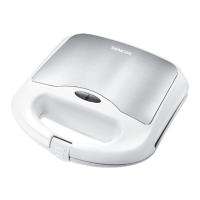
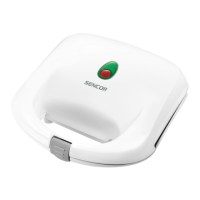
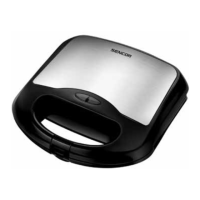
The SENCOR Sandwich Maker is an appliance designed for household use, specifically for preparing sandwiches. It features baking plates with a non-stick surface, capable of making two square sandwiches at a time. The device operates by heating these plates to toast the sandwiches, indicated by a green light that turns on and off to signal the maintenance of the operating temperature. A red light indicates that the appliance is connected to a power source. The sandwich maker is equipped with thermally insulated handles and a latch to secure them during operation, ensuring safe handling.
Before first use, the appliance should be removed from its packaging, and any promotional labels or stickers should be taken off. The baking plates should be wiped with a lightly dampened cloth and then thoroughly dried. It is recommended to run the appliance empty for 5 to 7 minutes initially to eliminate any potential odors; light smoke may be emitted during this phase, which is normal and will dissipate.
To operate, connect the sandwich maker to a properly grounded power socket. Both the red power indicator (A2) and the green heating indicator (A1) will illuminate. The baking plates (A6) should be coated with a small amount of butter or cooking oil, and the sandwich maker should be closed to facilitate faster heating. Prepare your sandwiches by placing the filling precisely between two slices of bread. Avoid overfilling, as this may prevent the appliance from closing properly and could cause damage. Once the baking plates reach the operating temperature, the green indicator (A1) will turn off.
Open the sandwich maker using the handle (A3) and place one or two prepared sandwiches onto the bottom baking plate. Close the appliance and secure the handles with the latch (A4). Toasting typically takes 3 to 5 minutes. After this time, release the latch and use the handle to tilt open the top plate to check the sandwich. If sufficiently toasted, remove it using a wooden or heat-resistant spatula; never use metal utensils like knives or forks, as these can damage the non-stick coating. If further toasting is desired, extend the time. The toasting time can vary based on the type of bread, ingredients, and personal preference. Before toasting additional sandwiches, close the maker and wait for the green indicator to turn off again. After use, disconnect the power cord from the socket and allow the appliance to cool before cleaning.
The manual provides several tips for sandwich making. For fillings, various ingredients can be used, such as meat, fish, cheeses, smoked goods, boiled egg slices, mushrooms, or fruits and vegetables like bananas, apples, pineapples, or tomatoes. It is important not to use an excessive amount of filling to prevent spillage onto the baking plates. Fillings can be seasoned with spices, herbs, or ketchup. For a golden-brown finish, a light layer of butter can be spread on the top side of the sandwich bread slice.
Recipes are included for inspiration, such as Ham, cheese and pineapple sandwich, Tomato and cheese sandwich, and Chocolate spread and banana sandwich. These recipes generally follow the same procedure: preheat the plates, assemble the sandwich with the specified ingredients, and toast for 3 to 5 minutes.
Regular cleaning and maintenance are crucial for the longevity and performance of the sandwich maker. Always disconnect the appliance from the power socket and allow it to cool down completely before cleaning. The non-stick surface of the baking plates (A6) should be cleaned after each use to prevent food residue buildup. Use a lightly dampened, soft cloth for cleaning. If stubborn burnt food residue remains, sprinkle the plates with water and a mild kitchen detergent, then wipe with a clean damp cloth until thoroughly dry. It is easier to clean the baking plates when they are still slightly warm.
The outer surface of the sandwich maker should be wiped with a lightly dampened cloth and then dried. Never wash the appliance under running water or submerge it in water or any other liquid. Avoid using abrasive cleaning products, steel wool, or solvents, as these can damage the cleaned surface.
For storage, once the baking plates (A6) are cold, close the top plate and secure the handles (A3) with the latch (A4). The power cord can be wound into the space provided on the underside of the appliance (A5). Store the sandwich maker in a clean, dry place, out of reach of children. Storing the appliance in a vertical position can help save space in the kitchen.
The appliance is not designed to be controlled by a programmed device, external timer switch, or remote control. It should not be used in an industrial environment, outdoors, or for purposes other than its intended use. Do not place the appliance on or near electric or gas stoves, on a kitchen sink drainboard, on the edge of a table, or on an unstable surface; it must be on a stable and even surface. Ensure sufficient air circulation by maintaining clearance on all sides: 50 cm from flammable materials in the direction of main heat radiation and at least 10 cm in other directions. The temperature of accessible surfaces can be high during and after operation due to residual heat, so avoid touching them directly.
Always disconnect the appliance from the power socket when unattended, not in use, or before moving or cleaning. The power cord should not come into contact with water or heated surfaces. Disconnect by pulling the plug, not the cord, to prevent damage. If the power cord is damaged, it must be replaced by an authorized service center or similarly qualified person to prevent hazards; never use the appliance with a damaged power cord. Do not attempt to repair or adjust the appliance yourself to avoid electrical shock; all repairs must be performed by an authorized service center. Tampering with the appliance voids legal rights related to performance or warranty.
 General
| Non-stick plates | Yes |
|---|---|
| Indicator light | Yes |
| Color | Stainless Steel |
| Storage | Vertical |
| Material | Metal |

 To Next Page