EasyManua.ls Logo

Sencore PS163 - PHASE SHIFT and TIME DELAY MEASUREMENTS; TIME DELAY BETWEEN SIGNALS; PHASE SHIFT BETWEEN SIGNALS

Default Icon
28 pages
Print Icon
To Next Page IconTo Next Page
To Previous Page IconTo Previous Page
Loading...
3.
Adjust
the
control
in
the
network
until.a
circle
or
a
near
circle
is
obtained
on
the
scope
screen.
4.
Apply
the
unknown
frequency
to
the
rear
“Z”
Axis
jack
on
the
PS163,
and
slide
the
“Z”
AXIS
switch
to
the
ON
position.
Adjust
the
generator
until
the
pattern
stands
still.
Count
the
number
of
line
segments,
and
multiply
the
known
frequency
by
the
number
of
segments
to
find
the
unknown
frequency.
The
11
segments
shown
in
Fig.
9
indicate
that
the
unknown
is
higher
than
the
known
frequency.
Note
that
the
shape
of
the
overall
circle
is
dependent
upon
the
phase
shift
network
and
not
the
frequencies
in-
volved.
Tt
P
=
3
+
S)
t
Ji
++
GR;
ua
+
١
i
١
|
1
A
سے󰾯
å󰾰
کد
+
|
|11
Segments,
|
Fig.
9.
Modulated
ring
showing
unknown
frequency
11
times
the
known
frequency.
PHASE
SHIFT
and
TIME
DELAY
MEASUREMENTS
There
are
two
methods
of
measuring
the
phase
shift
or
time
delay
between
two
signals.
The
first
method
is
to
measure
the
time
delay
between
the
two
signals,
and
compare
this
to
the
total
time
of
one
cycle
to
find
the
phase
shift.
The
second
method
is
to
use
a
Lissa-
jous
figure
to
measure
the
phase
directly.
The
first
method
is
most
useful
where
the
timing
between
pulses,
such
as
in
color
TV,
is
critical.
The
second
method
is
most
useful
in
amplifiers
where
a
phase
shift
can
cause
a
distorted
output.
TIME
DELAY
BETWEEN
SIGNALS
1.
Use
DUAL
ALTERNATE
VERTICAL
INPUT,
AUTO
TRIGGERED
HORIZONTAL
SWEEP,
and
INT.
A
HORIZONTAL
SYNC.
1
a
+
1
:
2.
Connect
CHANNEL
A
to
the
input
or
nonadjust-
able
signal.
Connect
CHANNEL
B
to
the
other,
and
adjust
the
251683
controls
for
two
cycles
of
informa-
tion
as
shown
in
Fig.
10.
The
actual
time
delay
be-
tween
the
two
signals
can
be
measured
as
follows:
18
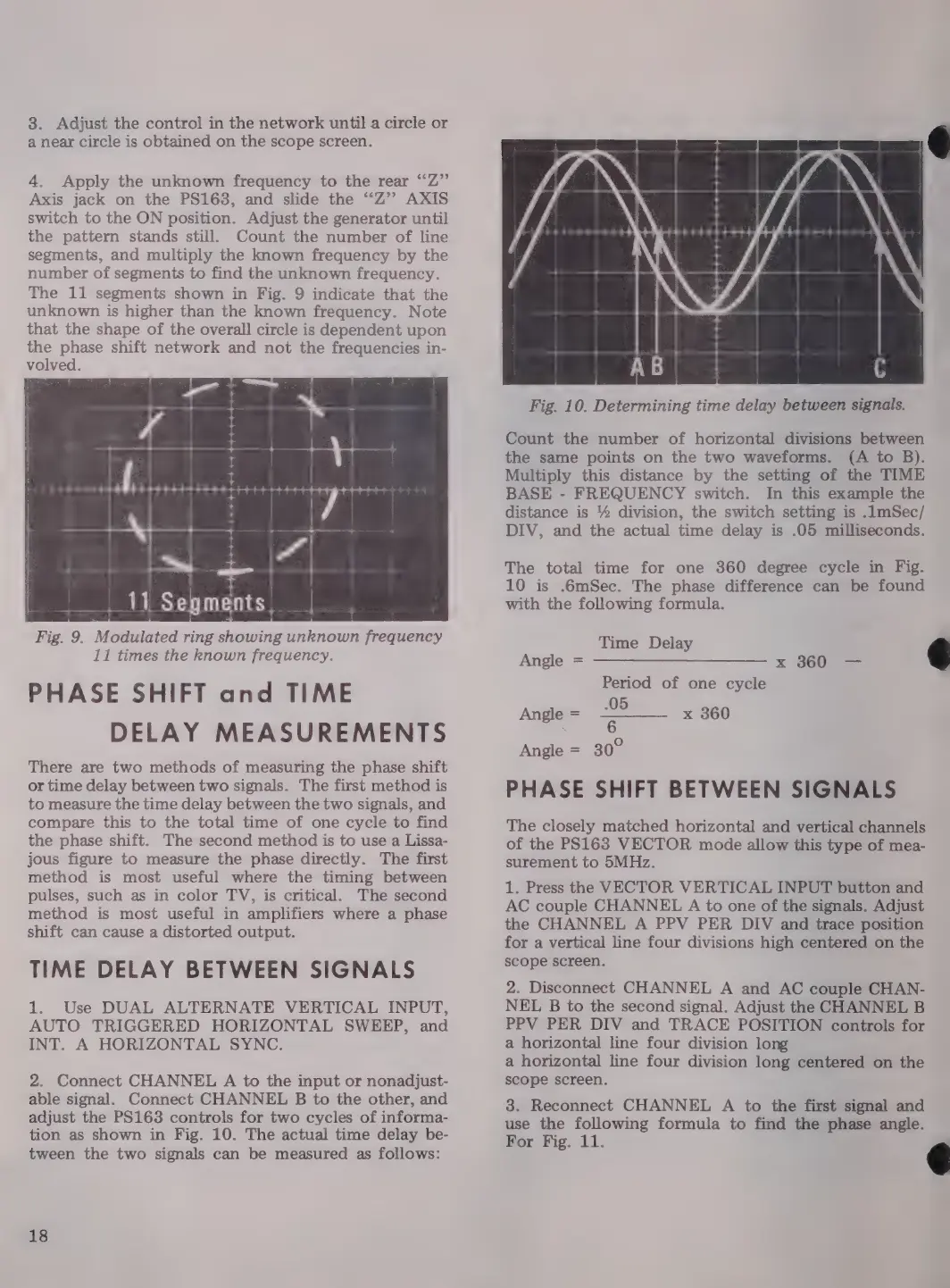
Fig.
10.
Determining
time
delay
between
signals.
Count
the
number
of
horizontal
divisions
between
the
same
points
on
the
two
waveforms.
(A
to
B).
Multiply
this
distance
by
the
setting
of
the
TIME
BASE
-
FREQUENCY
switch.
In
this
example
the
distance
is
%
division,
the
switch
setting
is
.lmSec/
DIV,
and
the
actual
time
delay
is
.05
milliseconds.
The
total
time
for
one
360
degree
cycle
in
Fig.
10
is
.6mSec.
The
phase
difference
can
be
found
with
the
following
formula.
Time
Delay
Angle
=
=
©
6
Period
of
one
cycle
Angle
=
E
x
360
Angle
=
30°
PHASE
SHIFT
BETWEEN
SIGNALS
The
closely
matched
horizontal
and
vertical
channels
of
the
PS163
VECTOR
mode
allow
this
type
of
mea-
surement
to
5MHz.
1.
Press
the
VECTOR
VERTICAL
INPUT
button
and
AC
couple
CHANNEL
A
to
one
of
the
signals.
Adjust
the
CHANNEL
A
PPV
PER
DIV
and
trace
position
for
a
vertical
line
four
divisions
high
centered
on
the
scope
screen.
2.
Disconnect
CHANNEL
A
and
AC
couple
CHAN-
NEL
B
to
the
second
signal.
Adjust
the
CHANNEL
B
PPV
PER
DIV
and
TRACE
POSITION
controls
for
a
horizontal
line
four
division
long
a
horizontal
line
four
division
long
centered
on
the
scope
screen.
3.
Reconnect
CHANNEL
A
to
the
first
signal
and
use
the
following
formula
to
find
the
phase
angle.
For
Fig.
11.
3

Related product manuals