Notes :
For each adjustment, INP2 > INP1 and DSP2> DSP1. If this is not the case, check the mounting
direction of the force transducer.
A safe lifting operation is only ensured if the above condition has been satisfied.
After configuring and validating the parameters of your CRANE-BOY, return to display mode (press
the PAR key until “END” appears).
Check that when there is no load, the display is equal to zero and that when the crane is
loaded, the display corresponds to the load that is being lifted.
The details of every parameter are available in the PAXS user guide.
2.2.2. 2° Configuration of the triggering thresholds (set points)
The adjustments in this section are independent of the load lifted at the time of adjustment.
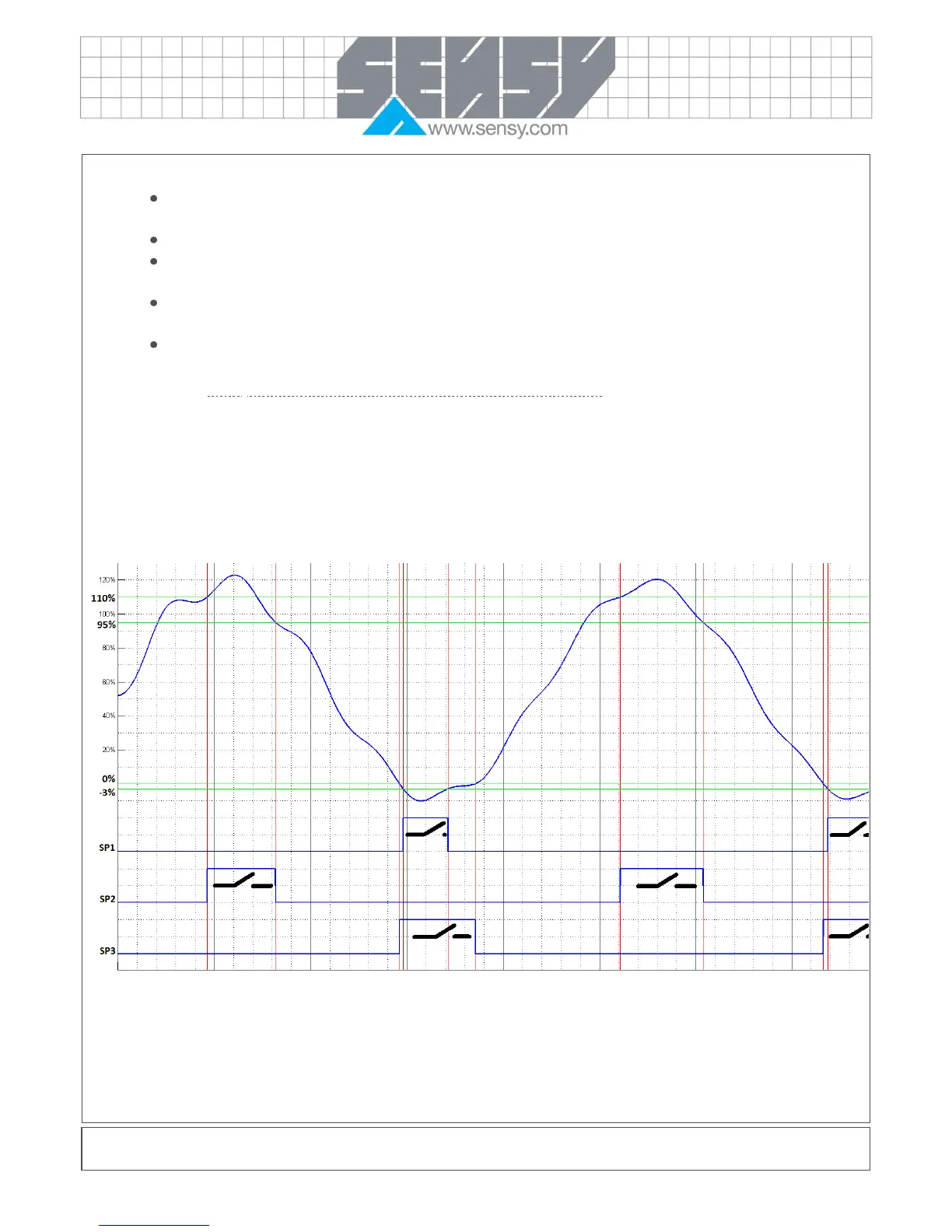
- SP1 is reserved for safety in case either the yellow or brown wire breaks.
- SP2 must be reserved for load limitation: its SP-2 and HYS-2 values will eventually be readjusted to the
characteristics of the transducer’s Wheatstone bridge if this was not carried out at SENSY’s factory.
- SP3 is factory-set to be used for cable slack: its SP-3 and HYS-3 values will eventually be readjusted to
the characteristics of the transducer’s Wheatstone bridge, if this was not carried out at SENSY’s factory.
- SP4 is available to activate a function other than load limitation (but this relay is not protected against a
broken wire). By default, this is not used.
Enter menu “6 –SPt” (SENSY access code = 7) and configure the parameters as shown in the table below.
The SENSY adjustments (factory setting) are such that a lifting system with a force transducer supplying a 1
mV/V signal at nominal capacity (100%) operates in the following way:
- 110% limitation (relay SP2 opens)
- 15% hysteresis (after opening, SP2 closes at 95 %)
- 0% cable slack (SP3 opens)
- 0,1 hysteresis (after opening, SP3 closes at +0,1)


 To Next Page