Page 33
.
Patient Monitoring with the SDMS
Good to know!
The change of a parameter’s reading within a certain time
(‘Delta-Time’) may indicate a gradual worsening of the
patient’s status. A ‘∆10-value for PCO
2
’ of ‘+ 7 mmHg’ or
more in a patient receiving opioid analgesics and sedatives,
for example, indicates opioid induced hypoventilation
and, therefore, may help to earlier recognize a developing
respiratory depression, especially in patients receiving
supplemental oxygen.
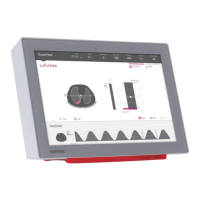
During patient monitoring, a baseline can be set by using the
respective function in the ‘Quick Access Menu’. The point of
time, at which the baseline was set, and the baseline itself
are subsequently displayed graphically (vertical and horizontal
white lines). A timer in the top left of the screen indicates
the elapsed time (hh:mm) since the baseline was set. A pa-
rameter’s baseline is numerically indicated on the left and its
∆B-value, i.e. the difference between its current reading and
its reading at the point the baseline was set, on the right of its
online trend.
Example: ‘Baseline values for PCO
2
’ of ‘33.3 + 10.1 mmHg
(00:12)’ indicate that the current PCO
2
reading is 10.1 mmHg
higher than the baseline of 33.3 mmHg which was set
12 minutes ago.
Good to know!
To assess the possible impact of a change in patient treat-
ment (e.g. changing ventilator settings, administration
of drugs such as sedatives or opioids, changing supply of
supplemental oxygen etc.) on the patient’s ventilation and/or
oxygenation, it is recommended to set a baseline just before
changing the treatment.
Operator Events
By using the ‘Quick Access Menu’ it is possible to store up
to eight different types of Operator Events in the internal
memory of the SDM for subsequent display in V-STATS™ after
downloading trend data. Within V-STATS™, operator events
are visualized as colored triangles and, among other, can be
used to split a measurement into multiple ‘Analysis Periods’
(e.g. to analyze the different phases of a split night).
Note: Operator Events are not visualized on the SDM.
RHP Online Trends/Setting RHP Reference
Once a SenTec TC Sensor is stabilized on the skin in an en-
vironment with constant ambient temperature, the heating
power required to maintain the sensor temperature depends
to a small fraction on the local skin blood flow beneath the sen-
sor site and, hence, heating power fluctuations may indicate
changes in local skin blood flow.


 To Next Page