Need help?
Do you have a question about the SenTech IR-SNIF-MCD Series and is the answer not in the manual?
Explains safety symbols used on equipment and within the manual.
Covers input power, opening the monitor, maintenance, cleaning, and intended use.
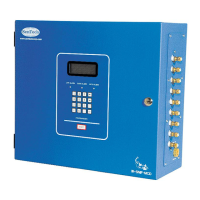
Details the four main functional blocks: Pneumatics, Infrared Bench, Control Electronics, and Power Supply.
Lists package contents and optional purchases for the IR-SNIF-MCD.
Guidance on selecting locations for the monitor, sample points, and alarms.
Details the requirements and procedures for connecting primary power to the monitor.
Explains how to connect external alarms and building systems to the monitor's relays.
Describes interface options like analog outputs, RS-485, and remote control panel connections.
Verifies correct monitor sequencing and integration with external devices.
Procedures for testing the monitor's response to refrigerant samples and end-to-end system functionality.
Outlines recommended periodic maintenance and filter inspection/replacement.
Lists commonly ordered parts and guidance for monitor repair.
Introduces the operator interface structure: Start-up, Operational, and Menu Screens.
Describes initial power-on screens, optics warm-up, and normal operation modes.
Details access to system setup, alarm tests, date/time, and trending features.
Covers changing passwords, system flags, alarm settings, and input/output configurations.
Lists part numbers and provides a diagram for component location.
Defines wire abbreviations and lists connections between monitor components.
Addresses problems related to no power, no display, and DC power faults.
Guides on resolving pneumatics failures, leak detection issues, and system alarms.
 General
| Measurement Principle | Non-Dispersive Infrared (NDIR) |
|---|---|
| Measurement Range | 0-100% LEL |
| Operating Temperature | -20°C to +50°C |
| Operating Humidity | 0-95% RH (non-condensing) |
| Output Signal | 4-20 mA |
| Ingress Protection | IP65 |
| Resolution | 0.1% LEL |
| Sensor Type | NDIR |
| Target Gas | Methane |
| Response Time (T90) | < 30 seconds |
| Power Supply | 24 VDC |

 To Next Page