43
The SGC Building, 13737 S.E. 26th St. Bellevue, Washington 98005 USA
P.O. Box 3526, 98009 Tel: (425) 746-6310 Fax: (425) 746-6384
© 1997 SGC Inc.
voltage (electrical "pressure"), the internal friction of the hose is analogous to wiring resistance and the size of the
hose is analogous to size of the wire. (By the way, the water faucet is equivalent to a switch, too.)
When electricity flows from the power supply to the radio at low current levels, the internal resistance of the
wire has little effect. But as current increases, the voltage drop becomes more pronounced. Remember the garden
hose? When you shut off the nozzle, the hose pressure is high. The voltage in the wire is also high. But turn on the
nozzle, and the pressure along the hose drops; and you can get only so much water through the hose.
Now apply this effect to your power wiring: Turn on the radio a little bit, such as the receive mode where little
power is drawn, and things will likely be just fine with #16 or #14 wire at 25 feet. But turn on the transmitting
portion of the transceiver and nothing will work correctly because the voltage will drop dramatically.
Having power cables which are too small is like trying to fill a storm drain with a garden hose--it can't be done
properly without doing something to keep the storm drain from working and doing its job.
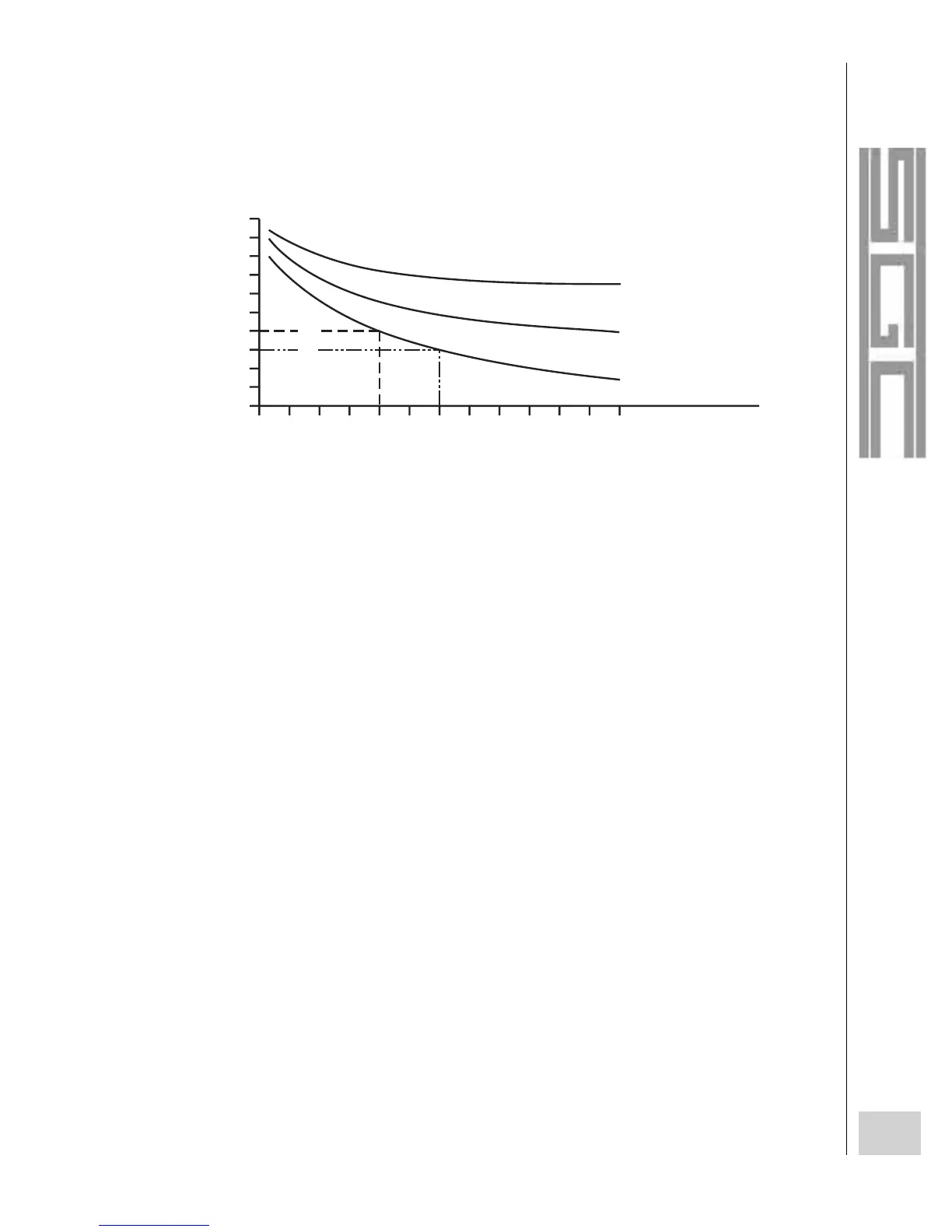
Let's consider wire sizes between the power source and the radio. At 25 feet, we recommend #6 wire. At 12
feet, we also recommend #6. At 2 feet, we recommend #8, but we use #6 because it's more in line with our practice
of building tremendous margins into all SGC products.
18
0 102030405060
00
0
2
4
6
8
10
12
14
16
MINIMUM WIRE GAUGE RECOMMENDATIONS:
DC INSTALLATIONS
POWER CABLE LENGTH IN FEET
32 VDC
24 VDC
12 VDC
CONDUCTOR SIZE (AWG)
a
b
EXAMPLE:
a/ 100W SSB gauge 6 for 12V operation
b/ 150W SSB gauge 4 for 12V operation



 To Next Page