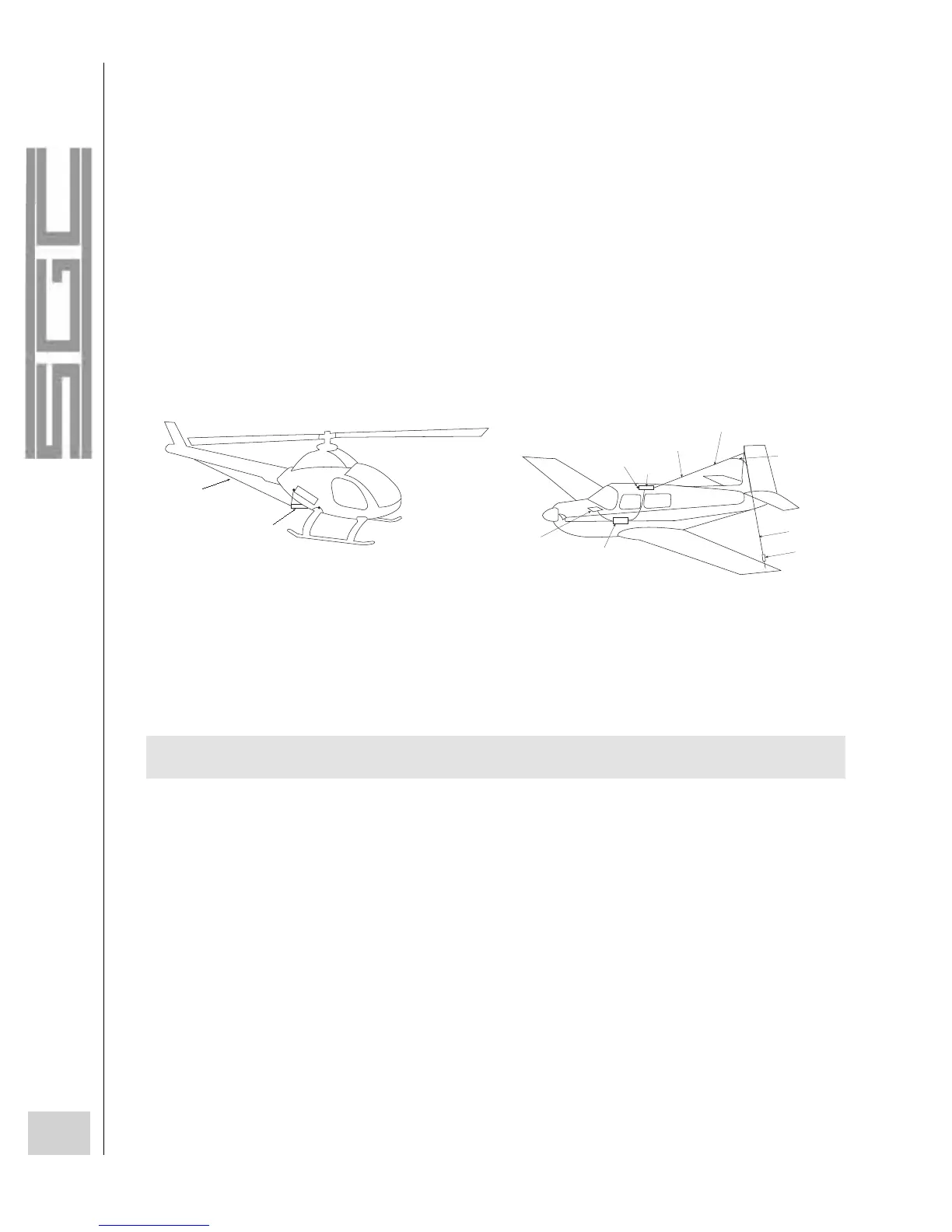
Aeronautical operations require antennas that are both compact and out of the way. Usually either vertical
whip antennas or wire antennas that are strung along the craft are used.
As covered much earlier in this user guide, radio signals are waves that travel through the air. Every radio
frequency is at a different wavelength because the frequency is the number of waves that pass by a particular point
in a second (radio waves all travel at the speed of light).
Many years ago it was discovered that in order for antenna systems to work correctly, they should be the same
size as or a certain fraction of the actual wavelength of the radio signal that you are listening to or plan to transmit.
This theory is known as resonance--every antenna should be cut to a resonant frequency, if possible, for best results.
The most basic type of antenna is simply a long wire, known as a longwire (brilliant deduction, eh?). It is
simply a piece of wire that is strung in a relatively straight configuration and is cut to a single wavelength for a
given frequency. If a transmitter was sending a signal into one end of this antenna, most of the signal would be
directed off of the end of the wire (away from the transmitter). The signal pattern from the end is not like an angle
50
The SGC Building, 13737 S.E. 26th St. Bellevue, Washington 98005 USA
P.O. Box 3526, 98009 Tel: (425) 746-6310 Fax: (425) 746-6384
© 1997 SGC Inc.
AERONAUTICAL
ANTENNA PATTERN BASICS


 To Next Page