80
The SGC Building, 13737 S.E. 26th St. Bellevue, Washington 98005 USA
P.O. Box 3526, 98009 Tel: (425) 746-6310 Fax: (425) 746-6384
© 1997 SGC Inc.
As was mentioned in the previous section, it is of utmost importance to have your antenna as high above the
ground as possible, and as far away of any obstructions or contamination of appliance or industrial RF pollution
(such as power lines, telephone lines, mills or other industrial machinery). In some cases,
the ground will absorb quite a bit of the signal. A few examples of this kind of ground
absorption are when an antenna, such as a dipole or a longwire, is located near the
ground. "Near the ground" means that any distance less than a half wavelength above the
ground will skew the signal pattern and absorb a certain amount of the signal.
Considering that a half wavelength for the 40-meter amateur band would be 66 feet off the ground and a half
wavelength for the 80-meter amateur band would be 122 feet off the ground, it will often be impossible for you to
mount an antenna at such a height. Thus, the "as high as possible" rule is used.
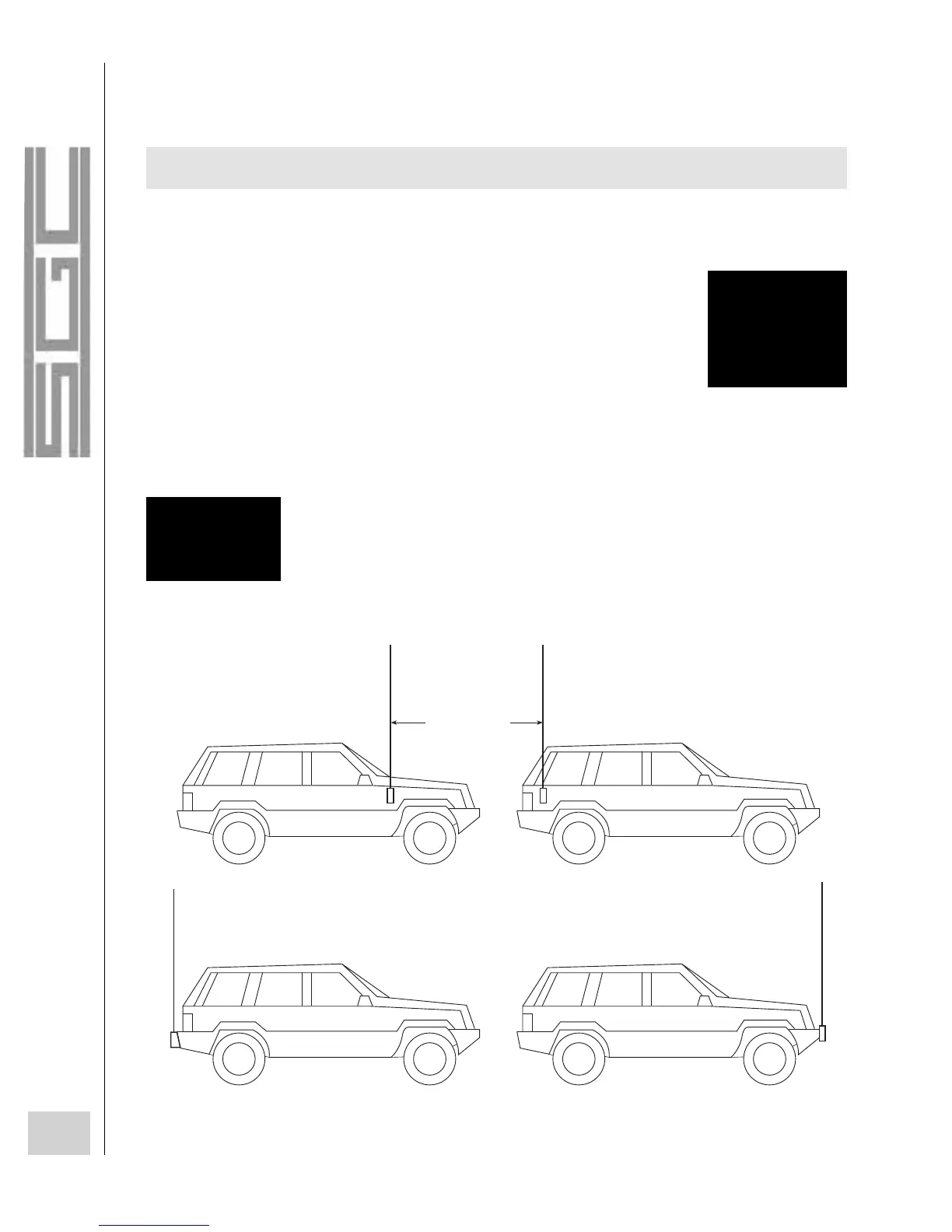
Mobile and portable mounting locations are even more difficult to to deal with
because physical objects also absorb RF signals. As a result, your antenna has to contend
with ground losses and signal absorption because the antenna is near the ground. The last
thing you want to do is have your signals absorbed by a part of the vehicle. The best
Always mount the
antenna as high as
possible, and away
from obstructions and
interfering objects.
LOCATION
The best vehicle
antenna location is
on the roof or trunk.


 To Next Page