73
The SGC Building, 13737 S.E. 26th St. Bellevue, Washington 98005 USA
P.O. Box 3526, 98009 Tel: (425) 746-6310 Fax: (425) 746-6384
© 1997 SGC Inc.
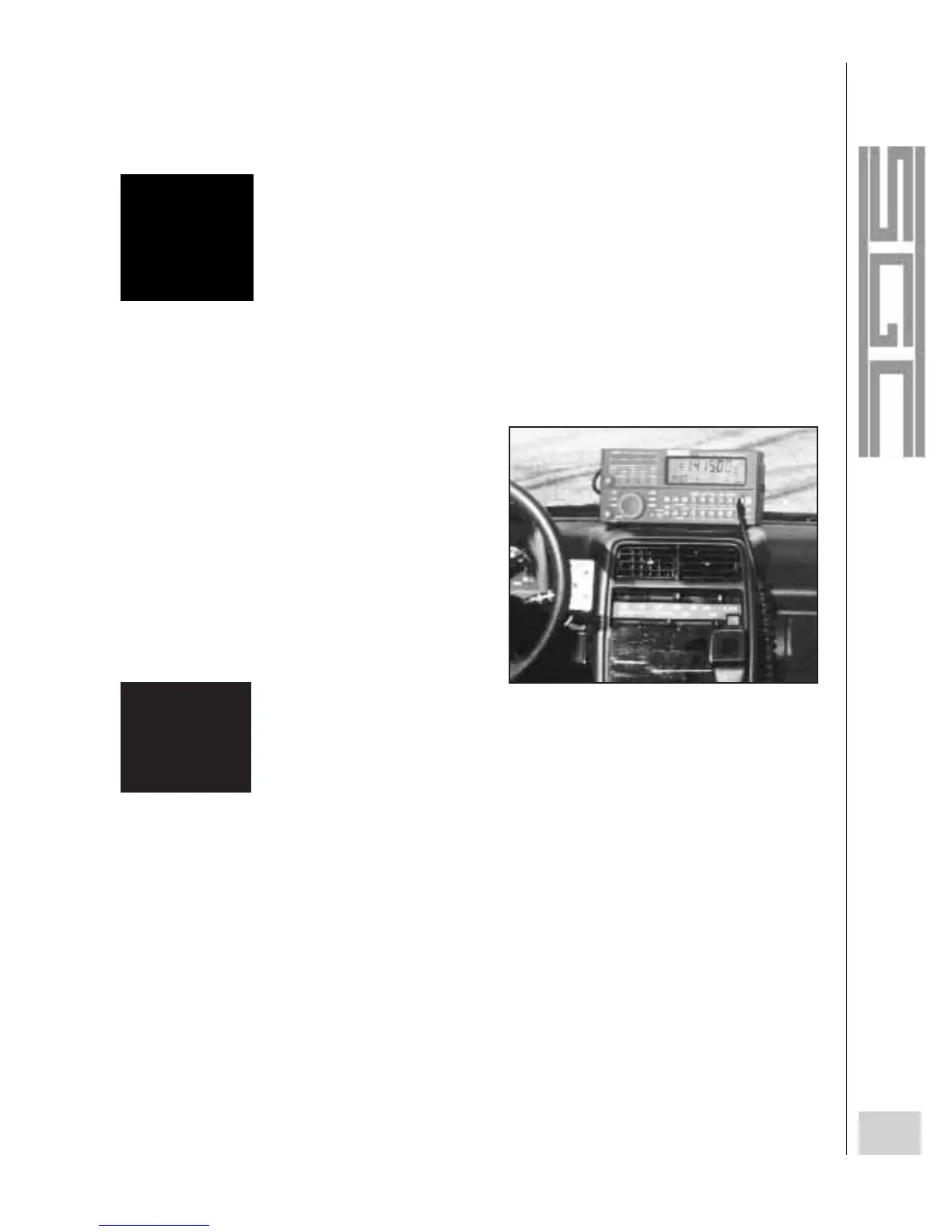
For most vehicular locations, it is best to mount the transceiver in the dashboard or just under the dashboard (or
control panel). This way, all of the controls are right in front of you; if you are driving or
flying, you will be able to easily operate the transceiver from the driver's seat. If more
people are on board and more concentration needs to be put into radio operations, the radio
can be operated by someone in the front seat beside the driver.
Because different types of transceivers are used in so many different applications, it is
difficult to make recommendations on how they should be installed. However, it is often most practical to mount
the equipment under the dash or control panel by merely screwing in the mounting plate. If there is any question as
to the number of bumps and jolts that the radio will receive while installed in that location, use a shock mount.
Shock mounts aren't always recommended, but it is better to play it safe with your communications equipment,
especially in large helicopters or tugboats.
If you are installing a transceiver, such as the SG-2000, in
a marine or car operating environment, you might want to take
advantage of the remote head technology of the radio. With
the remote head, you can place the SG-2000 in an out-of-the-
way location (right next to your DC power source,whether it is
an AC/DC power supply or your battery system) and set up the
much smaller remote head somewhere else. That allows you to
have the extra space to operate from a small, but convenient
location. When mounting the control
head in this manner, use the remote head kit's gimbal mount. This mount allows you to
change the control head angle to prevent glare on the display screen. Also, because the
mount is adjustable, other operators can change the angle to their liking.
Running power cables As inconvenient as it might seem, whenever you operate a
piece of electrical equipment, the power must come from somewhere, and power cables must be installed. With any
transceiver, the power cables must be kept as short as possible. No wire or cable is 100% efficient and the longer
that your cable is, the more power will be lost. As a result, if the power cable is too long, the transceiver will
operate with less-than-optimum amounts of power. Also, the longer the power cables are, the better the chance that
something could go wrong along the way (shorts, opens, etc.). SGC recommends that you use runs of less than 25
feet for your transceiver power cables; in any case, you should try to keep the cables as short as possible.
In addition to the specifications for the cable length, the cable gauge is also very important. If more power is
running through the cable than it can accommodate, then it will overheat or simply prevent the transceiver from
With any HF
transceiver, the
power cables must
be kept as short
as possible.
For most vehicular
locations, it is best
to mount the
transceiver in the
dashboard or
control panel.


 To Next Page