91
The SGC Building, 13737 S.E. 26th St. Bellevue, Washington 98005 USA
P.O. Box 3526, 98009 Tel: (425) 746-6310 Fax: (425) 746-6384
© 1997 SGC Inc.
Unfortunately, when you use a can-type dummy load, you can't see "what's happening" with your transmitter.
In this case, you can use a light-bulb dummy load to test your transmitter. Here, the light bulb is directly connected
to the output of the transmitter and it dissipates the RF energy as light. The light bulb dummy load is more useful
than the oil-can type because you can guess how much power is being output, you can see the voice modulate the
SSB (the light will flicker with your voice peaks), and you can tune the transmitter for maximum output (if the
transmitter is an older model that requires tuning).
Before building or using the light-bulb dummy load, remember that these models typically don't dissipate the
transmitter's output as well as an oil-can dummy load. The result is that RF will "leak" out; I have heard a few
stories of amateurs who were heard around town while operating their transmitters into a light-bulb dummy load. If
you use this system, make sure that you test the equipment on a clear, harmless frequency (NEVER test with the
transmitter set on an emergency frequency, such as 2182 kHz).
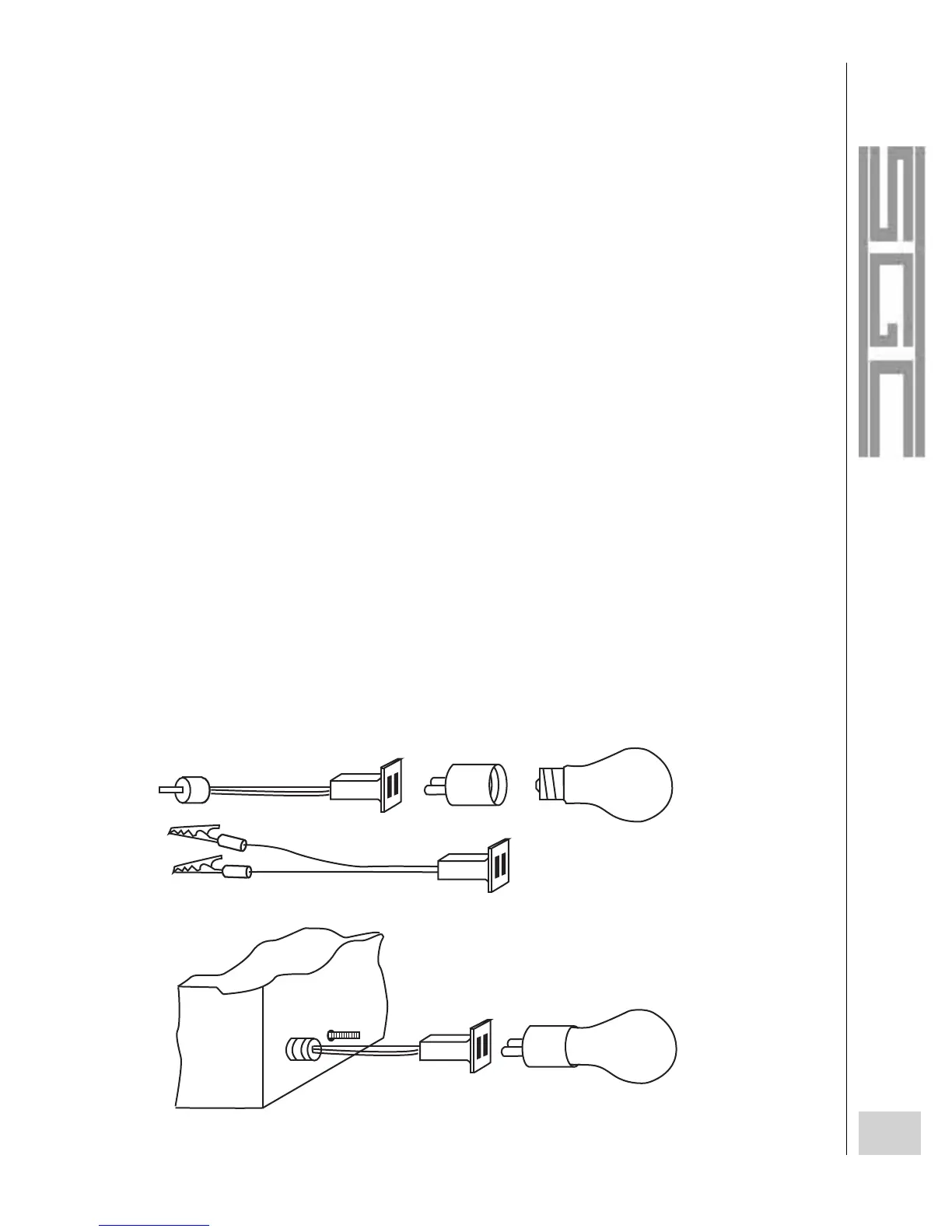
SGC recommends that you build the light-bulb dummy load with the following parts (although I have made
one with an old light fixture and a makeshift version with just alligator clip leads and a light bulb):
* AC socket to cable with a PL-259 connector
* AC socket to cable with alligator clips (needed with coupler)
* Light bulb to AC adapter
* 75 to 125 watt light bulb, 120 to 220 VAC
* SG-2000 transceiver
* SG-230 coupler (optional)


 To Next Page