Need help?
Do you have a question about the Shindaiwa M235 and is the answer not in the manual?
Provides details on genuine parts, service, and dealer information.
Instructions on locating and using model and serial numbers for parts and service.
Details warranty service requirements and how to find an authorized dealer.
Contact information for assistance with product application, operation, or maintenance.
Importance of registering the product for warranty coverage and manufacturer contact.
Information on how to obtain replacement operator and parts manuals.
Explanation of safety alert symbols and keywords like DANGER, WARNING, CAUTION.
Explains the 'CAUTION' safety alert symbol and its meaning for minor/moderate injury.
Indicates information necessary for unit protection, tips for use, care, and maintenance.
Defines the meaning of the circle and slash symbol as a prohibition.
Lists and defines various international symbols used in the manual for operation.
Symbol and description for a hot surface warning.
Symbol indicating the correct fuel and oil mixture ratio.
Warning to keep bystanders away due to potential kickback hazards.
Symbol and explanation for the hazard of thrown objects.
Symbol and description for the hazard of finger severing.
Safety instruction regarding proximity to electrical hazards and bystanders.
Safety advice on planning an escape route from falling hazards.
Specific warning about using attachments with blades.
Covers physical condition and necessary safety equipment for operation.
Details how physical state affects judgment and dexterity.
Mandates eye protection meeting ANSI Z87.1 or CE requirements.
Recommends sturdy gloves for grip, protection, and vibration reduction.
Recommends wearing hearing protection when operating the unit.
Advises on using dust masks for airborne allergens and dust.
Specifies required clothing: long sleeves/pants, closed shoes, no loose items.
Warns about electromagnetic fields interfering with pacemakers and advises consultation.
Discusses risks of prolonged exposure to cold and vibration (Raynaud's Phenomenon).
Recommends staying warm, maintaining circulation, and limiting operation hours.
Explains risks of RSI/CTS and how to prevent them.
Dangers associated with overhead electrical conductors and unit insulation.
Warns against indoor/poorly ventilated operation due to exhaust emissions.
Emphasizes providing manuals to users for safe operation instructions.
Mandates clearing the work area of spectators, children, and animals.
Instruction on maintaining a firm grip on handles.
Advice on maintaining balance and footing on stable surfaces.
Warning about hot housings and avoiding contact.
Stresses using only approved attachments and checking unit condition.
Warns about moving parts causing severe injuries and keeping clear.
Emphasizes stopping the engine and ensuring parts are stopped before servicing.
Explains emission control systems (EM, TWC, EVAP) and label interpretation.
Describes the location and purpose of the emission control label on the engine.
Defines emission compliance period and its relation to maintenance.
Instructs to locate, understand, and maintain legibility of safety decals.
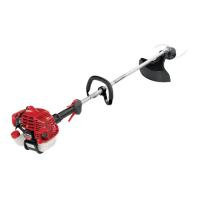
Visual guide with numbered parts for identifying unit components.
Step-by-step instructions for connecting the power head to the lower shaft assembly.
Guidance on positioning and securing the support handle for comfortable operation.
Warning about moving parts causing severe injuries and keeping clear.
Warning about hot exhaust and carbon monoxide, and directing it away.
Warning about sparks igniting dry vegetation and contacting fire authorities.
Specifies approved gasoline octane, ethanol limits, and required two-stroke oil standards.
Warns against using diesel, E15, E85, or methanol fuels due to damage risk.
Details ISO-L-EGD and J.A.S.O. FD standards for two-stroke oil.
Warns about hazards of two-stroke oil if swallowed or inhaled.
Emphasizes extreme care with flammable fuel, avoiding sparks, and refueling outdoors.
Explains the danger of gasoline vapors igniting and causing explosions.
Step-by-step guide for mixing fuel and oil at a 50:1 ratio.
Advises on proper fuel storage, container use, and disposal of waste materials.
Step-by-step instructions for starting a cold engine, including choke and purge bulb use.
Detailed instructions on using the recoil starter for engine ignition.
Explains adjusting the choke after starting and operating the throttle.
Procedure for starting a warm engine, noting differences from cold start.
Warning that the cutting attachment should not move at idle to prevent injury.
Instructions on how to safely stop the engine using the throttle and stop switch.
Advice on what to do if the stop switch fails to function correctly.
Warning about moving parts and hot surfaces during maintenance.
Warns that poor maintenance can lead to serious injuries.
Defines skill levels (1, 2, 3) for performing maintenance tasks.
Table detailing maintenance tasks, procedures, and required skill levels by frequency.
Provides specific notes on grease application and fuel tank maintenance.
Instructions for inspecting, cleaning, and replacing the air filter.
Instructions for safely removing and replacing the fuel filter.
Guide for checking, cleaning/replacing, and gapping the spark plug.
Details the importance of cooling air flow and how to maintain it.
Steps to remove air cleaner and engine covers to clean cylinder fins.
Explains causes of overheating, such as blocked air intakes or dirt buildup.
Instructions for removing, cleaning, and replacing the spark arrestor screen.
Procedure for cleaning carbon deposits from the exhaust port.
Lists components of the spark arrestor screen assembly for removal and replacement.
Steps for cleaning carbon deposits from the cylinder exhaust port using specific tools.
Warning against using metal tools for cleaning exhaust ports to prevent cylinder damage.
Covers engine break-in, high altitude operation, and carburetor adjustment.
Instructions for checking and adjusting the engine idle speed using the idle speed screw.
Steps for lubricating the upper drive shaft by removing the attachment and applying grease.
Details on cleaning and greasing the upper flex cable and coupler.
A chart listing engine problems, checks, causes, and remedies.
Troubleshooting steps for engine starting issues like fuel, spark, and air filter problems.
Troubleshooting steps for engine performance issues like sputtering or stalling.
Troubleshooting steps for when the engine fails to crank or turn over.
Comprehensive steps for preparing the unit for storage, including draining fuel and oiling cylinder.
Warning about storing the unit in areas with potential for flame or spark accumulation.
Detailed specifications for the M235 model, including dimensions, engine type, and capacities.
Specifies approved fuel types, octane ratings, and required oil standards.
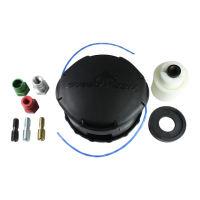
Lists recommended optional attachments with their part numbers.
Instructions for registering the product online or by mail for warranty and updates.
The physical product registration card with fields for owner and purchase details.
Questions about factors influencing the purchasing decision.


 To Next Page
 General