EasyManua.ls Logo

Shindaiwa T270 - User Manual

Shindaiwa T270
24 pages
Print Icon
To Next Page IconTo Next Page
Loading...
C270
WARNING!
To minimize the risk of injury to yourself and others, read
this manual and familiarize yourself with its contents.
Always wear eye protection when operating this unit!
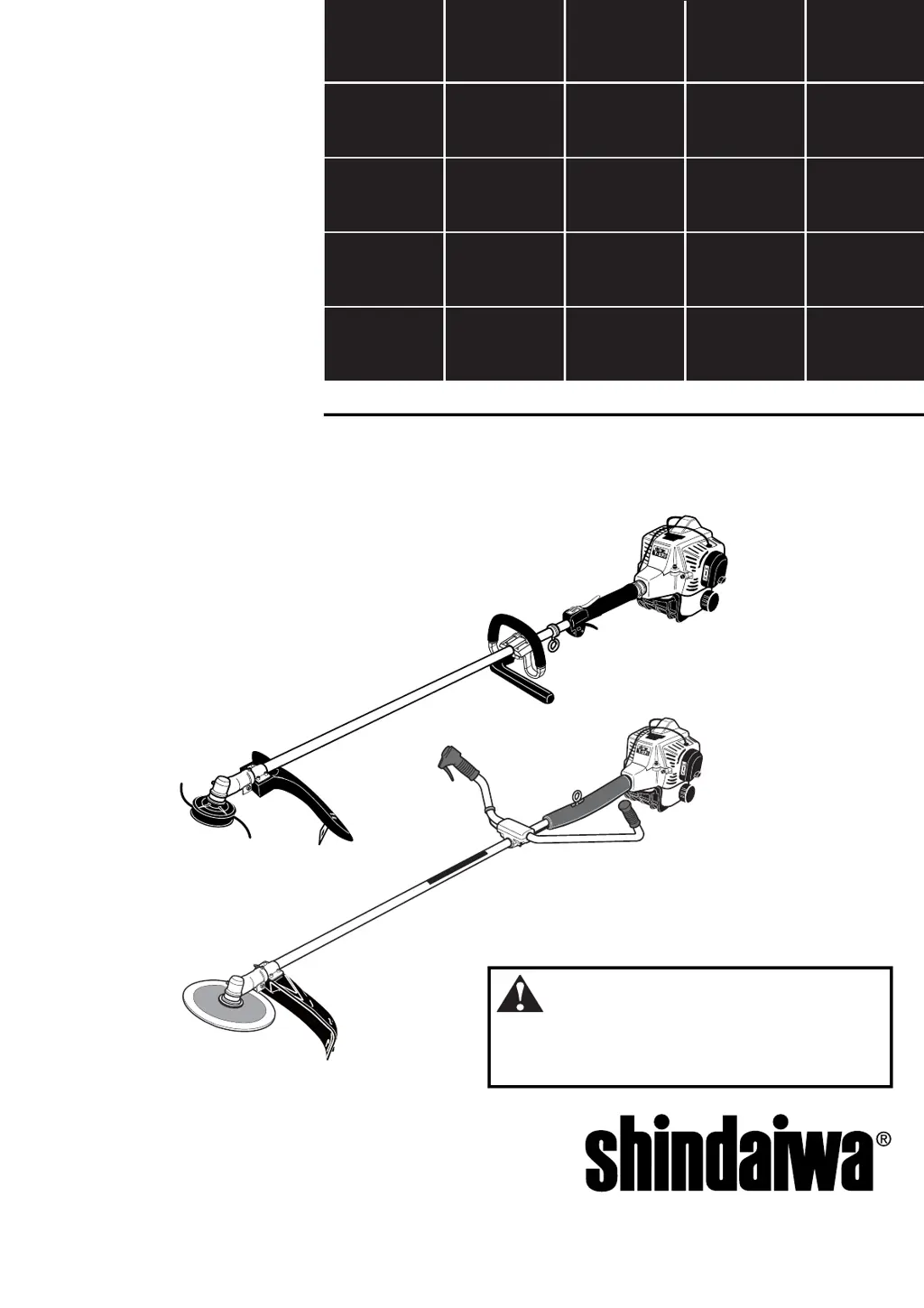
SHINDAIWA OWNER’S/OPERATOR’S MANUAL
T270 GRASS TRIMMER
C270 BRUSHCUTTER
T270

Questions and Answers

Summary

Attention Statements Explained

Warning Statements

Statements indicating potential for serious bodily injury if not followed.

Caution Statements

Statements indicating potential for unit damage if not followed.

Important Statements

Statements of special significance for operation or maintenance.

Notes for Easier Operation

Handy tips and information to make tasks easier.

General Safety Instructions

Safe Operation Practices

General advice for operating trimmers and brushcutters safely.

Unauthorized Attachment Warning

Warning against installing non-approved attachments.

Safety Judgment Guidelines

Essential safety advice for preventing injury and damage.

Operational Procedure Disclaimer

Disclaimer regarding operational procedures and local laws.

California Emissions Warning

Warning about chemicals in exhaust known to cause cancer or birth defects.

General Safety Instructions

Operator Alertness and Fitness

Requirement for physical and mental fitness to operate the unit safely.

Operation Under Influence Warning

Warning against operating while tired or under the influence of substances.

Fire Risk Prevention

Crucial safety tips to prevent fires related to fuel and hot engine parts.

The Properly Equipped Operator

Personal Protective Equipment and Safe Handling

Guidelines on required PPE and safe operating posture and movement.

Environmental and Hazard Awareness

Safety and Information Label Maintenance

Instructions to ensure safety labels are maintained and readable.

Product Description and Components

Unit Components and Modification Warning

Overview of unit components and a warning against unauthorized modifications.

Product Specifications

Pre-Assembly Checks

Checklist of components and tools required before assembly.

Terminology for Operation

Defines directional terms used in the manual for clarity.

Assembly: Driveshaft;Powerhead Connection

Connecting Outer Tube to Powerhead

Step-by-step instructions for connecting the outer tube to the powerhead.

Powerhead Connection Caution

Warning to avoid forcing the tube during connection to prevent damage.

Assembly: Throttle Cable and Handle

Installing Throttle Cable (T270)

Detailed steps for installing the throttle cable on the T270 model.

Adjusting Throttle Lever Free Play

Procedure for checking and adjusting throttle lever free play.

Throttle Assembly Screw Caution

Warning about overtightening throttle assembly screws causing damage.

Assembling Handle to Outer Tube (T270)

Instructions for attaching the handle and barrier bar to the outer tube.

Assembly: Handle and Linkage (C270)

Assembling Handle (C270)

Steps for positioning and securing the handle on the C270 model.

Throttle Body Screw Caution (C270)

Warning against overtightening throttle body screws.

Connecting Linkage and Ignition Leads (C270)

Instructions for routing the throttle cable and connecting ignition wires.

Ignition Wire Interchangeability Note

Note regarding the interchangeability of ignition switch wires.

Assembly: Cutting Attachment Shield

Installing Cutting Attachment Shield

Step-by-step guide to installing the cutting attachment shield.

Shield Clamp Screw Tightening Caution

Caution on tightening shield clamp screws before final tightening.

Shield Installation Warning

Critical warning about operating without a secured cutting attachment shield.

Sub-Shield Installation (C270 Trimmer Head)

Instructions for attaching the sub-shield for trimmer head use on C270.

Sub-Shield Usage Warning (C270)

Warning to always use the sub-shield with a trimmer head on C270.

Sub-Guard Hooking Caution

Caution to ensure the sub-guard is properly hooked.

Adjusting Line Cutter Position

Procedure for changing the line cutter position.

Line Cutter Handling Warning

Warning about the sharpness of the line cutter and the need for gloves.

Line Cutter Nuts Note

Note about the uncaptured nuts for the line cutter.

Assembly: Trimmer Head (T270;C270)

Trimmer Head Assembly Note

Note on pre-installed parts and shaft thread direction for trimmer head assembly.

Assembling the Trimmer Head

Detailed steps for assembling the trimmer head onto the gearcase shaft.

Blade Selection (C270 Brushcutter)

Cutting Attachment Recommendation Warning

Warning to use only Shindaiwa-approved cutting attachments.

Blade Type and Material Matching Warning

Warning to match blade type to material and keep blades sharp.

Blade Types and Applications

Description of different blade types and their intended uses for brushcutting.

Assembly: Brushcutter Blade (C270)

Brushcutter Blade Assembly Note

Note on pre-installed parts and shaft thread direction for brushcutter blade assembly.

Assembling the Brushcutter Blade

Detailed steps for assembling the brushcutter blade onto the gearcase shaft.

Brushcutter Blade Safety Clip Warning

Critical warning about operating the brushcutter without a secured safety clip.

Mixing Fuel

Gasoline Type and Alcohol Content Caution

Caution regarding alcohol content in gasoline and its effect on engine lubrication.

Fuel Mixture and Oil Type Caution

Caution on using only unleaded gasoline and recommended 2-cycle mixing oil.

50:1 Fuel Mixture Examples

Examples of quantities for mixing gasoline and 2-cycle oil.

Fuel Storage and Stabilization

Advice on mixing only necessary fuel and using stabilizers for storage.

Filling the Fuel Tank

Fueling Safety Precautions

Critical safety instructions to follow when refueling the unit.

Fueling Procedure

Step-by-step instructions for safely filling the fuel tank.

Starting the Engine

Ignition Switch Operation Note

Explanation of the two-position ignition switch labels.

Engine Start Procedure

Detailed steps for preparing and starting the engine.

Primer System Functionality

Clarification on how the primer system works and its limitations.

Recoil Starter Caution

Caution against pulling the recoil starter to its full length to prevent damage.

Cutting Attachment Rotation Warning

Warning that the cutting attachment may rotate upon engine start.

Starting Position Warning

Warning not to start the engine while in the operating position.

Choke and Idle Operation

Instructions for adjusting the choke and the effect of throttle on idle setting.

Engine Flooding Troubleshooting

Guidance on what to do if the engine fails to start after multiple attempts.

Post-Start Engine Warm-up and Operation

Steps to take after the engine starts, including warm-up and checking attachment rotation.

Stopping the Engine

Engine Stopping Procedure

Instructions for properly stopping the engine using the ignition switch.

Adjusting Engine Idle Speed

Idle Speed Adjustment Purpose

Explanation of why idle speed adjustment is necessary.

Engine Idle Adjustment Procedure

Step-by-step instructions for adjusting the engine idle speed.

Idle Speed Rotation Warning

Critical warning against the cutting attachment rotating at idle.

Carburetor Adjustment Note

Note that carburetor mixture is factory preset and not field serviceable.

Non-Emission Engine Carburetor Settings

Initial factory settings for carburetor mixture on non-emission engines.

Checking Unit Condition

Protective Device Check Warning

Warning to ensure all protective devices are in place before operation.

Debris Protection Warning

Warning that shields do not guarantee full protection from thrown debris.

Cutting Attachment and Unit Integrity Checks

Checks for proper installation, condition, and use of authorized parts.

General Operation Safety Checks

Safety checks regarding foreign object impacts, load, fasteners, and blade sharpness.

Shoulder Strap Usage

Shoulder Strap Adjustment and Fit

Instructions for properly adjusting and securing the shoulder strap.

Shoulder Strap for Blade Use (C270;T270)

Requirement for shoulder strap use when operating with a blade.

Blade Operation Shoulder Strap Warning

Warning to always use a shoulder strap when operating with a blade.

Shoulder Strap for Trimmer Head Use (T270)

Recommendation for using a shoulder strap for comfort with trimmer heads.

Cutting Grass with Trimmer Head

Trimmer Head Model Variety

Information about different trimmer head models available for the T270.

Trimmer Head Compatibility Note

Note that trimmer heads can be fitted to the C270 brushcutter.

Trimmer Head Operation and Styles

Guidance on referring to specific trimmer head instructions and listing styles.

Flail Head Description

Description of the flail head attachment.

Trimming and Mowing Technique

How to properly trim and mow grass with the unit.

Line Tangling Caution

Caution against tangling the trimmer line with obstacles.

Engine Speed for Grass Cutting

Recommendation to operate at full throttle while cutting grass.

Low RPM Operation Caution

Caution that low RPM operation can cause clutch failure.

Edging Technique

How to perform edging with the trimmer.

Using A Brushcutter Blade

Pre-Blade Use Area Inspection Warning

Warning to inspect and clear the work area before using a blade.

Brushcutter Blade Safety Requirements

Essential safety rules and equipment requirements for brushcutter blade operation.

Understanding Blade Thrust

Explanation of blade thrust and the need for constant alertness.

Brushcutter Handlebar Importance

Importance of the handlebar or barrier bar for preventing contact with the blade.

Brushcutter Shoulder Strap Benefits

Benefits of using a shoulder strap for brushcutter operation.

Engine Speed Considerations for Brushcutting

Advice on engine speeds to prevent damage, wear, and debris wrapping.

Brushcutting Technique and Blade Rotation

Technique for brushcutting, including blade rotation and movement direction.

Wood Cutting Technique Warning

Warning about feeding the blade slowly when cutting wood.

Approved Blade Types Warning

Warning against using non-approved cutting blades.

Vertical Cutting Technique

Technique for making vertical cuts with the brushcutter blade.

Vertical Cut Height Warning

Warning to keep the blade below waist height during vertical cuts.

Maintenance Overview and Warnings

Emission Control System Maintenance

Information on who can perform emission control system maintenance and warranty implications.

Pre-Maintenance Safety Disconnection

Critical safety step to disconnect the spark plug wire before any maintenance.

Non-Standard Parts Warning

Warning that non-standard parts may cause damage or injury.

Non-Standard Parts Warranty Note

Note that using non-standard parts may void the warranty.

Muffler Condition and Spark Arrester

Importance of a functional muffler and spark arrester for safety and hearing.

Spark Plug Maintenance

Keeping the spark plug and connections clean and tight.

Fastener Tightness Check

Ensuring all nuts, bolts, and screws are securely tightened.

Blade Sharpening and Condition

Importance of keeping blades sharp and checking for damage.

Damaged Blade Repair Warning

Warning against repairing damaged blades, which can cause serious injury.

Approved Blade Type Warning

Warning against using unapproved blade types.

Blade Interchangeability Warning

Warning that blades are not interchangeable between different unit types.

Daily Maintenance Checks

Pre-Workday Maintenance Checklist

List of checks to perform before starting daily work.

Daily Pre-Operation Inspection

Daily checks for engine cleanliness, fasteners, and leaks.

10-Hour Maintenance

Air Cleaner Element Cleaning (10-Hour)

Procedure for cleaning the air cleaner element every 10 hours.

Air Cleaner Condition Caution

Caution regarding operating with a damaged or wet air cleaner element.

10;15-Hour Maintenance

Spark Plug Cleaning and Gapping (10;15-Hour)

Instructions for cleaning, gapping, or replacing the spark plug.

Spark Plug Removal Caution

Caution to clean the area around the spark plug before removal.

50-Hour Maintenance

Cylinder Cover and Fins Cleaning (50-Hour)

Cleaning the cylinder cover and fins every 50 hours.

Gearcase Greasing (50-Hour)

Procedure for greasing the gearcase every 50 hours.

Fuel Filter Replacement Caution

Caution regarding piercing the fuel line during filter replacement.

Fuel Filter Replacement

Steps for inspecting and replacing the fuel filter element.

Muffler Maintenance and Spark Arrester Cleaning

Muffler Spark Arrester Cleaning

How to clean the muffler's spark arrester screen to restore performance.

Muffler;Spark Arrester Integrity Warning

Warning against operating with a damaged or missing muffler or spark arrester.

Long Term Storage Preparation

Unit Cleaning and Oiling for Storage

Cleaning and oiling external parts before storage.

Draining Fuel for Storage

Procedure for draining the fuel tank for long-term storage.

Fuel Stabilization for Storage

Importance of using fuel stabilizers for stored fuel.

Carburetor and Fuel Line Fuel Removal

Steps to remove residual fuel from the carburetor and lines.

Carburetor Fuel Storage Caution

Caution about potential issues from gasoline left in the carburetor.

Cylinder Lubrication for Storage

Procedure for lubricating the cylinder with oil before storage.

Pre-Storage Repair Check

Importance of repairing or replacing worn/damaged parts before storage.

Air Cleaner Storage Preparation

Cleaning and drying the air cleaner element for storage.

Storage Location and Conditions

Recommendation for storing the unit in a clean, dust-free environment.

Blade Sharpening

Blade Sharpening Principles

Principles for resharpening blades, emphasizing balance.

Sharpening Shindaiwa Tornado Blade

Specific instructions for sharpening the Shindaiwa Tornado Blade.

Sharpening Multiple-Tooth Circular Blade

Instructions for sharpening multiple-tooth circular blades.

Blade Sharpening Contour Warning

Warning to only sharpen teeth and not alter the blade's contour.

Troubleshooting Guide: Engine Not Starting

Engine Crank Check

Troubleshooting steps for when the engine does not crank.

Compression Check

Troubleshooting steps for lack of compression.

Fuel Quality Check

Troubleshooting fuel-related issues affecting starting.

Fuel Flow Check

Troubleshooting fuel flow issues during priming.

Spark at Plug Wire Check

Troubleshooting spark issues related to the ignition switch.

Wet Spark Plug Troubleshooting

Steps for dealing with a wet spark plug indicating flooding.

Spark Plug Fouling;Gapping

Troubleshooting issues related to fouled or improperly gapped spark plugs.

Troubleshooting Guide: Low Power Output

Engine Overheating - Operator Error

Addressing low power caused by operator overworking the unit.

Lean Carburetor Mixture

Troubleshooting low power due to a lean carburetor mixture.

Dirty Cooling Fins

Addressing rough engine operation due to dirty cooling fins.

Carbon Deposits in Engine;Muffler

Troubleshooting rough running caused by carbon deposits.

Clogged Air Cleaner Element

Diagnosing low power due to a clogged air cleaner.

Loose or Damaged Spark Plug

Checking for low power issues related to the spark plug.

Air Leakage or Clogged Fuel Line

Troubleshooting low power from air leaks or fuel line blockages.

Water in Fuel

Diagnosing low power issues caused by water in the fuel.

Piston Seizure

Troubleshooting low power due to piston seizure.

Faulty Carburetor;Diaphragm

Diagnosing low power from a faulty carburetor or diaphragm.

Overheating Condition

Troubleshooting low power related to engine overheating.

Improper Fuel Ratio

Diagnosing low power due to incorrect fuel mixture.

Carbon Deposits in Combustion Chamber

Troubleshooting engine knocking from carbon deposits.

Troubleshooting Guide: Additional Problems

Poor Acceleration: Clogged Air Cleaner

Addressing poor acceleration due to a clogged air cleaner.

Poor Acceleration: Clogged Fuel Filter

Troubleshooting poor acceleration from a clogged fuel filter.

Poor Acceleration: Lean Carburetor Mixture

Diagnosing poor acceleration from a lean carburetor mixture.

Poor Acceleration: Low Idle Speed

Troubleshooting poor acceleration due to low idle speed.

Engine Stops Abruptly: Switch Off

Troubleshooting abrupt engine stops related to the ignition switch.

Engine Stops Abruptly: Empty Fuel Tank

Diagnosing abrupt engine stops due to an empty fuel tank.

Engine Stops Abruptly: Clogged Fuel Filter

Troubleshooting abrupt engine stops from a clogged fuel filter.

Engine Stops Abruptly: Water in Fuel

Diagnosing abrupt engine stops from water in the fuel.

Engine Difficult to Shut Off: Spark Plug Issue

Troubleshooting difficulty shutting off the engine due to spark plug issues.

Engine Difficult to Shut Off: Ignition Failure

Diagnosing engine shutdown issues from ignition failure.

Engine Difficult to Shut Off: Piston Seizure

Troubleshooting engine shutdown from piston seizure.

Engine Difficult to Shut Off: Ground Wire;Switch

Diagnosing shutdown issues from ground wire or switch problems.

Engine Difficult to Shut Off: Overheating;Spark Plug

Troubleshooting shutdown from overheating caused by incorrect spark plug.

Cutting Attachment Rotates at Idle: High Idle Speed

Troubleshooting cutting attachment rotation at idle due to high engine idle.

Cutting Attachment Rotates at Idle: Clutch Issue

Diagnosing attachment rotation at idle from clutch spring problems.

Excessive Vibration: Damaged Attachment

Troubleshooting excessive vibration from a damaged cutting attachment.

Excessive Vibration: Shaft;Bushing Issue

Diagnosing excessive vibration from shaft or bushing problems.

Summary

Attention Statements Explained

Warning Statements

Statements indicating potential for serious bodily injury if not followed.

Caution Statements

Statements indicating potential for unit damage if not followed.

Important Statements

Statements of special significance for operation or maintenance.

Notes for Easier Operation

Handy tips and information to make tasks easier.

General Safety Instructions

Safe Operation Practices

General advice for operating trimmers and brushcutters safely.

Unauthorized Attachment Warning

Warning against installing non-approved attachments.

Safety Judgment Guidelines

Essential safety advice for preventing injury and damage.

Operational Procedure Disclaimer

Disclaimer regarding operational procedures and local laws.

California Emissions Warning

Warning about chemicals in exhaust known to cause cancer or birth defects.

General Safety Instructions

Operator Alertness and Fitness

Requirement for physical and mental fitness to operate the unit safely.

Operation Under Influence Warning

Warning against operating while tired or under the influence of substances.

Fire Risk Prevention

Crucial safety tips to prevent fires related to fuel and hot engine parts.

The Properly Equipped Operator

Personal Protective Equipment and Safe Handling

Guidelines on required PPE and safe operating posture and movement.

Environmental and Hazard Awareness

Safety and Information Label Maintenance

Instructions to ensure safety labels are maintained and readable.

Product Description and Components

Unit Components and Modification Warning

Overview of unit components and a warning against unauthorized modifications.

Product Specifications

Pre-Assembly Checks

Checklist of components and tools required before assembly.

Terminology for Operation

Defines directional terms used in the manual for clarity.

Assembly: Driveshaft;Powerhead Connection

Connecting Outer Tube to Powerhead

Step-by-step instructions for connecting the outer tube to the powerhead.

Powerhead Connection Caution

Warning to avoid forcing the tube during connection to prevent damage.

Assembly: Throttle Cable and Handle

Installing Throttle Cable (T270)

Detailed steps for installing the throttle cable on the T270 model.

Adjusting Throttle Lever Free Play

Procedure for checking and adjusting throttle lever free play.

Throttle Assembly Screw Caution

Warning about overtightening throttle assembly screws causing damage.

Assembling Handle to Outer Tube (T270)

Instructions for attaching the handle and barrier bar to the outer tube.

Assembly: Handle and Linkage (C270)

Assembling Handle (C270)

Steps for positioning and securing the handle on the C270 model.

Throttle Body Screw Caution (C270)

Warning against overtightening throttle body screws.

Connecting Linkage and Ignition Leads (C270)

Instructions for routing the throttle cable and connecting ignition wires.

Ignition Wire Interchangeability Note

Note regarding the interchangeability of ignition switch wires.

Assembly: Cutting Attachment Shield

Installing Cutting Attachment Shield

Step-by-step guide to installing the cutting attachment shield.

Shield Clamp Screw Tightening Caution

Caution on tightening shield clamp screws before final tightening.

Shield Installation Warning

Critical warning about operating without a secured cutting attachment shield.

Sub-Shield Installation (C270 Trimmer Head)

Instructions for attaching the sub-shield for trimmer head use on C270.

Sub-Shield Usage Warning (C270)

Warning to always use the sub-shield with a trimmer head on C270.

Sub-Guard Hooking Caution

Caution to ensure the sub-guard is properly hooked.

Adjusting Line Cutter Position

Procedure for changing the line cutter position.

Line Cutter Handling Warning

Warning about the sharpness of the line cutter and the need for gloves.

Line Cutter Nuts Note

Note about the uncaptured nuts for the line cutter.

Assembly: Trimmer Head (T270;C270)

Trimmer Head Assembly Note

Note on pre-installed parts and shaft thread direction for trimmer head assembly.

Assembling the Trimmer Head

Detailed steps for assembling the trimmer head onto the gearcase shaft.

Blade Selection (C270 Brushcutter)

Cutting Attachment Recommendation Warning

Warning to use only Shindaiwa-approved cutting attachments.

Blade Type and Material Matching Warning

Warning to match blade type to material and keep blades sharp.

Blade Types and Applications

Description of different blade types and their intended uses for brushcutting.

Assembly: Brushcutter Blade (C270)

Brushcutter Blade Assembly Note

Note on pre-installed parts and shaft thread direction for brushcutter blade assembly.

Assembling the Brushcutter Blade

Detailed steps for assembling the brushcutter blade onto the gearcase shaft.

Brushcutter Blade Safety Clip Warning

Critical warning about operating the brushcutter without a secured safety clip.

Mixing Fuel

Gasoline Type and Alcohol Content Caution

Caution regarding alcohol content in gasoline and its effect on engine lubrication.

Fuel Mixture and Oil Type Caution

Caution on using only unleaded gasoline and recommended 2-cycle mixing oil.

50:1 Fuel Mixture Examples

Examples of quantities for mixing gasoline and 2-cycle oil.

Fuel Storage and Stabilization

Advice on mixing only necessary fuel and using stabilizers for storage.

Filling the Fuel Tank

Fueling Safety Precautions

Critical safety instructions to follow when refueling the unit.

Fueling Procedure

Step-by-step instructions for safely filling the fuel tank.

Starting the Engine

Ignition Switch Operation Note

Explanation of the two-position ignition switch labels.

Engine Start Procedure

Detailed steps for preparing and starting the engine.

Primer System Functionality

Clarification on how the primer system works and its limitations.

Recoil Starter Caution

Caution against pulling the recoil starter to its full length to prevent damage.

Cutting Attachment Rotation Warning

Warning that the cutting attachment may rotate upon engine start.

Starting Position Warning

Warning not to start the engine while in the operating position.

Choke and Idle Operation

Instructions for adjusting the choke and the effect of throttle on idle setting.

Engine Flooding Troubleshooting

Guidance on what to do if the engine fails to start after multiple attempts.

Post-Start Engine Warm-up and Operation

Steps to take after the engine starts, including warm-up and checking attachment rotation.

Stopping the Engine

Engine Stopping Procedure

Instructions for properly stopping the engine using the ignition switch.

Adjusting Engine Idle Speed

Idle Speed Adjustment Purpose

Explanation of why idle speed adjustment is necessary.

Engine Idle Adjustment Procedure

Step-by-step instructions for adjusting the engine idle speed.

Idle Speed Rotation Warning

Critical warning against the cutting attachment rotating at idle.

Carburetor Adjustment Note

Note that carburetor mixture is factory preset and not field serviceable.

Non-Emission Engine Carburetor Settings

Initial factory settings for carburetor mixture on non-emission engines.

Checking Unit Condition

Protective Device Check Warning

Warning to ensure all protective devices are in place before operation.

Debris Protection Warning

Warning that shields do not guarantee full protection from thrown debris.

Cutting Attachment and Unit Integrity Checks

Checks for proper installation, condition, and use of authorized parts.

General Operation Safety Checks

Safety checks regarding foreign object impacts, load, fasteners, and blade sharpness.

Shoulder Strap Usage

Shoulder Strap Adjustment and Fit

Instructions for properly adjusting and securing the shoulder strap.

Shoulder Strap for Blade Use (C270;T270)

Requirement for shoulder strap use when operating with a blade.

Blade Operation Shoulder Strap Warning

Warning to always use a shoulder strap when operating with a blade.

Shoulder Strap for Trimmer Head Use (T270)

Recommendation for using a shoulder strap for comfort with trimmer heads.

Cutting Grass with Trimmer Head

Trimmer Head Model Variety

Information about different trimmer head models available for the T270.

Trimmer Head Compatibility Note

Note that trimmer heads can be fitted to the C270 brushcutter.

Trimmer Head Operation and Styles

Guidance on referring to specific trimmer head instructions and listing styles.

Flail Head Description

Description of the flail head attachment.

Trimming and Mowing Technique

How to properly trim and mow grass with the unit.

Line Tangling Caution

Caution against tangling the trimmer line with obstacles.

Engine Speed for Grass Cutting

Recommendation to operate at full throttle while cutting grass.

Low RPM Operation Caution

Caution that low RPM operation can cause clutch failure.

Edging Technique

How to perform edging with the trimmer.

Using A Brushcutter Blade

Pre-Blade Use Area Inspection Warning

Warning to inspect and clear the work area before using a blade.

Brushcutter Blade Safety Requirements

Essential safety rules and equipment requirements for brushcutter blade operation.

Understanding Blade Thrust

Explanation of blade thrust and the need for constant alertness.

Brushcutter Handlebar Importance

Importance of the handlebar or barrier bar for preventing contact with the blade.

Brushcutter Shoulder Strap Benefits

Benefits of using a shoulder strap for brushcutter operation.

Engine Speed Considerations for Brushcutting

Advice on engine speeds to prevent damage, wear, and debris wrapping.

Brushcutting Technique and Blade Rotation

Technique for brushcutting, including blade rotation and movement direction.

Wood Cutting Technique Warning

Warning about feeding the blade slowly when cutting wood.

Approved Blade Types Warning

Warning against using non-approved cutting blades.

Vertical Cutting Technique

Technique for making vertical cuts with the brushcutter blade.

Vertical Cut Height Warning

Warning to keep the blade below waist height during vertical cuts.

Maintenance Overview and Warnings

Emission Control System Maintenance

Information on who can perform emission control system maintenance and warranty implications.

Pre-Maintenance Safety Disconnection

Critical safety step to disconnect the spark plug wire before any maintenance.

Non-Standard Parts Warning

Warning that non-standard parts may cause damage or injury.

Non-Standard Parts Warranty Note

Note that using non-standard parts may void the warranty.

Muffler Condition and Spark Arrester

Importance of a functional muffler and spark arrester for safety and hearing.

Spark Plug Maintenance

Keeping the spark plug and connections clean and tight.

Fastener Tightness Check

Ensuring all nuts, bolts, and screws are securely tightened.

Blade Sharpening and Condition

Importance of keeping blades sharp and checking for damage.

Damaged Blade Repair Warning

Warning against repairing damaged blades, which can cause serious injury.

Approved Blade Type Warning

Warning against using unapproved blade types.

Blade Interchangeability Warning

Warning that blades are not interchangeable between different unit types.

Daily Maintenance Checks

Pre-Workday Maintenance Checklist

List of checks to perform before starting daily work.

Daily Pre-Operation Inspection

Daily checks for engine cleanliness, fasteners, and leaks.

10-Hour Maintenance

Air Cleaner Element Cleaning (10-Hour)

Procedure for cleaning the air cleaner element every 10 hours.

Air Cleaner Condition Caution

Caution regarding operating with a damaged or wet air cleaner element.

10;15-Hour Maintenance

Spark Plug Cleaning and Gapping (10;15-Hour)

Instructions for cleaning, gapping, or replacing the spark plug.

Spark Plug Removal Caution

Caution to clean the area around the spark plug before removal.

50-Hour Maintenance

Cylinder Cover and Fins Cleaning (50-Hour)

Cleaning the cylinder cover and fins every 50 hours.

Gearcase Greasing (50-Hour)

Procedure for greasing the gearcase every 50 hours.

Fuel Filter Replacement Caution

Caution regarding piercing the fuel line during filter replacement.

Fuel Filter Replacement

Steps for inspecting and replacing the fuel filter element.

Muffler Maintenance and Spark Arrester Cleaning

Muffler Spark Arrester Cleaning

How to clean the muffler's spark arrester screen to restore performance.

Muffler;Spark Arrester Integrity Warning

Warning against operating with a damaged or missing muffler or spark arrester.

Long Term Storage Preparation

Unit Cleaning and Oiling for Storage

Cleaning and oiling external parts before storage.

Draining Fuel for Storage

Procedure for draining the fuel tank for long-term storage.

Fuel Stabilization for Storage

Importance of using fuel stabilizers for stored fuel.

Carburetor and Fuel Line Fuel Removal

Steps to remove residual fuel from the carburetor and lines.

Carburetor Fuel Storage Caution

Caution about potential issues from gasoline left in the carburetor.

Cylinder Lubrication for Storage

Procedure for lubricating the cylinder with oil before storage.

Pre-Storage Repair Check

Importance of repairing or replacing worn/damaged parts before storage.

Air Cleaner Storage Preparation

Cleaning and drying the air cleaner element for storage.

Storage Location and Conditions

Recommendation for storing the unit in a clean, dust-free environment.

Blade Sharpening

Blade Sharpening Principles

Principles for resharpening blades, emphasizing balance.

Sharpening Shindaiwa Tornado Blade

Specific instructions for sharpening the Shindaiwa Tornado Blade.

Sharpening Multiple-Tooth Circular Blade

Instructions for sharpening multiple-tooth circular blades.

Blade Sharpening Contour Warning

Warning to only sharpen teeth and not alter the blade's contour.

Troubleshooting Guide: Engine Not Starting

Engine Crank Check

Troubleshooting steps for when the engine does not crank.

Compression Check

Troubleshooting steps for lack of compression.

Fuel Quality Check

Troubleshooting fuel-related issues affecting starting.

Fuel Flow Check

Troubleshooting fuel flow issues during priming.

Spark at Plug Wire Check

Troubleshooting spark issues related to the ignition switch.

Wet Spark Plug Troubleshooting

Steps for dealing with a wet spark plug indicating flooding.

Spark Plug Fouling;Gapping

Troubleshooting issues related to fouled or improperly gapped spark plugs.

Troubleshooting Guide: Low Power Output

Engine Overheating - Operator Error

Addressing low power caused by operator overworking the unit.

Lean Carburetor Mixture

Troubleshooting low power due to a lean carburetor mixture.

Dirty Cooling Fins

Addressing rough engine operation due to dirty cooling fins.

Carbon Deposits in Engine;Muffler

Troubleshooting rough running caused by carbon deposits.

Clogged Air Cleaner Element

Diagnosing low power due to a clogged air cleaner.

Loose or Damaged Spark Plug

Checking for low power issues related to the spark plug.

Air Leakage or Clogged Fuel Line

Troubleshooting low power from air leaks or fuel line blockages.

Water in Fuel

Diagnosing low power issues caused by water in the fuel.

Piston Seizure

Troubleshooting low power due to piston seizure.

Faulty Carburetor;Diaphragm

Diagnosing low power from a faulty carburetor or diaphragm.

Overheating Condition

Troubleshooting low power related to engine overheating.

Improper Fuel Ratio

Diagnosing low power due to incorrect fuel mixture.

Carbon Deposits in Combustion Chamber

Troubleshooting engine knocking from carbon deposits.

Troubleshooting Guide: Additional Problems

Poor Acceleration: Clogged Air Cleaner

Addressing poor acceleration due to a clogged air cleaner.

Poor Acceleration: Clogged Fuel Filter

Troubleshooting poor acceleration from a clogged fuel filter.

Poor Acceleration: Lean Carburetor Mixture

Diagnosing poor acceleration from a lean carburetor mixture.

Poor Acceleration: Low Idle Speed

Troubleshooting poor acceleration due to low idle speed.

Engine Stops Abruptly: Switch Off

Troubleshooting abrupt engine stops related to the ignition switch.

Engine Stops Abruptly: Empty Fuel Tank

Diagnosing abrupt engine stops due to an empty fuel tank.

Engine Stops Abruptly: Clogged Fuel Filter

Troubleshooting abrupt engine stops from a clogged fuel filter.

Engine Stops Abruptly: Water in Fuel

Diagnosing abrupt engine stops from water in the fuel.

Engine Difficult to Shut Off: Spark Plug Issue

Troubleshooting difficulty shutting off the engine due to spark plug issues.

Engine Difficult to Shut Off: Ignition Failure

Diagnosing engine shutdown issues from ignition failure.

Engine Difficult to Shut Off: Piston Seizure

Troubleshooting engine shutdown from piston seizure.

Engine Difficult to Shut Off: Ground Wire;Switch

Diagnosing shutdown issues from ground wire or switch problems.

Engine Difficult to Shut Off: Overheating;Spark Plug

Troubleshooting shutdown from overheating caused by incorrect spark plug.

Cutting Attachment Rotates at Idle: High Idle Speed

Troubleshooting cutting attachment rotation at idle due to high engine idle.

Cutting Attachment Rotates at Idle: Clutch Issue

Diagnosing attachment rotation at idle from clutch spring problems.

Excessive Vibration: Damaged Attachment

Troubleshooting excessive vibration from a damaged cutting attachment.

Excessive Vibration: Shaft;Bushing Issue

Diagnosing excessive vibration from shaft or bushing problems.

Shindaiwa T270 Specifications

General IconGeneral
Engine Type2-stroke
Shaft TypeStraight
Starter SystemRecoil
Fuel Capacity600 ml
Shaft Length1524 mm

Related product manuals