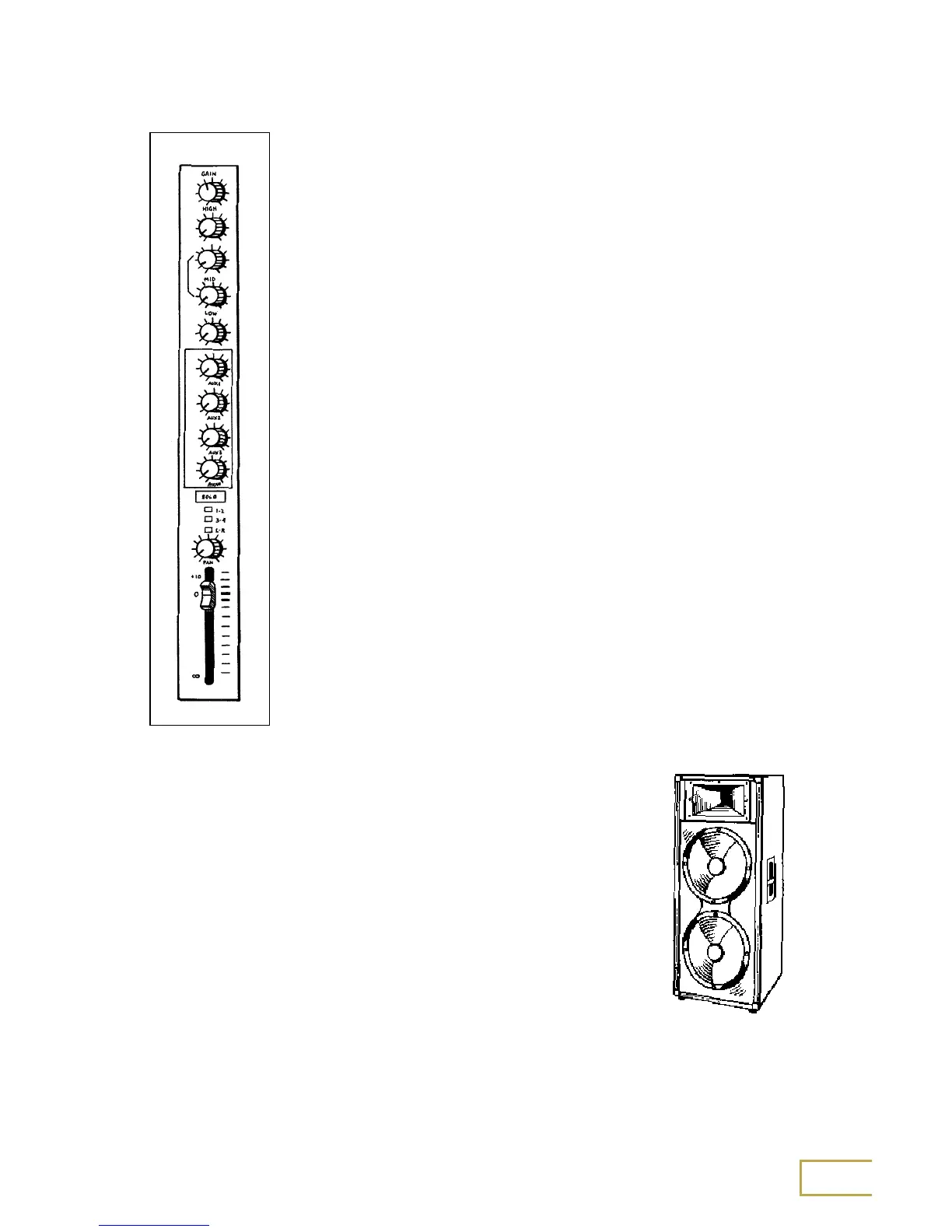
Auxiliary sends are additional outputs
from the mixer that can be used to route
the microphone signal to
other devices without
affecting the main output
of the mixer. Common
applications for auxiliary sends include stage monitors or effects
processors. The bus section is used to assign the microphone sig-
nal to the main outputs of the mixer. The pan control typically serves
two functions, either working with the bus section to choose which
output the signal is routed to, or to adjust the left-to-right balance if
you are using a stereo sound system. At the bottom of the channel
strip is the fader, which gives you precise control of the volume of
each microphone that is assigned to the master outputs of the mixer.
Amplifiers and loudspeakers work together to reproduce the com-
bined microphone signals from the mixer at a much higher level. A
typical power amplifier has two inputs (left and right) and two outputs
to connect to loudspeakers. Note that amplifier outputs are designed
for loudspeakers only! The signal at this point is much too high
to connect to any device besides a loudspeaker. Most amplifiers also
have input sensitivity controls as well.
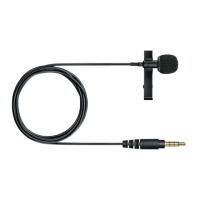
Loudspeakers (see figure 13) come in many shapes and sizes,
choosing the right one depends largely on the individual application.
Some things to consider: the size of the auditorium, portability
requirements, and budget. Most sound
reinforcement loudspeakers are multi-way
devices, which means each speaker cabinet includes two (or
more) individual loudspeakers, each optimized to reproduce a
specific frequency range. Two-way boxes with a woofer for low
frequencies and a horn for highs are the most common variety.
This type of loudspeaker is appropriate for applications involving
voice reproduction and most musical instruments that do not
require a good deal of low-end response. Subwoofers can
complement the two-way boxes for rock bands or music with a
considerable amount of low frequency content. Large touring
sound systems occasionally employ up to a five-way system.
For ease of setup and portability, these devices are occasionally combined into
one unit, either a powered mixer (mixer/amplifier) or powered loudspeaker
(amplifier/loudspeaker).
Music
Guide
Educators
17
Figure 13:
Loudspeaker
Figure 12:
Mixer Input
Channel


 To Next Page