What can I do about feedback?
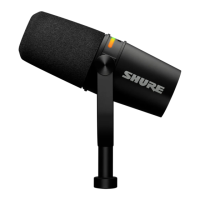
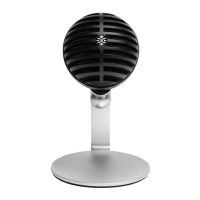
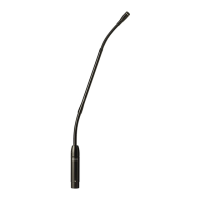
The single easiest way to reduce feedback is to move the microphone closer
to the desired sound source. Additionally, using a directional microphone
(cardioid, supercardioid, etc.) will typically increase the amount of gain
before feedback. Reducing the number of open microphones with an
automatic mixer will also improve the situation. Try to keep microphones and
loudspeakers as far away from each other as possible. Lastly, acoustically treat
the room to eliminate hard, reflective surfaces such as glass, marble, and wood.
When all of the above solutions have been exhausted, the next step is to look
towards equalizers and automatic feedback reducers.
Compressors, as mentioned above, are used to control varying sound levels. When
a singer is performing, certain notes or phrases tend to be louder than
others. Typically, that singer’s volume is set to the maximum possible level
without causing distortion further downstream in the sound system. In a loud
environment, quieter passages will get lost unless someone "rides" the vocal fader
to boost the singer during these quiet passages. The volume then needs to be
reduced to prevent distortion when the singer gets loud again. A compressor allows
the volume to be left at the "boosted" level by reducing the peaks (loud parts) by a
preset amount so they don’t cause distortion. An unfortunate myth that arose from
this practice promotes the idea that the compressor actually makes quiet sounds
louder. Two controls common to most compressors are threshold and ratio.
The threshold determines at what point the compressor function activates, and
ratio controls how much the signal is compressed. A lower threshold causes the
compressor to activate on quieter sounds, while a higher threshold requires louder
sound to activate. Similarly, a lower ratio control reduces the level by a small amount
(e.g. a ratio of 2:1 results in a level half of what it would normally be.) A higher ratio
(such as 10:1) would reduce the signal to a much greater degree.
A specialized form of compressor, called a limiter, uses a very high ratio (often ∞:1)
that prevents any signal from surpassing the level set by the threshold. Limiters are
primarily used as overall system protection at the output of the mixer, while
compressors are typically employed on an individual channel basis.
Finally, special effects processors allow the user to add ambience (reverb) or create
unique sounds (chorus, flange, delay).
20


 To Next Page