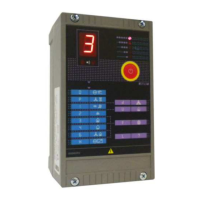
ESA ESTRO - E7014P rev. 02 - 03/05/17
www.esapyronics.com
25
INSTALLATION
For correct installation respect the following instructions:
1 - Avoid placing ESA ESTRO near intense magnetic or
electric fields and in conditions of direct exposure to heat
or combustion products, liquids, solvents or corrosive
gases.
2 - Do not limit in any way the area surrounding the instru-
ment, but guarantee adequate space and ventilation to
avoid overheating the device.
3 - Installation must be done by qualified staff respecting
the regulations in force at the time and place of installa-
tion.
4 - All processing of the container necessary for installa-
tion of the instrument requires a protection degree equal
to or not lower than IP40. For systems used in open air,
the protection degree must be equal to IP54. The protec-
tion degree can also be guaranteed by the application in
which the instrument is put.
5 - If the system has a phase-phase type power, install an
insulation transformer, connecting it to one end of the
secondary winding referred to ground.
6 - During wiring refer to the technical documentation,
respecting polarity between phase and neutral. The termi-
nals for the electrical connections are screw-on type and
can accept wires with sections from 0.5 to 2.5mm² and
the choice of conductors and their location must be suita-
ble for the application.
7 - Adequately tighten the wires into the terminals to pre-
vent malfunction or overheating which can lead to dange-
rous conditions. Numbering and the use of appropriate
terminals on the conductors is recommended.
8 - The connection from the ignition transformer to the
corresponding electrode of the burner, must be performed
with cable HV (High Voltage) unshielded, specific for high
voltage. Use the connector with integral suppression
device for connecting the ignition electrode. The length of
the HV cable must not exceed the size indicated, otherwi-
se the ignition transformer must be placed in the vicinity
of the burner. The HV cable must be installed far from
power cables and metal conduits: ideally it should be left
in the open air. For further information on the connection
of the ignition transformer, refer to ESA E5004 and E5005
data sheets.
9 - The laying out of the flame signal cables must be
separated from power cables and other cables. The use
of multi-core cables is not allowed, nor the use of shiel-
ded cables. The type of cables must ensure the minimum
insulation required between the conductors.
10 - Detection probes and any connectors must be isola-
ted and made inaccessible using proper protection, so as
to allow access only to qualified personnel.; if it is consi-
dered necessary, place warnings near the probes.
11 - Always make sure the protective earth is connected
to the correct terminals and to all metallic frameworks of
related elements as well as to the burner with suitable
conductors The non-connection of the protective earth to
the device, determines irreparable damage as well as a
dangerous condition for the application. If necessary use
the shoulder screw provided in the base of the instru-
ment, for the interconnection of the grounding conduc-
tors.
12 - When using the digital input it is necessary to con-
nect RC filter that is supplied to the terminal as well.
13 - In applications with multiple burners, parallel connec-
tions between the outputs of the instruments are not allo-
wed. If the system is controlled via ECS serial interface,
follow the specific wiring instructions.
14 - The laying out of the ECS communication line must
be separated from power lines, motor control (inverter)
and network voltage; above all neither MULTIPOLAR nor
SHIELDED cables are to be used.
15 - For the ECS communication lines, use the specific
ECS CABLE; alternatively we recommend the use of
busway systems taking into account a maximum length of
the connecting cable between the busway and instrument
of 1 m, both for communication and for the power supply.
16 - The conductors on the inputs of the expansion cards
must be wrapped at least once around the ferrites sup-
plied.
17 - In applications with proportional regulation valves
(e.g. 4-20mA) controlled by the PLC, to carry out the pre-
purge cycle it is possible to directly interface the PLC
input to expansion card outputs, which then command
the valve according to the device requests. The air valve
position or air flow check, must be done directly by the
device.


 To Next Page
 Loading...