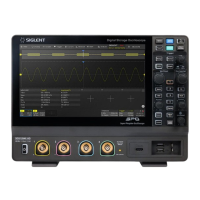
The SDS3000X HD Series Digital Oscilloscope is a versatile instrument designed for displaying, analyzing, and storing electrical signals, making it an essential tool for electronic design, manufacturing, and maintenance. This user manual provides critical safety information, installation instructions, and basic operational tutorials for the instrument.
Function Description
The SDS3000X HD is a multi-functional digital oscilloscope that offers a comprehensive suite of features for signal analysis. It supports various trigger types, serial bus decoding, advanced measurement capabilities, mathematical operations, and power analysis functions. The device is equipped with a capacitive touch screen for intuitive interaction and can also be controlled remotely via a web browser or SCPI commands.
Important Technical Specifications
The SDS3000X HD series includes several models with varying analog bandwidths, all featuring 4 analog channels and a maximum sampling rate of 4 GSa/s per channel.
- SDS3104X HD: 1 GHz Analog Bandwidth, 4 GSa/s @ each channel, 4 Analog Channels.
- SDS3054X HD: 500 MHz Analog Bandwidth, 4 GSa/s @ each channel, 4 Analog Channels.
- SDS3034X HD: 350 MHz Analog Bandwidth, 4 GSa/s @ each channel, 4 Analog Channels.
Power and Grounding Requirements:
- Power Supply: Single-phase, 100 to 240 Vrms (+/-10%) AC power at 50/60 Hz (+/-5%).
- Automatic Voltage Adaptation: No manual voltage selection is required.
- Power Consumption: Up to 120 W, depending on options and accessories.
- Grounding: The instrument grounds through a protective earth conductor. Ensure proper grounding before connecting input/output terminals to avoid electric shock.
Working Environment:
- Operating Temperature: 0 ℃ to +50 ℃.
- Non-operating Temperature: -30 ℃ to +70 ℃.
- Humidity: Operating: 5% ~ 90 %RH at 30 ℃, derating to 50 %RH at 50 ℃; Non-operating: 5% ~ 95% RH.
- Altitude: Operating: ≤3,000 m, 25 ℃; Non-operating: ≤15,000m.
- Installation Category: Category II (local power distribution level).
- Degree of Pollution: Pollution Degree II (dry, non-conductive pollution, occasional temporary conductivity due to condensation).
- IP Rating: IP20 (as defined in IEC 60529).
Usage Features
Front Panel and Touch Screen:
The oscilloscope features a capacitive touch screen for touch, drag, pinch, spread, and selection box gestures. Most front panel controls duplicate touch screen functionality, allowing for quicker operation. Knobs are multi-functional, with a quick push recalling a specific function indicated by silkscreen.
Channel Control:
- Analog Channels (C1-C4): Can be turned on/off, activated/deactivated by pressing their respective buttons. Vertical scale (Volts/div) and DC offset can be adjusted using dedicated knobs.
- Digital Channels (D0-D15): The SDS3000X HD-16LA option enables acquisition and analysis of up to 16 digital signals using the SPL2016 logic probe. Digital channels can be turned on/off, and their threshold levels and display labels can be set.
- Math Functions (F1-F4): Supports arithmetic operations (addition, subtraction, multiplication, division), algebra (differential, integral, square root, absolute, sign, exp, ln, interpolate), and FFT.
- Memory Waveforms (M1-M4): Allows importing and displaying waveforms from analog, zoom, math, or file sources for comparison.
Acquisition and Horizontal Control:
- Timebase: Adjusts the horizontal scale (time/div) and trigger delay.
- Zoom: Enables horizontal and vertical waveform zoom, dividing the display into a main window and a zoom window.
- Acquisition Modes: Normal, Peak Detect, Average, and ERES (Enhanced Resolution) for optimizing signal capture and noise reduction.
- Memory Depth: Supports various memory depths up to 400 Mpts (single channel), 200 Mpts (dual-channel), and 100 Mpts (quad-channel) for long duration captures.
- Roll Mode: Displays waveforms moving from right to left, suitable for timebase settings of 50 ms/div and above.
- Sequence Mode: Fast acquisition mode that divides memory into segments (up to 80,000) to minimize dead time between trigger events, ideal for capturing rare events.
Trigger System:
- Trigger Types: Edge, Slope, Pulse, Video, Window, Interval, Dropout, Runt, Pattern, Serial, Qualified, Nth Edge, Delay, and Setup/Hold.
- Trigger Source: C1-C4 (analog), EXT, EXT/5, AC Line, D0-D15 (digital).
- Trigger Coupling: DC, AC, HFR (High-Frequency Reject), LFR (Low-Frequency Reject).
- Trigger Modes: Auto, Normal, Single, Force.
- Holdoff: Can be set by time or event count to stabilize triggering on complex waveforms.
- Noise Reject: Adds hysteresis to the trigger circuit for better noise immunity.
- Zone Trigger: Allows defining two rectangular zones ("intersect" or "not intersect") to isolate specific events.
Serial Trigger and Decode:
Supports triggering and decoding for I2C, SPI, UART, CAN, LIN, FlexRay, CAN FD, I2S, MIL-STD-1553B, SENT, Manchester, and ARINC429 protocols. Provides signal settings, trigger conditions, and bus display/list views for decoded data.
Measurements:
- Automatic Measurements: Offers a wide range of vertical (Max, Min, Pk-Pk, Top, Base, Amplitude, Mean, Cycle Mean, Stdev, Cycle Stdev, RMS, Cycle RMS, Median, Cycle Median, Overshoot, Preshoot, L@T), horizontal (Period, Freq, Time@max, Time@min, +Width, -Width, +Duty, -Duty, +BWidth, -BWidth, Delay, T@M, Rise Time, Fall Time, 10-90%Rise, 90-10%Fall, CCJ), and miscellaneous (Area, Edges, Pulses, Slope) parameters.
- Statistics: Displays mean, min, max, standard deviation, and count of measurements.
- Histogram: Visualizes the probability distribution of measured values in horizontal or vertical directions.
- Trend/Track: Observes long-term changes or time plots of horizontal parameters.
- Gate Function: Measures parameters within a specified time range of the signal.
- Amplitude Strategy: Configurable strategies (Auto, Histogram, Max/Min) for accurate top and base value calculations.
- Threshold: User-definable measurement thresholds (Percent or Absolute).
- Hardware Frequency Counter: Provides 7-digit frequency measurement accuracy using the trigger signal.
DVM (Digital Voltage Meter):
Measures DC and AC amplitudes, displaying results in Bar, Histogram, and Trend formats. Operates asynchronously to the acquisition system.
Counter:
Measures frequency, period, or counts events, also asynchronously to the acquisition system.
Mask Test:
Allows users to create masks and define pass/fail rules for waveform compliance testing. Failures can trigger an output pulse from the Aux Out port.
Navigate:
Provides tools to navigate through search events, time, and history frames.
Power Analysis (SDS3000HD-PA option required):
Analyzes power quality, current harmonics, inrush current, switching loss, slew rate, modulation, turn on/off, transient response, PSRR, power efficiency, and SOA (Safe Operating Area). Requires differential voltage and current probes, and a deskew fixture for accurate measurements.
Bode Plot:
Provides automatic Bode plot functionality for frequency response analysis of devices-under-test. Supports SIGLENT SAG1021I or SDG series arbitrary function generators. Measures gain and phase at each frequency point.
Generates 6 basic waveforms (Sine, Square, Ramp, Pulse, Noise, DC) and 45 built-in arbitrary waveforms. Output frequency up to 50 MHz, amplitude range -3 V to +3 V, and 42 V isolated voltage.
Save/Recall:
Supports saving and recalling setups, screenshots (BMP, JPG, PNG), and waveform data (Binary, CSV, Matlab) to internal storage, USB devices, or network storage.
Utility Functions:
- System Information: Displays software and hardware versions, serial number, and MAC address.
- System Setting: Language selection, screen saver, beeper, touch screen enable/disable, auto power-on, date/time, and reference position settings.
- I/O Setting: LAN configuration (dynamic/static IP, DNS, VNC port).
- Install Options: Allows installation of software options using license keys or USB.
- Maintenance: Firmware upgrade, self-test (screen, keyboard, LED), and self-calibration.
- Service: LXI compliance, SMB Files share (client/server), and Web Server for remote control.
- Emulation: Changes SCPI command set to be compatible with Tektronix scopes.
- Save Button: Quick save for screenshots and files.
- Quick Action: Customizable button for quick access to preset functions.
Maintenance Features
Cleaning:
Clean only the exterior with a damp, soft cloth. Do not use chemicals or abrasives. Unplug the power cord before cleaning.
Equipment Maintenance and Service:
Do not dismantle the instrument for maintenance due to high voltage components and static-sensitive internal devices. Return to the factory or designated maintenance organization for service. Ensure power is disconnected before any repair.
Self-Calibration:
Recommended if ambient temperature changes by more than 5 ℃. Disconnect all inputs and allow the oscilloscope to warm up for at least 30 minutes before performing self-calibration.
Firmware Upgrade:
Firmware can be upgraded via external USB memory devices. Ensure the U disk contains the correct upgrade file (*.ads). Do not cut off power during the upgrade.
Self-Test:
Includes screen, keyboard, and LED tests to check for electrical or mechanical problems with the user interface.
Abnormal Conditions:
Do not operate if there are visible signs of damage or if the scope has been subjected to severe transport stresses. Disconnect power if protection is suspected to be impaired.
Safety Compliance:
Complies with UL 61010-1:2012/R: 2018-11 and CAN/CSA-C22.2 No. 61010-1:2012/A1:2018-11 for safety requirements of electrical equipment for measurement, control, and laboratory use. Also complies with UL 61010-2-030:2018 and CAN/CSA-C22.2 No. 61010-2-030:2018 for particular requirements for testing and measuring circuits.

 Need help?
 General



 To Next Page