
 Need help?
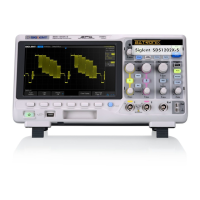
Do you have a question about the SIGLENT SDS1104X-E and is the answer not in the manual?
Ensures proper power line connection and instrument grounding for electrical safety.
Guidelines for correctly connecting signal wires and respecting terminal ratings.
Advice on overvoltage protection and electrostatic discharge prevention measures.
Instructions for adequate ventilation and avoiding exposed components during operation.
Prohibits operation with removed covers, suspected failures, or in hazardous environments.
Guidelines for safe handling, keeping surfaces clean, and avoiding moisture.
Defines WARNING and CAUTION terms as they appear within the manual.
Defines DANGER, WARNING, and CAUTION terms indicated on the product itself.
Explains common safety symbols found on the oscilloscope for hazard identification.
Explains measurement categories II, III, and IV for safe electrical measurements according to IEC standards.
Steps for safely cleaning the oscilloscope and probes using specified materials.
Lists applicable safety standards recognized by US nationally recognized testing laboratories.
Lists applicable safety standards certified by Canadian authorities (CAN/CSA).
Details serial decode, math, cursors, measurements, display, save/recall.
Covers adjusting legs, connecting power, and probe setup for first use.
Details the power requirements and how to connect the oscilloscope to a power source.
Describes the process of powering on the oscilloscope and initial self-tests.
Step-by-step guide on how to properly connect the oscilloscope probe.
Choosing the signal source and setting trigger modes (Auto, Normal, Single).
Setting the trigger voltage level and signal conditioning options.
Choosing from various trigger types like Edge, Slope, Pulse, Video.
Setup for triggering and decoding Inter-Integrated Circuit (I2C) communication signals.
Setup for triggering and decoding Serial Peripheral Interface (SPI) communication signals.
Setup for triggering and decoding Universal Asynchronous Receiver/Transmitter (UART) signals.
Setup for triggering and decoding Controller Area Network (CAN) communication signals.
Setup for triggering and decoding Local Interconnect Network (LIN) communication signals.
Pass/Fail testing, AWG control, and IO communication setup.
Updating firmware, running self-tests for hardware components.
Procedures to reset the oscilloscope to its original factory settings via Save/Recall menu.
Solutions for screen display issues, no waveform, or unstable waveform display.
Diagnosing trigger stability, Run/Stop, and PC connectivity problems.
Troubleshooting steps for USB connection and storage device recognition problems.
 General
| Bandwidth | 100 MHz |
|---|---|
| Channels | 4 |
| Waveform Capture Rate | 100, 000 wfm/s |
| Vertical Resolution | 8 bits |
| Input Impedance | 1 MΩ ± 2% || 16 pF ± 3 pF |
| Input Coupling | DC, AC, GND |
| Operating Temperature | 0 °C to +50 °C |
| Weight | 2.6 kg |
| Display | 7-inch TFT-LCD (800x480) |
| Interfaces | USB Host, USB Device, LAN, Pass/Fail |
| Max Input Voltage | 400 Vpk (DC + AC Peak) |
| Trigger Types | Edge, Pulse, Slope, Video |
| Memory Depth | 14 Mpts |


 To Next Page
