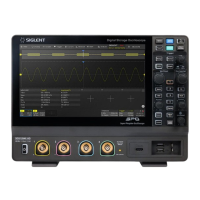
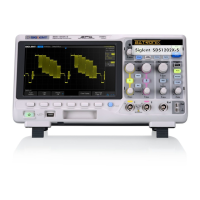
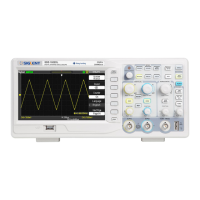
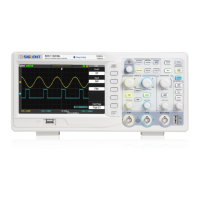
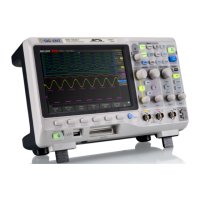
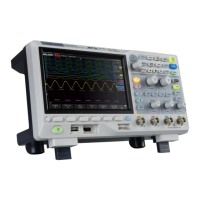
The SIGLENT SDS1000X-E and SDS1000X-U Series Super Phosphor Oscilloscopes are advanced digital storage oscilloscopes designed for a wide range of measurement and analysis tasks. These instruments are equipped with a variety of features to ensure accurate and stable waveform display, making them suitable for both educational and professional environments.
Function Description
The SDS1000X-E and SDS1000X-U series oscilloscopes are primarily used for visualizing and analyzing electrical signals. They capture and display waveforms, allowing users to measure various parameters such as voltage, frequency, and time intervals. The "Super Phosphor" technology enhances the display, providing a clear and detailed view of complex signals, including transient events and signal variations.
Key functions include:
- Waveform Display and Analysis: The large LCD display provides a clear interface for viewing waveforms. Users can adjust vertical and horizontal scales, position waveforms, and utilize features like zoom for detailed inspection.
- Triggering: The oscilloscopes offer a comprehensive set of trigger types to capture specific events within a signal. These include Edge, Slope, Pulse, Video, Window, Interval, DropOut, Runt, Pattern, and Serial Bus (IIC/SPI/UART/RS232/CAN/LIN) triggers. This versatility ensures that even complex or infrequent events can be reliably captured and analyzed.
- Measurement: The instruments support various automatic measurements, including peak-to-peak voltage, mean, minimum, maximum, standard deviation, and count. Users can select multiple parameters to be displayed simultaneously, providing a quick overview of signal characteristics.
- Acquisition Modes: Multiple acquisition modes are available, such as Normal, Peak-Detect, Average, and Eres, allowing users to optimize signal capture based on their specific needs. Interpolation modes (Sinx/X or linear) further refine waveform representation.
- Math Functions: Built-in math operations like addition, subtraction, multiplication, division, FFT, integral, differential, and square root enable advanced signal processing directly on the instrument.
- Reference Waveforms: Users can save and recall reference waveforms to compare current signals against known good or bad signals, aiding in troubleshooting and analysis.
- Digital Channels (SDS1000X-E 4-channel scope): The 4-channel SDS1000X-E models support 16 digital channels, expanding their capabilities to mixed-signal analysis.
- Decode Function: An optional decode function supports two serial buses for analog signal decoding, including IIC, SPI, UART/RS232, CAN, and LIN protocols, which is crucial for embedded system debugging.
- History Mode: The history mode allows recording up to 80,000 frame waves, enabling users to review past events and analyze signal behavior over time.
- Connectivity: USB Host and Device ports, along with a LAN interface, provide options for data transfer, remote control, and connecting external storage devices.
- Pass/Fail or Trigger Out: A BNC port can output a signal reflecting the current waveform capture rate or a pass/fail test pulse, useful for automated testing.
Usage Features
The oscilloscopes are designed for ease of use with a combination of dedicated buttons, a universal knob, and a clear menu-driven interface.
- Front Panel Controls:
- LCD Display: The primary interface for waveform visualization and menu navigation.
- Universal Knob: A versatile control for selecting menu items, adjusting parameters, and inputting filenames. Its illuminated ring indicates when it's active for menu selection.
- Common Function Menus: Dedicated buttons for frequently used functions like Cursors, Acquire, Measure, Display/Persist, Utility, Decode, Save/Recall, Clear Sweeps, History, and Navigate.
- Run/Stop Button: Toggles between continuous waveform acquisition ("RUN," glowing yellow) and pausing the display ("STOP," glowing red).
- Auto Setup Button: Automatically adjusts horizontal time base, vertical scale, and trigger mode for a stable display of the input signal.
- Vertical Control: Dedicated buttons and knobs for each analog channel (CH1, CH2, CH3, CH4 on 4-channel models) to adjust vertical scale (V/div) and position. Math, Ref, and Digital functions are also accessible here.
- Horizontal Control: Knobs for adjusting the horizontal time base (s/div) and position (delay). A "Roll" mode is available for slow-moving signals.
- Trigger Control: Buttons and a knob for setting trigger type, source, slope, holdoff, coupling, noise reject, and level. "Auto," "Normal," and "Single" trigger modes are available.
- Probe Compensation/Ground Terminal: A dedicated terminal for compensating probes and providing a ground reference.
- USB Host: A front-panel USB port for connecting USB flash drives.
- Power Button: Turns the instrument on and off.
- Adjusting Waveform Intensity/Graticule/Transparency: The "Display/Persist" button, in conjunction with the universal knob, allows users to fine-tune the intensity of the waveform, the graticule, and the overall display transparency.
- Probe Compensation: Before first use, probes should be compensated to ensure accurate measurements. This involves connecting the probe to the compensation signal output and adjusting the probe's low-frequency compensation until a correct square waveform is displayed.
- Supporting Legs: Adjustable supporting legs allow tilting the oscilloscope for better viewing angles and stable placement.
- Security Lock Hole: A security lock hole on the rear panel allows users to physically secure the instrument to a fixed location, preventing theft.
Maintenance Features
Proper maintenance ensures the longevity and reliable operation of the oscilloscope.
- General Care and Cleaning:
- Avoid direct sunlight for extended periods.
- Do not expose the instrument or probes to fog, liquid, or solvents.
- Regularly clean the instrument and probes. Disconnect from power sources before cleaning.
- Use a soft, wet cloth to clean the instrument. For loose dust, use a soft dry cloth.
- Be careful when cleaning the LCD to avoid scratching it.
- Do not use corrosive liquids or chemical cleansers.
- Ensure the instrument is completely dry before restarting to prevent short circuits.
- Power Cord and Fuse:
- Only use the power cord designed for the instrument and authorized by local regulations.
- The instrument is grounded through the protective earth conductor of the power cord; ensure it's correctly grounded before connecting inputs/outputs.
- If the fuse requires replacement, use only a fuse with the same rating as the original. Contact SIGLENT directly if unsure.
- Ventilation:
- Ensure adequate ventilation to prevent overheating, which can damage the instrument.
- Regularly inspect the intake and fan for obstructions.
- Safety Precautions:
- Always read the safety precautions to avoid personal injury or damage.
- Do not touch exposed contacts or components when the power is on.
- Do not operate the instrument with covers or panels removed.
- Avoid overvoltage situations (e.g., thunderstorms) that could lead to electrical shock.
- Operate in an electrostatic discharge protective area to prevent damage from static discharge.
- Ensure signal wire grounds are at earth potential and do not connect to high voltage.
- Inspect all terminals' ratings before connecting.
- When using probes, ensure the insulated wire is in good condition and avoid touching metallic parts when connected to high voltage.
- Troubleshooting: The manual provides a troubleshooting guide for common issues such as a dark screen, no waveform display, inaccurate voltage amplitude, unstable waveform display, waveform displaying like a ladder, and USB storage not being recognized. Solutions range from checking connections and settings to contacting SIGLENT for service.

 Need help?
 General

 To Next Page