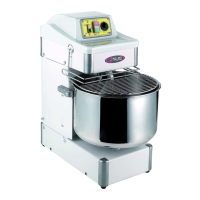
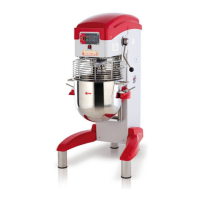
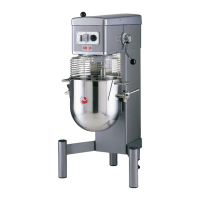
The provided manual describes the SL-50 and SL-60 Silver and Greenline Mixer Machines, which are spiral mixers designed for professional use in bakeries, catering, pastry, and pizza establishments.
Function Description:
These mixers are engineered to amalgamate food mixtures, primarily those using water and flour as their main ingredients. The spiral mechanism rotates within a rotary bowl, performing mixing, amalgamating, refining, and oxygenating actions to quickly and efficiently prepare dough. They are suitable for all types of leavened mixtures and baked products, using ingredients such as various flours, water, yeast, butter, sugar, aromas, colorings, salt, and liqueurs. The high-power motor, robust transmission system, and steel framework ensure durability and reliability. The machine operates on either a manual or timed cycle, with the spiral and bowl rotating together to mix ingredients. To remove the mixture, the mixer must be turned off via the master switch, the grid lifted, and the dough removed by hand using a plastic, aluminum, or wooden spatula to avoid scratching the bowl.
Important Technical Specifications:
- Models: Silver 50, Silver 60
- Power: 1.5-2.2 Kw (380V/50/3 - 2V)
- Bowl Capacity: 55 litres
- Dimensions (Silver 50): 875mm (A) x 550mm (B) x 1185mm (C) x 545mm (D)
- Dimensions (Silver 60): 925mm (A) x 550mm (B) x 1185mm (C) x 595mm (D)
- Weight (Silver 50/60): 200 Kg (machine only)
- Packaged Weight (Silver 50/60):
- Cellophane + pallet: 215 Kg (1000x650x1350 cm)
- Cardboard + pallet: 225 Kg (1000x650x1400 cm)
- Wooden cage or crate: 230-240 Kg (1000x650x1500 cm)
- Noise Emissions: 70 dbA (for normal use)
- Operating Temperature: 5 to 40°C
- Humidity: No greater than 90%
- Electrical Connection: Must comply with local standards; voltage and frequency must match the identification plate.
- Earthing System: Essential for operation.
- Maximum Pasta Capacity (Silver 50): 45 kg
- Flour Capacity (Silver 50): 19-20 kg
- Water Percentage (Silver 50): 55-60%
- Water Litres (Silver 50): 25-26 litres
- Bolt Tightening Torques:
- Mixer screws (8.8): M6 (9.7 Nm), M8 (23 Nm), M10 (47 Nm), M12 (80 Nm), M14 (130 Nm), M16 (196 Nm)
- Stop rod screws (10.9): M6 (13.6 Nn), M8 (33 Nn), M10 (6 Nn), M12 (113 Nn), M14 (180 Nn), M16 (275 Nn)
Usage Features:
- Installation: The mixer must be installed vertically on a smooth, sturdy, and level surface. If there's a risk of tipping, it should be anchored to the floor using four M8 or M10 bolts with 200 kg resistance.
- Controls:
- Master Switch: Located on the right side, it controls power to the mixer.
- Front Panels: Available in different versions.
- Manual Timer Panel: Features a manual timer, a selector for bowl rotation inversion, and a timer exclusion switch for failures. Includes start and stop buttons.
- Digital Timer Panels (Silverline Automatic / Greenline): Include a selector for bowl rotation inversion, timer exclusion switch, and an electromechanical emergency button. Digital timers are adjusted using "select," "+," and "-" keys for first and second speeds.
- Safety Grid: The mixer will only operate when the grid is down. Lifting the grid activates a micro switch, stopping the machine immediately (like an emergency stop). The start button must be pressed to restart.
- Bowl Rotation: The bowl should rotate clockwise (as indicated by an arrow). Incorrect rotation requires contacting a qualified electrician.
- Processing Rules:
- Pour the required amount of water into the bowl first.
- Add the correct amount of flour gradually to achieve the right consistency. Adding water to flour can create lumps and damage the mix.
- Other ingredients (salt, yeast, oil, etc.) are added as desired.
- Load Limits: The mixer's use limit is determined by the percentage of water, not just the volume of pasta. Using flours rich in gluten or mixes with low water percentages requires reducing the maximum mix capacity.
- Safety Devices:
- Master Switch: Cuts power for safe maintenance.
- Circuit Breaker Switch: Cuts power if the electric motor overheats.
- Fixed Guards: Casings and guards fixed with screws or mechanical locks can only be removed by specialized personnel for maintenance and must be re-mounted immediately.
- Mobile Guards: The grid's movement activates a micro switch, preventing operation when open.
Maintenance Features:
- General Maintenance: The mixer does not require extensive maintenance. Bearings and transmission parts are lubricated for life.
- Cleaning:
- The mixer is not jet-proof; do not wash with running water.
- Clean with a moist cloth and neutral detergents (e.g., Marseille soap).
- Thorough cleaning after each use is essential to prevent flour from depositing in moving parts, which can cause creaking and wear.
- Periodical Checks:
- Daily: Clean outside surfaces of the bowl and tools. Check operative and emergency controls.
- Monthly: Thorough cleaning of the mixer. Check operative and emergency controls. Inspect external components (tools, bowl, protective grid). Check transmission noise.
- Annually: Thorough cleaning and check of entire machinery. Thorough check of transmission organs. Check bolt tightening for entire machinery.
- Belt Tensioning:
- Upper Motor Belts (Spiral Primary Transmission): Loosen plate "A" bolts, adjust tension, then refasten.
- Secondary Transmission Chains (Spiral): Loosen intermediate pulley support plate bolts, adjust tension using register "B", then refasten. This affects primary transmission tension, requiring re-registration.
- Lower Motor Belts (Bowl Primary Transmission): Loosen intermediate pulley plate bolts, adjust tension using register "C", then refasten. This affects chain tension, requiring re-registration.
- Belt (Bowl Secondary Transmission): Loosen plate "D" bolts, adjust tension, then refasten.
- All tensioning operations must be carried out by a specialized mechanic.
- Electrical System Control: Periodical checks of automation functioning and earthing, operating modes, safety functions, terminal board contacts, cable integrity, luminous LEDs, and earthing system must be performed by a specialized electrician.
- Troubleshooting (Blockage of Machinery):
- No Warning Light/Mixer Not Starting: Check if the plug is inserted correctly or if wires are detached. Check the protection grid is open (rotate and reposition it) or if safety micro switches are anomalous (replace them).
- Continuous Noise: Check the efficiency of bearings (replace if necessary).
- Tool Not Revolving: Check for loose or worn belts (tighten or replace them).
- Extraordinary Maintenance: For interventions not mentioned in the manual (e.g., motor replacement, circuit board replacement, or if the mixer falls), contact SIGMA SrL authorized personnel or assistance service.
- Spare Parts: When requesting spare parts, always specify the mixer type, serial number, year of construction, position, description, item code, and desired amount.
- Dismantling and Waste Disposal: The purchaser is responsible for proper disposal according to local standards. Mechanical and electrical parts must be dismantled by competent personnel. Materials (steel, cast iron, brass, plastic) should be separated for recycling. The electrical system must be disposed of by a specialized company. Packaging complies with Directive 94/62/EC and can be assimilated with city waste.

 Need help?

 To Next Page
 General