SIGMA TANDEM SYSTEM OWNER’S MANUAL
Page 22:X
Section 2: Equipment • Chapter 3 - Packing the Reserve w/ Skyhook 11301 - 00.00.0000
A standard RSL does one thing. It pulls the reserve ripcord pin automatically after a breakaway.
The Skyhook RSL does this, and then goes two steps further.
A. It automatically releases the Left (non-RSL) riser, if the right (RSL) riser releases prematurely for any reason (Collins’
Lanyard). (You wouldn’t want your reserve container opened with one riser still attached, would you?)
B. It then uses your departing main canopy as a super “pilot chute” to get your reserve to line stretch faster than ever
before. Breakaway, to canopy-out-of-bag times are between ½ and ¾ of a second, depending on the size of your
reserve canopy. This is up to three times faster than a pilot chute can do it alone.
If you have a main total malfunction, or your AAD fires, the Skyhook Lanyard automatically releases, and therefore
does nothing to hinder normal reserve deployment.
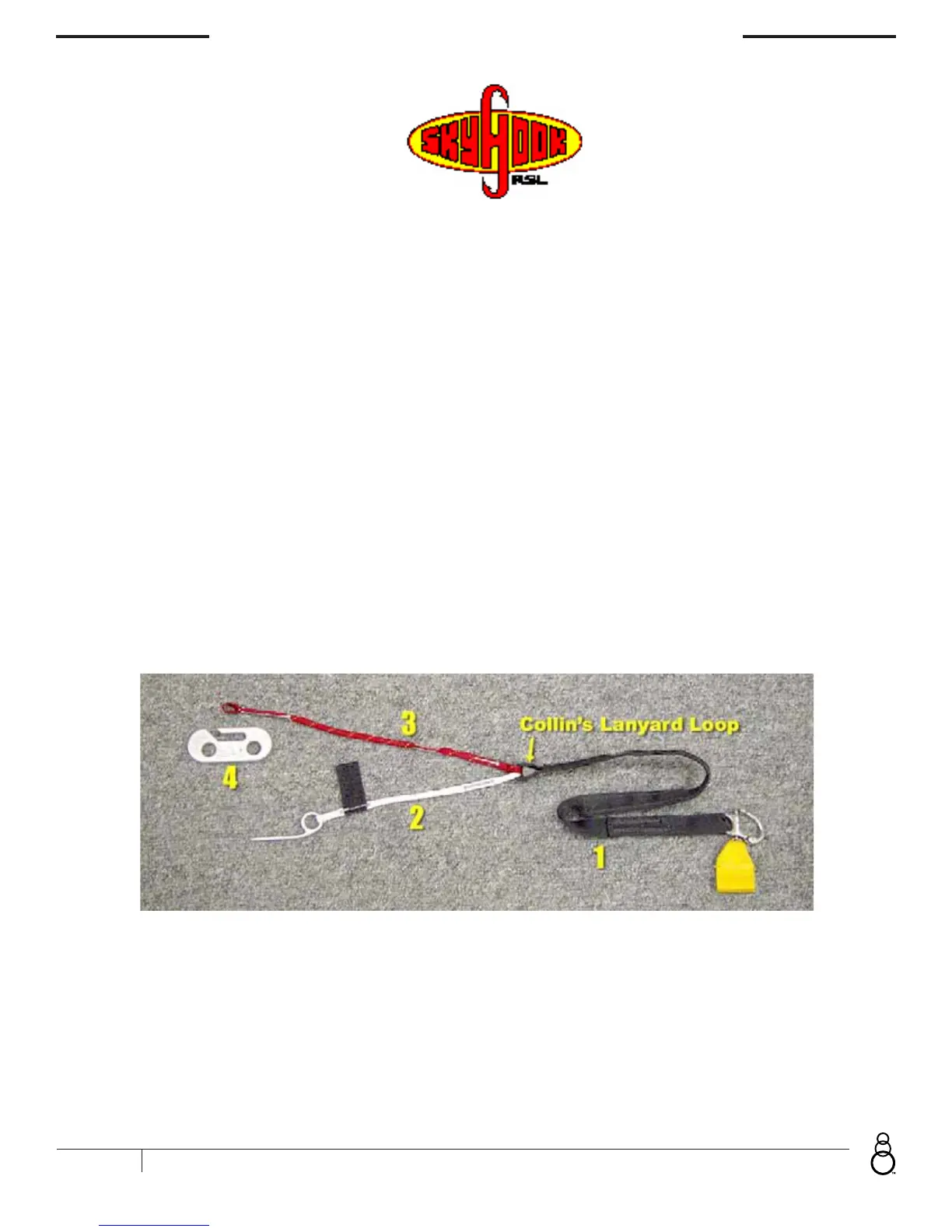
The Skyhook RSL System has four parts:
1. The RSL Lanyard (5/8 or 1”, black webbing) with a snap shackle that connects to your right main riser at one end,
and the Collins’ Lanyard loop at the other.
2. The White Ripcord Lanyard, with one end sewn to the RSL loop, and the reserve ripcord pin at the other.
3. The Red Skyhook Lanyard, also sewn to the RSL loop, with the Skyhook attachment loop at its free end.
4. The Skyhook itself, which is sewn to the reserve pilot chute bridle.
(Because the RSL Lanyard, Collins’ Lanyard, and Skyhook Lanyard are all part of one integrated system, pulling the
yellow tab on the RSL snap shackle inactivates all three.)
SKYHOOK PACKING INSTRUCTIONS


 To Next Page