23
2.1 BOILER ROOM
The boiler room should feature all the
characteristics required by standards
governing liquid fuel heating systems.
2.2
BOILER ROOM DIMENSIONS
Position the boiler body on the founda-
tion bed, which should be at least 10
cm high. The body should rest on a
surface allowing shifting, possibly by
means of sheet metal.
Leave a clearance between the boiler
and the wall of at least 0.60 m, and
between the top of the casing and the
ceiling of 1 m (0.50 m in the case of
boilers with incorporated D.H.W. tank).
The ceiling height of the boiler room
should be less than 2.5 m.
2.3 CONNECTING UP SYSTEM
When connecting up the water supply
to the boiler, make sure that the speci-
fications given in fig. 1 are observed.
All connecting unions should be easy
to disconnect by means of tightening
rings.
A closed expansion tank system
must be used.
2.3.1 Filling the water system
Before connecting the boiler, thorou-
ghly flush the system to eliminate
scale which could damage the
appliance.
Filling must be done slowly so as to allow
any air bubbles to be bled off through the
air valves. In closed-circuit heating
systems, the cold water filling pressure
and the pre-charging pressure of the
expansion vessel should be no less than
or equal to the height of the water head
of the installation (e.g. for water head of
5 metres, the vessel pre-charging pres-
sure and installation filling pressure
should be at least 0.5 bar).
2.3.2
Water system characteristics
THE WATER USED FOR THE CENTRAL
HEATING SYSTEM SHOULD BE TREA-
TED IN THE FOLLOWING CASES:
– for extensive systems (with high
contents of water);
– frequent addition of water into the
system;
– should it be necessary to empty the
system either partially or totally.
2.4 CONNECTING UP FLUE
The flue is of fundamental importance
for the proper operation of the boiler;
if not installed in compliance with the
standards, starting the boiler will be
difficult and there will be a consequent
formation of soot, condensate and
encrustation.
The flue used to expel combustion pro-
ducts into the atmosphere must meet
the following requirements:
–
be constructed with waterproof
materials, and resistant to smoke
temperature and condensate;
– be of adequate mechanical resilien-
ce and of low heat conductivity;
– be perfectly sealed to prevent coo-
ling of the flue itself;
– be as vertical as possible; the termi-
nal section of the flue must be fitted
1.6.4 Burner assembly
The boiler is supplied to be assembled
on the burner.
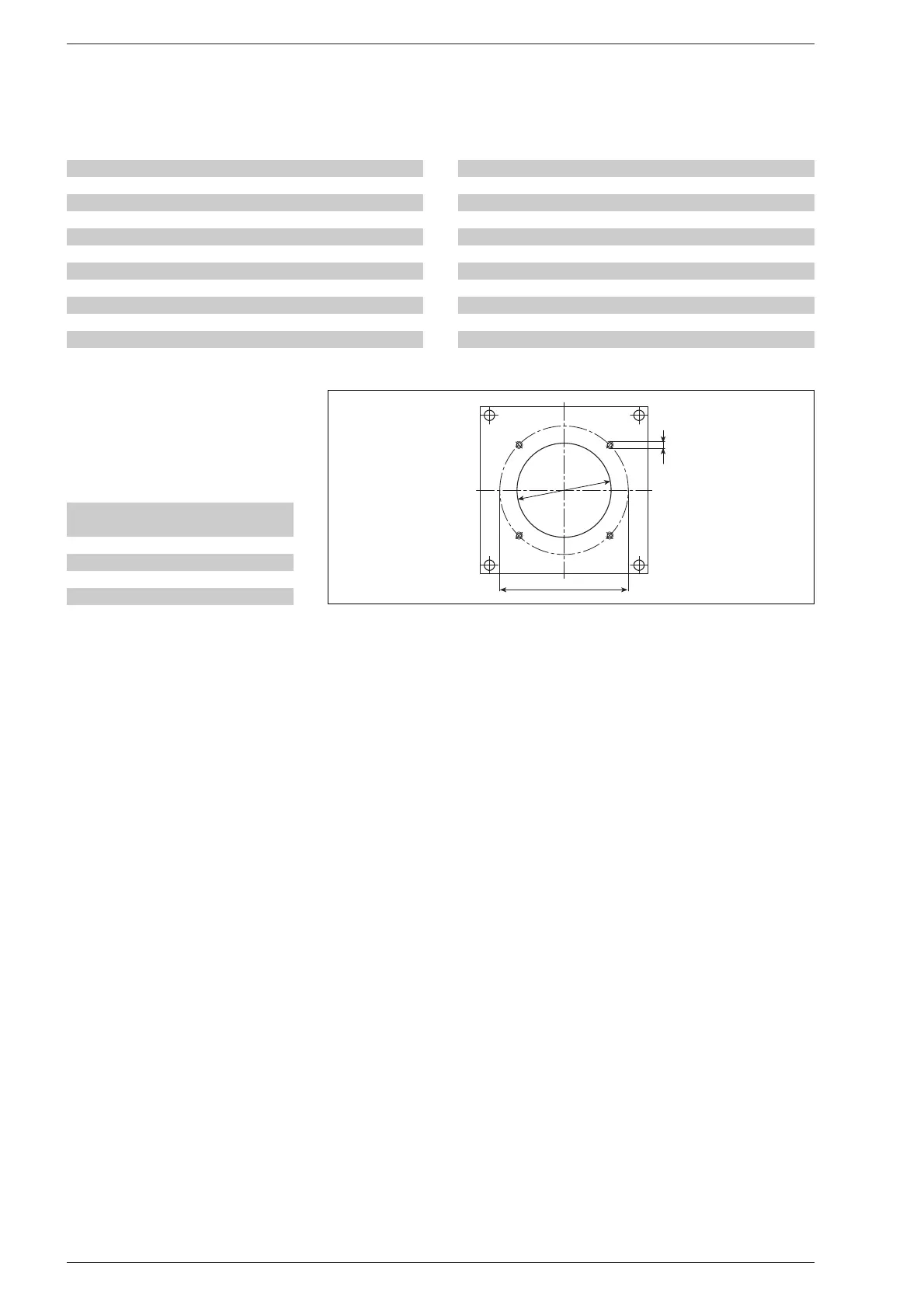
The connection flange dimensions are
indicated in fig. 4.
2 INSTALLATION
A B C
mm mm ø
1R 4÷6 110 150 M8
1R 7÷9 130 170 M8
2R 6-7 130 170 M8
2R 8÷15 160 190 M10
1.6.3 F.B.R. burners
Boiler Model Atomising angle
1R4 G1 2001 60°
1R5 G1 2001 60°
1R6 G2 2001 60°
1R7 G2 2001 60°
1R8 G2 2001 60°
1R9 G2 MAXI 60°
Boiler Model Atomising angle
2R6 G2 MAXI 60°
2R7 FG 14 TC 60°
2R8 FG 14 TC 60°
2R9 G 20 TC 60°
2R10 G 20 TC 60°
2R11 G 20 TC 60°
2R12 G 20 TC 60°
2R13 G 20 TC 60°
2R14 G 30/2 TC 60° - 45°
2R15 G 30/2 TC 60° - 45°


 To Next Page