EasyManua.ls Logo

Simplex STS - User Manual

Simplex STS
28 pages
Print Icon
To Next Page IconTo Next Page
Loading...
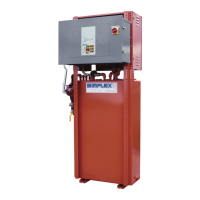
STS DAY TANK
PACKAGED DAY TANK SYSTEMS
Question and Answer IconNeed help?

Do you have a question about the Simplex STS and is the answer not in the manual?

Summary

1 WARNINGS AND CAUTIONS

Safety Information Symbols

Explains symbols indicating safety information.

Cautions

Details critical safety warnings, including electrical hazards and proper handling.

2 NAMEPLATES AND PLACARDS

3 INSTALLATION

Overview of Use

Discusses Day Tank placement and installation guidelines.

Installation Operation

Details steps for installing the Day Tank, including vent and overflow pipes.

Vent Openings

Explains the mandatory vent pipe installation and its purpose.

Day Tank Intake Line and Engine Supply

Covers connecting intake, engine supply, and return lines using black pipe.

Day Tank Pump Priming Procedure

Details the process of priming the Day Tank pump using oil or fuel.

4 DAY TANK OPERATION

Control Panel Overview

Describes the Day Tank control panel, including its membrane, pushbuttons, and status indicators.

Day Tank Control Circuitry

Explains the components of the control circuitry, including contactors and fuses.

Automatic Operation

Details how the system operates automatically based on fuel levels and sensor inputs.

High Level Fill Disabled

Explains the condition and indication of a high fuel level alarm.

Fill Test Pushbutton

Describes the function and operation of the fill test pushbutton.

Low Level Fill Alarm

Describes the low fuel level alarm indication and its triggers.

Manual Operation

Explains how to operate the Day Tank system manually.

Lamp Test

Describes how to test the LED lamps on the control board.

Automatic Duplex Pump Controller, Option 345

Details the features and operation of duplex pump systems.

Overflow - Return Tank, Option 383

Explains the function of the overflow-return tank and its pump.

Overflow - Return Pump and Controller Added to the Day Tank, Option 390

Describes the overflow-return pump system and its controller.

5 MAINTENANCE

Each Year

Outlines the annual maintenance tasks for the Day Tank.

6 TROUBLESHOOTING

No Fuel Delivered

Lists causes and solutions for no fuel delivery.

Insufficient Fuel Delivered

Lists causes and solutions for insufficient fuel delivery.

Rapid Pump Wear

Lists causes and solutions for rapid pump wear.

Pump Delivers for Short Period and Quits

Lists causes and solutions for intermittent pump operation.

Pump Requires too Much Power

Lists causes and solutions for excessive pump power consumption.

Noisy Operation

Lists causes and solutions for noisy pump operation.

Pump Requires Frequent Re-Priming

Lists causes and solutions for frequent pump re-priming.

Motor Does Not Turn or Turns Intermittently

Lists causes and solutions for motor starting issues.

Pump Leaks Fuel

Lists causes and solutions for fuel leaks from the pump.

7 DRAWINGS AND PARTS LIST

Abbreviation Index

Provides a list of abbreviations used in the manual.

TECHNICAL DATA

Conversion Factors

Provides conversion factors for pressure, flow, and other units.

Hydraulic Formulas

Lists relevant hydraulic formulas for system calculations.

APPENDIX A - PRODUCT WARRANTY

Overview

This document describes the Simplex STS Day Tank, a packaged day tank system designed for fuel oil applications. It provides comprehensive information on its installation, operation, maintenance, and troubleshooting.

Function Description:

The Simplex STS Day Tank is an industrial electrical control, test, and accessory equipment primarily used in fuel supply systems. Its core function is to store and supply fuel oil to prime movers (e.g., engines, generators) while maintaining a controlled fuel level. The system is designed for automatic operation, refilling the day tank as fuel is consumed. It incorporates various safety and control features to ensure reliable and safe operation, including high and low fuel level alarms, overflow protection, and pump control. The day tank acts as an intermediate fuel storage unit, drawing fuel from a main storage tank and delivering it to the engine.

Important Technical Specifications:

  • Fuel Compatibility: Designed for use with fuel oil classified as Class II or Class III combustible liquids, having a flash point at or above 100°F (38°C). It explicitly warns against using liquids with a flash point less than 100°F.
  • Electrical Supply: Control power typically requires 115 VAC, 1-PH, 60 Hz, 15A circuit breaker protected.
  • Pump Lift: Maximum pump lift of 20 feet.
  • Fluid Viscosity: Suitable for fluid viscosities between 32-100 SSU.
  • Short Circuit Current Rating: 5 KA RMS Symmetrical, 600V Max.
  • Enclosure Type: Not specified in detail, but implies an industrial-grade enclosure.
  • Control Fuses: 2A, 250VAC, ABC type.
  • Motor Starting Contactor: Double pole, 24VDC coil, rated at 20A.
  • Fuel Level Sensors: Utilizes four fuel level sensors (FS1-FS4) to monitor tank capacity at various points (25%, 50%, 90%, 95%).
  • Alarm Contacts: Dry contacts for Low Fuel Level, High Fuel Level, and Leak Alarm relays are rated at 5A@30VDC and 5A@125VAC.
  • Vent Pipe Sizing: The vent opening capacity is critical for safety, with minimum nominal pipe sizes ranging from 2 inches for 20 sq ft wetted surface to 10 inches for 1000 sq ft and over.
  • Overflow Pipe Sizing: Must be at least twice the diameter of the pump fill pipe (minimum 1" I.D. for 10 and 25 gallons; minimum 2" I.D. for 50-500 gallons).
  • Tank Pressure Withstand: Designed to withstand pressures up to 25 PSI (for 10 and 25 gallon tanks) and 15 PSI (for 50-400 gallon tanks). Operation without a vent pipe is strictly not recommended due to potential for distortion or rupture.

Usage Features:

  • Automatic Operation: The system automatically refills the day tank between 50% and 90% capacity as fuel is consumed. The control panel includes a three-position Auto-Off-Manual switch.
  • Manual Operation: Allows continuous pump/motor operation independent of fuel level sensors, useful for initial priming or specific operational needs.
  • Fill Test Pushbutton: A momentary switch to quickly verify pump/motor/fuel level sensor operation in Auto mode. Holding it down allows the pump to run past the normal stop level up to 95% capacity for testing purposes.
  • Status Indicators (LEDs): The control panel features LEDs for "Power Available," "Tank Filling," "Tank Leak," "Not In Auto" (blinking), "High Level Alarm," "Tank Full," "Normal Operating Range," "Fill Start," and "Low Level Alarm," providing clear operational status at a glance.
  • High Level Fill Disabled: When the fuel level reaches or exceeds 95% capacity, a "High Level Alarm" is triggered, the pump/motor is de-energized and locked out until the fuel level drops to 90% or less. This prevents overfilling.
  • Low Level Fill Alarm: Initiated when the day tank capacity reaches 25%, energizing the low fuel alarm relay and illuminating the "Low Level Alarm" LED.
  • Duplex Pump Controller (Option 345): Enhances reliability by adding a second, backup pump and level control. It supports automatic lead pump alternation with lag pump backup, or simultaneous twin pump operation.
  • Overflow - Return Tank (Option 383): Manages overfill situations by pumping excess fuel from the day tank to an overflow-return tank, preventing spillage and maintaining safe operating levels.
  • Overflow - Return Pump and Controller (Option 390): An advanced overflow management system that activates an overflow-return pump when an overfill alarm is triggered, pumping fuel down to a 70% level.

Maintenance Features:

  • Annual Maintenance:
    • Drain water and sediment from the tank. If normal engine/generator testing doesn't consume a full tank of fuel, drain and refill with fresh fuel.
    • Remove the inspection port to examine the interior components. Test sending unit operation with the tank drained. Replace the inspection port gasket.
    • Press the Test Fill pushbutton to observe pump and motor performance.
    • Inspect pump/motor alignment and wear, and check for pump leaks.
    • Re-tighten hose clamps, pump bracket, motor bracket, and pump/motor coupler hardware.
    • Inspect all plumbing connections for leaks. Test all options and fuel level alarms.
    • Re-tighten all electrical connections.
  • Maintenance After First Three Years: Re-oil the Day Tank motor with 10 drops of 5W30 or 10W oil. Avoid over-oiling.
  • Pre-lubrication: The pump is pre-lubricated with heavy oil (SAE 30) prior to shipment.
  • Priming Procedure: Manual priming is required for initial start-up. This involves filling the inlet line with fuel oil or lube oil and observing fuel flow through a clear flex hose. The pump motor should not be run dry during priming.
  • Design for Reliability: Components are chosen for long, reliable life, and the day tank is constantly lubricated by the diesel fuel it transfers.
  • Inspection for Damage: Annual inspection for damage, leakage, or rust on both inside and outside of the tank is recommended, with prompt repair or replacement of significantly damaged parts.

Simplex STS Specifications

General IconGeneral
BrandSimplex
ModelSTS
CategoryIndustrial Equipment
LanguageEnglish

Related product manuals