5
1. INTRODUCTION
1.1 General Description
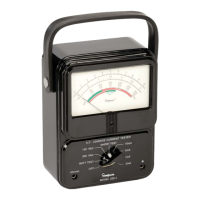
The Simpson Model 228 is a special purpose AC/DC milliammeter that mea-
sures potentially hazardous leakage current on electrical and electronic equip-
ment. This Instrument meets the guidelines published in IEC 990, “Methods of
Measurement of Touch Current and Protective Conductor Current.” Most stan-
dards agencies in the United States — including ANSI, ISA and UL are in the
process of implementing the networks from IEC 990 into their specifications.
NOTE: For specification information call:
ANSI at (212) 642-4900 or
UL in Northbrook, IL at (847) 272-8800.
The Model 228 tests equipment operating at 120-220 volts AC or DC power line
circuits only. Instrument features include:
• Separate leakage current networks for measuring the following electrical
shock response levels:
Perception/reaction (shock hazard)
Let-go (shock hazard)
Burn hazard
• 0-300 volt scale for measuring open circuit voltage between accessible parts
and ground.
• An RMS reading meter with scales that read shock hazard up to 10 Measure-
ment Indication Units (MIU), burn hazard up to 100 mA and peak indicating
RMS shock hazard. (Refer to Section 7, Measurement Procedures) for more
information.
• Output connections for an external peak reading Instrument (required for
measuring peak readings on non-sinusoidal waveforms).
• Convenient battery test function.
The 228 is battery operated. In some applications, the lead attached to the “Ground”
input may not be attached to earth ground. As a result, the output jacks may be
“floating.” To prevent a shock hazard, do not connect any connectors or equip-
ment with accessible conductive surfaces.
1.2 What Is Leakage Current?
“Leakage Current” is a generic term applied to many forms of unwanted currents.
“Leakage Current” (or more accurately, “Touch Current”) as it relates to electrical
shock hazards, is the current that flows to ground through the human body due to
inadequate insulation or improper grounding between internal supplies and ac-
cessible conductive parts.
!



 To Next Page