7
WARNING: These response networks are for non-medical applications and do
not include patient contact cases. This Instrument is not intended for use in medi-
cal applications.
1.4 Shock Hazard
The level at which leakage current will cause a shock varies greatly between
people. As a result the IEC, UL, and other safety agencies set limits where most
people will not feel a shock or will not react to any leakage current present. The
most commonly used leakage current limit is 0.5 MIU RMS (0.7 MIU peak) using
the reaction response network. This level is safe for most conditions and for most
people, but there are cases where 0.5 MIU may pose a hazard. In those cases
tighter limits are required. The safety agencies also acknowledge that some con-
ditions exist where higher currents can be permitted without an increased risk of
injury.
When making routine leakage current measurements as part of equipment main-
tenance, refer to the equipment manufacturer for the acceptable leakage current
level. When using the 228 for testing safety of new designs, check with the appro-
priate safety agency for the correct leakage current limits.
1.5 Burn Hazard
Another potential leakage current hazard is electrical burns. Electrical burns can
occur at current frequencies as low as 30KHz or lower. The potential of electrical
burns is constant regardless of frequency and is measured in mA RMS. A limit of
70 mA is almost universally accepted as being a safe limit to prevent leakage
current-related electrical burns.
1.6 Inspection of Instrument
Immediately upon receipt, inspect the Instrument for damage. Verify that your
Instrument includes all of its components and accessories. If you find the unit to
be damaged, notify the carrier and supplier immediately. Do not use a damaged
Instrument.
1.7 Components and Accessories
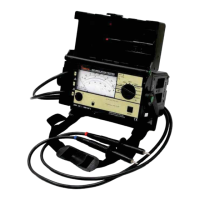
• Operator’s Manual
• Test Lead Set: Red and black insulated test probe set. Simpson Part Number
00125.
• Two (2) 9-volt, NEDA type 1604A alkaline batteries.
!



 To Next Page