4
ADJUSTING CHAIN TENSION
t.
USING GLOVES OR A RAG TO PROTECT YOURSELf
F-ROM THE SHARP CUTTERS, PULL THE CHAJN
AROUND THE BAR BY HAND AND MAKE THE T!=N-
SION AS TIGHT AS POSSIBLE WITHOUT CAUSING ANY
BIND BETWEEN THE CHAIN AND THE BAR. TU-RN
TI-IE ADJUSTING SCREW "CLOCKWISE" TO INCREASE
H,NSION
,OR
"COUNTERCLOCKWISE" TO 'DECREASE
TENSION.
'.!
LIFT UP GUIDE BAR NOSE. HOLD IT UP AND TIGHTEN
CLU~ CH COVER NUT SECURELY USING A 6-INCH OR
SMALLER
OPEN END OR CRESCENT WRENCH.
fUELING THE SAW
The engine is lubricated by oil mixedwith gasoline. The right
amount
of oil in the mixture is very
important.
CAUTION: ALWAYS SHUT ENGINE OFF BEFORE FILL-
ING TANK_
1.
GASOLINE:
Use "regular", clean, fresh gasoline.
{Premium
grade
gasoline is not necessary).
Use properly identified container marked - "GASO-
LINE".
Do not use winter blend gasoline in summertime or
vice versa.
Do not use'fuel
which
was stored longer than 2 months,
because starting the saw may be
a
ifficu It. (Remove
old fuel mixture and dispose of it safely).
Do not use lead-tree gasoline.
::....
-~
...
.'
2.
OIL:
For best performance and longest service I·ife, .use
SK1L
Chain Saw Oil.
If
SKIL
Chain Saw Oil is not available, use other good
blend 2-CYCLE 01 L - SAE-30-MS.
Do not use multi-grade oil (lOW-30), or any oils formu-
lated for 4-cycle engines.
3.
FUEL MIX (16: 1)
Fuel mix
proportions
are:
16
parts of gasoline to
1
part
of oil. Use following chart:
FUEL
MIX CHART 16:1
GASOLINE OIL
GASOLINE OIL
(Ounces)
:
(u.s.
Gallons)
(Ounces)
(I
mperialGallons)
--
1/4
GAL.
2
OZ.
1/4
GAL.
2-1f20Z:
1/2
GAL.
4 OZ_
1/2
GAL.
5
OZ.
1
GAL.
S
OZ.
1
GAL.
10
OZ.
2
GAL.
16 OZ.
2
GAL.
20 OZ.
-
Select container 'with a flexible spout for easy pouring.
Mark the container - "CHAIN SAW FUEL MIX".
ALWAYS MIX IN 16:1 proportions, regardless of what
is indicated on the oil container.
~_ ALWAYS prepare the mixture in a separate conta iner
and mix THOROUGHLY (shake well) before pouring
Into fuel tank. (Never mix in fuel tank).
Do not let dirt get into the gas tank while pouring.
Wipe the saw with a rag to remove spilled fuel.
STARTING THE SAW
1.
READ THE SAFETY RULES BEFORE ANY ATIEt
TO. START THE SAW.
2. CHECK CHAIN TENSION.
3.
HOLD THE SAW BY THE REAR HANDLE FIRMLY IN
YOUR RIGHT HAND.
4.
SLIDE IGNITION SWITCH TO THE "ON" PPSITION.
5.
PULL CHOKE ALL THE WAY OUT. (It is not necessary
to choke a warm engine.)
6.
POINT BAR AND CHAIN. AWAY FROM YOURSELF
AND ALL OTHER OBJECTS.
7.
SQUEEZE THROTTLE_
.-,
8.
GRASP STARTER HANDLE FIRMLY IN LEFT HAND',
AND SLOWLY PULLOUT UNTIL RESISTANCE IS FELT.
9.
PULL THE STARTE~ HANDLE FIRM AND FAST, AND
AT THE SAME TIME PUSH THE SAW AWAY FROM YOU
WITH YOUR RIGHT HAND, REPE~T UNTIL THE EN-
GIN E FIR ES. Do not pull.~opeto it's end,
todo
somay breakrope.
10.
WHEN THE ENGINE FIRES,PUSH THE CHOKE IN AND
RELEASE THE THROTTLE HALF WAY. (Cold engine
may require several pulls to
start.)
11.
TO STOP ENGINE, PUSH IGNITION SWITCH TO "OFF".
Follow the aboveprocedureonly.
If
your sawdoesnot start
10
to
15
pulls on the rope, your sawis in needof maintenance.
is the air filter clean?
A.stbe spark plug -ctear.and properly gapped?
Is the carburetor .adjusted?If not. perform steps
1
and
2
of
ADJUSTING CARBURETOR.
. 10'
.;,
"1"
r ;
s.
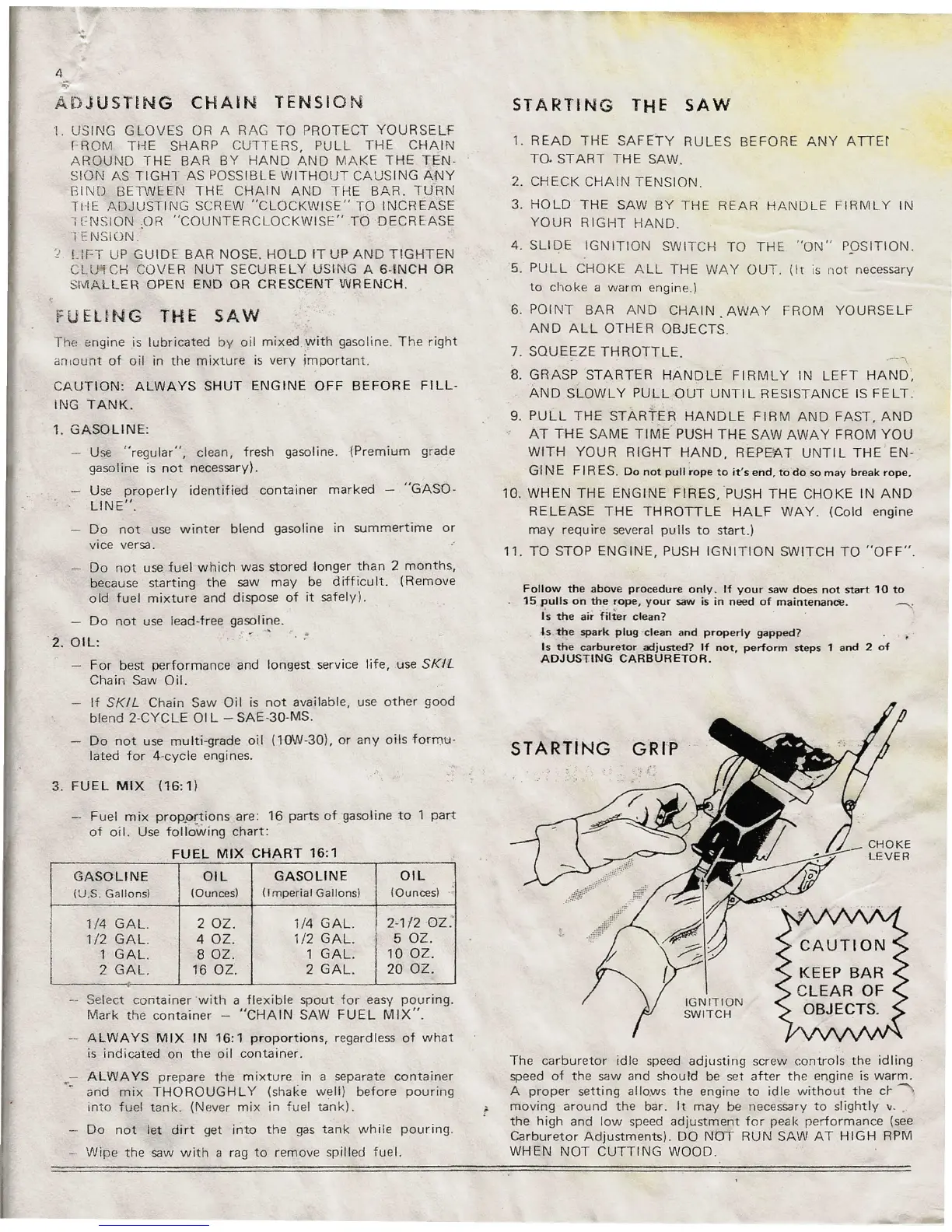
CAUTION
KEEP BAR
CLEAR OF
OBJECTS.
IGNITION
SWITCH
The carburetor idle speed adjusting screw controls the idling
speed of the saw and should be set after the engine is warm.
A proper setting allows the engine to idle without the cf ...•.•.••
moving around the bar. It may be necessary to slightly
II.• '
the high and low speed adjustment for peak performance (see
Carburetor Adjustments). DO NOT RUN SAW AT HIGH RPM
WHEN NOT CUTTING WOOD.


 To Next Page