6
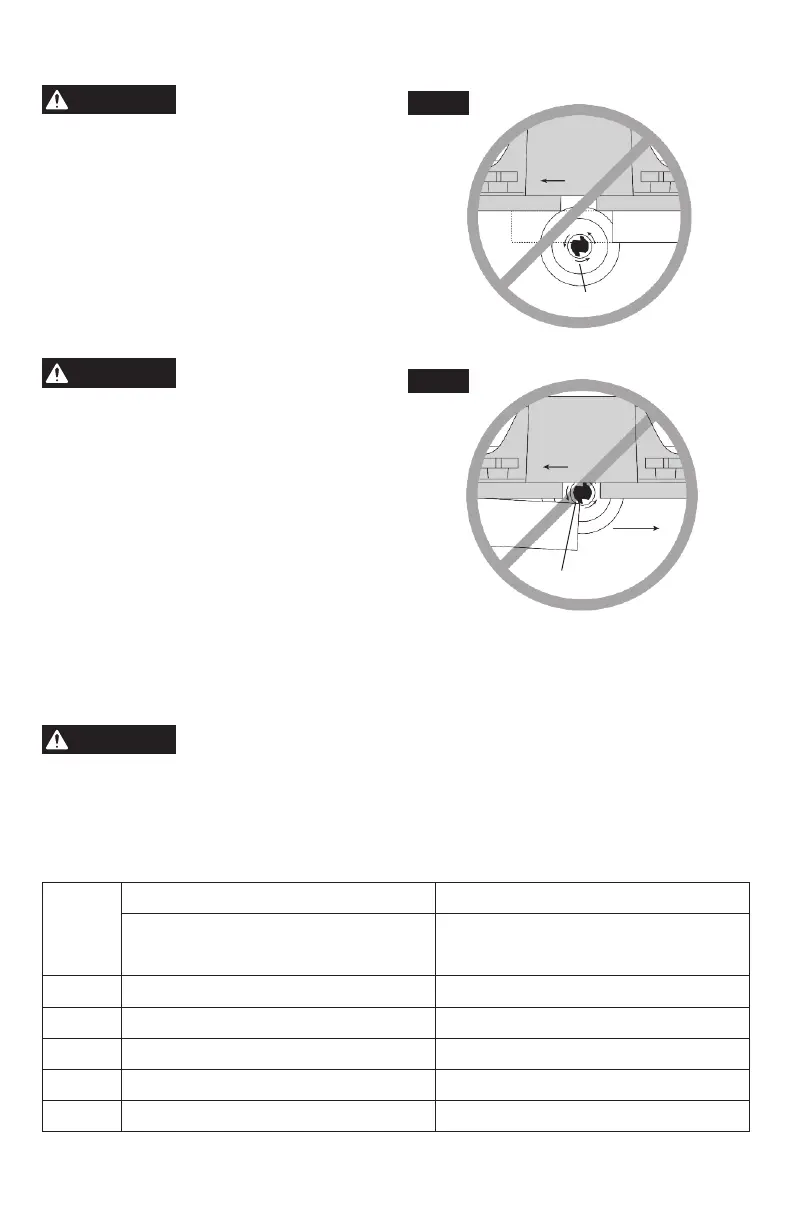
IMPROPER FENCE LOCATION AND WORKPIECE FEED
WARNING
Do not feed the workpiece
where the majority of the
workpiece is between the fence and the bit.
This creates a “fence trap” which is dangerous
for two reasons:
•
The front of the bit is exposed during the
cutting operation (Fig. A).
•
The bit can “Climb-cut,” where the bit enters
the workpiece in the same direction as the
feed direction. This is likely to cause the
workpiece to “climb” away from the tabletop
and may lead to loss of control during
operation (Fig. A).
WARNING
Feed the workpiece only
against the rotation of the
bit. Do not “back feed” the work into the bit.
The bit rotates counterclockwise as viewed
from the top of the table. “Back feeding” the
work is dangerous for two reasons:
•
It will cause climb-cutting where the
workpiece can “climb” off the tabletop in
the direction of the bit rotation, pulling the
workpiece and possibly your hands into the
rotating bit (Fig. B).
•
It is difcult to keep the workpiece against
the fence face as the bit rotation will push the
workpiece away from the fence.
IMPORTANT INFORMATION ABOUT EXTENSION CORDS
WARNING
An extension cord with adequate size conductors that is capable of
carrying the current for your tool must be used.
This will prevent
excessive voltage drop, loss of power, or overheating. Grounded tools must use 3-wire
extension cords that have 3-prong plugs and receptacles.
NOTE:
The smaller the gauge number, the heavier the cord.
RECOMMENDED SIZES OF EXTENSION CORDS FOR 120-VOLT ALTERNATING
CURRENT TOOLS
Tool's
Ampere
Rating
Cord Size in A.W.G Wire Size in mm
2
Cord Length in Feet Cord Length in Meters
25 50 100 150 15 30 60 120
3
-6
1
8
1
6
1
6 14
0
.75
0
.75
1
.5 2.5
6
-8 18 16 14
1
2
0
.75
1
.0
2
.5
4
.0
8-10 18
1
6
1
4
1
2 0.75 1.0
2
.5 4.0
1
0-12
1
6
1
6 14 12 1.0
2
.5 4.0 -
1
2-16
1
4
1
2
- -
-
- - -
Fig. A
Direction of
feed
Workpiece
Exposed bit
Fig. B
Workpiece
Correct
direction of
feed
Incorrect
direction
Climb-cutting


 To Next Page