Need help?
Do you have a question about the Smeg FAB30 and is the answer not in the manual?
Covers essential safety guidelines for appliance operation and user protection.
Details risks to individuals and measures to prevent accidents during use.
Lists actions that could cause harm or malfunction to the appliance.
Provides guidance on initial setup and routine upkeep procedures.
Defines the intended use and limitations of the appliance.
Explains the importance and integral nature of the user manual.
Outlines manufacturer's responsibilities and limitations for damages.
Provides guidance on contacting support and using original spare parts.
Details the location and importance of the appliance's identification plate.
Explains how to access performance information via the EU EPREL database.
Provides instructions for proper disposal of the appliance and packaging.
Information for compliance checks regarding installation and ventilation.
Offers tips and methods to optimize energy consumption during operation.
An overview of the appliance's main components and features.
Essential steps to perform before the initial activation of the appliance.
Guidance for operating the appliance for the very first time.
Instructions on how to adjust and set the internal temperature.
Explanation of the audible and visual signal for an open door.
Guidance on how to use and position the various accessories.
Details on ensuring proper air circulation for optimal performance.
Instructions for arranging and storing food within the refrigerator.
Tips for arranging food to preserve flavor, moisture, and freshness.
Instructions for using and removing the freezer drawers.
Information on consuming defrosted foods and preserving nutritional value.
Explanation of normal operating sounds and potential causes of excessive noise.
Information about the heating system on the front surface.
Steps to follow when switching off the appliance for extended periods.
General recommendations for storing food items inside the appliance.
Comprehensive guide on cleaning the interior and exterior surfaces.
Instructions for cleaning the external parts of the appliance.
Detailed steps for cleaning the interior, including shelves and drawers.
Guidance on the defrosting process, including precautions.
Explanation of the automatic defrosting process for the refrigerator.
Information regarding the interior lighting and its repair.
Troubleshooting guide for common appliance malfunctions and their solutions.
Instructions for safely connecting the appliance to the electrical supply.
Key information regarding the appliance's electrical specifications and safety.
Guidelines and recommendations for correctly positioning the appliance.
Advice on selecting the optimal location for installing the appliance.
Information on using plastic spacers for proper condenser cooling.
Detailed steps for leveling and positioning the appliance correctly.
Warning about handling the door seal to prevent damage.
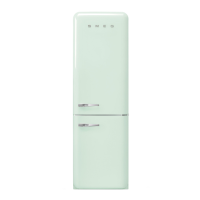
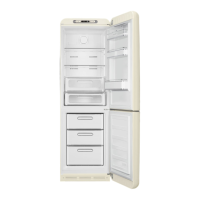
This document describes a refrigerator-freezer appliance, providing detailed instructions for its safe and efficient use, maintenance, and installation.
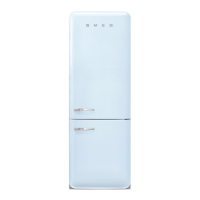
The appliance is designed for the refrigeration and conservation of fresh and frozen foods in the home. It features a refrigerator compartment for fresh foods and a freezer compartment for storing frozen foods, freezing fresh foods, and producing ice cubes. The interior is illuminated when the door is opened. A thermostat allows for setting the temperature inside both compartments. The appliance is not intended for professional or commercial use, nor is it designed to operate with external timers or remote-control systems. It is suitable for use in domestic or similar environments, such as staff kitchen areas, farmhouses, hotels, motels, residential environments, bed and breakfast establishments, and catering applications.
Preliminary Operations: Before first use, all protective films and labels (except the technical data plate) must be removed. All accessories should be washed. After installation or repositioning, the appliance should remain off for at least two hours before activation.
Temperature Setting: The temperature is set using a thermostat knob, ranging from minimum to maximum (position 5). Increasing the position decreases the temperature in the refrigerator compartment.
Door Open Alarm: If the appliance door is left open for an extended period, a sound and visual signal (flashing interior lights) will alert the user to close the door.
Accessories: The appliance includes shelves that can be positioned at different heights. To remove them, lift the rear part and pull them out. Perishable foods should be placed at the rear of the shelves where the temperature is lower. Door balconies and shelves are suitable for storing eggs, butter, dairy products, conserves, small food packages, and bottles. Heavy bottles should be handled carefully to prevent them from dropping.
Fruit and Vegetable Drawer: Located at the bottom of the refrigerator compartment, this drawer maintains a constant humidity level for storing fruit and vegetables. Storing vegetables with high water content may cause condensation on the glass shelf, which is a normal phenomenon.
Super-cold Drawer: This drawer maintains a temperature between -2°C and +3°C, ideal for preserving the freshness and flavor of delicate foods like meat, fish, and lightly frozen items for longer periods. Food to be frozen or ice trays should not be placed here.
Freezer Drawers: These are used for storing frozen foods and foods to be frozen. To remove them, pull them forward and lift the front part.
Ventilation: The appliance features forced air recirculation, which quickly dries food inside and ensures homogeneous refrigeration. Before introducing food, it should be thoroughly sealed.
Arranging Food (Refrigerator Compartment): Food should be arranged on shelves, wrapped, and hermetically covered to preserve flavor, moisture, and freshness, and to prevent odor contamination. This also helps prevent excessive humidity from the normal transpiration of food. Hot foods and drinks must be cooled to room temperature before being placed in the appliance.
Arranging Food (Freezer Compartment): For proper freezing, fruit and vegetables should be packed in portions of no more than 1 kg, and meat and fish in portions of up to 2 kg. Small packages freeze faster, preserving nutritional properties. Foods should be packaged in hermetically sealed containers, expelling as much air as possible. Suitable freezer bags/containers should be used instead of paper or shopping bags. Hot foods and drinks must be cooled to room temperature before being placed in the appliance.
Storage Advice: Always check food packaging expiry dates. Foodstuffs should be stored in closed or pre-packaged containers to prevent moisture and odor exchange. Perishable products should be removed if the appliance will be unused for a long period. Specific recommendations for storing items in the refrigerator compartment include eggs, butter, cheese in upper/central parts; drinks, bottles, cans in the lower part; conserves, wine, biscuits in the upper part; dairy products, ready meals, pastries, fruit juices, beer in the central part; meats, cold cuts in the lower part; and fresh/tropical fruit, vegetables, carrots, potatoes, onions in the fruit and vegetable drawer. For the freezer, food type, quantity, and freezing date should be marked on containers. Small, pre-packaged containers are recommended. Paper bags, cellophane, shopping bags, or pre-used freezer bags should not be used. Frozen food should not come into contact with fresh food to be frozen. Bagged frozen vegetables, ice, and ice cream should be kept.
Turning the Appliance Off: For long periods of disuse, the appliance should be unplugged, emptied, and, once defrosted, dried with a tea towel. The door should be left ajar to prevent unpleasant odors from moisture and stagnant air.
Cleaning the Appliance: The appliance's interior walls have antibacterial protection to prevent bacterial growth, but regular cleaning is still necessary.
Cleaning the Outside: The exterior can be cleaned with water or alcohol-based liquid detergents (e.g., window cleaning products). Abrasive detergents and rough sponges should be avoided to prevent surface damage. A soft brush can be used to remove dust and fume deposits from the condenser at the rear. The tank above the compressor should also be cleaned.
Cleaning the Inside: The interior should be cleaned with diluted liquid detergent and warm water, with a little vinegar added. Door balconies and shelves can be removed by tapping them upwards. Ice thicker than 3-5 mm should be removed, avoiding sharp objects or spray products.
Defrosting: The refrigerator/freezer compartment does not require manual defrosting as the process is automatic. Ice on the refrigeration plate melts when the compressor switches off, and the defrost water is channeled to a dedicated pan at the back, where it evaporates using the heat generated by the compressor. Occasional frost in the freezer compartment is normal. Electrical appliances (e.g., hair dryers) or sprays should not be used for defrosting, as they can damage plastic parts.
Troubleshooting ("What to do if..."):
General Safety Instructions: Children between 3 and 8 years old can load/unload food but should not use the appliance unsupervised. Children under 8 should be kept away unless constantly supervised. Never use water to extinguish fires; turn off the appliance and use a fire blanket. Avoid touching external heating elements. Cleaning and maintenance by users should not be done by unsupervised children. Do not modify the appliance or insert pointed metal objects into slots. Avoid touching frozen products with wet hands or putting them directly in the mouth. Do not store flammable, explosive, or volatile substances. Do not store explosive spray bottles. Tightly close and store alcoholic drinks vertically. Organic compounds, acids, and essential oils can corrode seals and plastic surfaces if left in contact. Turn off and unplug the appliance before cleaning or maintenance. Do not pull the cable to unplug.
Risk of Damaging the Appliance: Do not rest sharp metal objects on the appliance. Do not use abrasive or corrosive detergents on glass parts. Do not sit on the appliance, door, or open drawers. Do not use the door or handle to move the appliance. Do not use steam jets for cleaning. Do not use electrical appliances (e.g., hair dryers) or sprays for defrosting, as plastic parts may be damaged. Do not use the appliance to cool rooms. Always unplug in case of fault or cleaning/maintenance. Do not keep liquids in tins or glass containers in the freezer. Do not use sharp metal objects to remove ice build-up. Do not use plug adaptors. Do not place portable multiple sockets or power supply units at the back. Do not place heavy objects on top. Do not use sharp objects to remove ice/frost to avoid damaging walls.
Installation and Maintenance: The appliance must be grounded. Position with the aid of a second person. Do not use the open door to lever the appliance into place. Avoid excessive pressure on the open door. Do not install near heat sources; use insulation if necessary. Do not expose to direct sunlight or use outdoors. Installation and servicing must be done by qualified personnel. Electrical connection must be done by authorized personnel. If the power cable is damaged, contact technical support for replacement. Always use necessary PPE during installation, maintenance, or movement. Switch off power supply before any operation. If installed near another refrigerator/freezer, keep a minimum 2 cm distance. Do not attempt repairs without a qualified technician. Ensure the power supply cable is not caught or damaged during positioning. Install and secure correctly to prevent instability. This appliance can be used up to 2,000 meters above sea level.
Disposal: The appliance conforms to WEEE European directive (2012/19/EU) and must be disposed of separately from other waste. It does not contain hazardous substances. Disconnect the mains power supply, unplug, cut the power cable, and deliver to an appropriate recycling center or return to the retailer. Packaging materials are recyclable and should be delivered to an appropriate recycling center. Do not leave packaging unattended or let children play with plastic bags.
To Save Energy: Correct use, proper food packaging, constant temperature, and food hygiene affect storage quality. Reduce door opening frequency and duration. Clean the condenser periodically. Defrost frozen food in the refrigerator compartment. Shelf height does not affect energy consumption.
 General
| Type | Freestanding |
|---|---|
| Freezer Position | Bottom |
| Number of Shelves | 3 |
| Number of Door Bins | 3 |
| Defrost System | Automatic |
| Total Net Capacity | 294 litres |
| Door Type | Right-hinged (non reversible) |
| Color | Varies |

 To Next Page