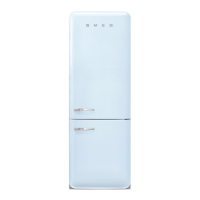
Need help?
Do you have a question about the Smeg FAB32UPGRN and is the answer not in the manual?
Key safety warnings and guidelines for safe appliance operation.
Directive to read and retain all safety and operational instructions.
Explains the safety alert symbol and its meaning.
Defines signal words like DANGER, WARNING, and CAUTION.
Warnings on flammable materials, outdoor installation, proper use, and child safety.
Guidelines for moving, climbing, and leaving children unattended.
Proper installation and grounding procedures for electrical safety.
Precautions for children, apparel, flammable substances, and electrical grounding.
Safety advice on cleaning, unplugging, and handling frozen products.
Guidelines for servicing, legal notices, and chemical warnings.
Safety measures to prevent child entrapment in discarded appliances.
Instructions for safe disposal of old refrigerators and packaging.
Explanation of symbols and conventions used in the user manual.
Overview of the appliance's main components and functions.
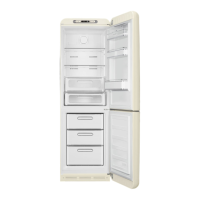
Details and definitions of various appliance parts and their functions.
How the fan distributes temperature and reduces condensation.
Description of the freezer compartment's purpose and use.
Overview of buttons, displays, and indicator lights for temperature control.
For storing fruit and vegetables, maintaining humidity.
For optimizing refrigerator space and placing foodstuffs.
For storing bottles inside the refrigerator compartment.
For storing frozen foods and foods to be frozen.
For storing small containers, bottles, and frozen foods.
Useful for storing eggs in balconies and shelves.
For producing ice cubes in the freezer compartment.
Warnings about using sharp objects, leaning on doors, and storing volatile substances.
Steps before first use, like removing film, labels, and washing accessories.
Guides on plugging in, switching on, and setting initial temperatures.
Instructions on adjusting refrigerator temperature using the control panel.
Explains causes of alarms (door open, high temperature) and how to deactivate them.
How to activate and deactivate the control lock feature.
How to position shelves and bottle rack for optimal storage.
Suitable items for door balconies and shelves, avoiding heavy bottles.
Location and purpose of the drawer for fresh foods requiring constant humidity.
How to remove and store frozen foods in freezer drawers.
Instructions for filling the ice tray and making ice cubes.
Tips for arranging foods for optimal flavour, moisture, and to prevent contamination.
Usage of the Super Cool function for quick cooling of large quantities.
Table showing recommended storage times for various foodstuffs.
Usage of the Super Freeze function for quick freezing of large quantities.
Table showing recommended storage times for frozen foods.
Advice on consuming defrosted foods and impact of partial defrosting.
Explains normal operating noises like buzzing and gurgling.
Explanation of the heating system to limit condensation.
Steps for switching off the appliance for long periods.
Tips for energy saving, like reducing door openings and cleaning condenser.
General tips on checking expiry dates and using closed containers.
Recommended placement for items in the refrigerator door.
Recommended placement for items within the refrigerator compartment.
Advice on marking, packaging, and quantity for freezing foods.
Recommended placement for items in the freezer compartment door.
Warnings against steam jets, harsh chemicals, abrasive materials.
Safety advice regarding power voltage and unplugging the appliance.
Methods for cleaning the exterior surfaces with mild detergents.
Instructions for cleaning the interior, including removable parts.
Information on automatic defrosting (No-Frost) and manual defrosting.
Step-by-step guide to replacing the interior light bulb.
Troubleshooting steps for when the appliance is not functioning.
Reasons for frequent compressor operation and checks to perform.
Causes and solutions for ice/condensation in the refrigerator.
Troubleshooting for water formation due to blocked drainage.
Causes for food freezing in the refrigerator and how to adjust.
Reasons for insufficient freezing in the freezer compartment.
Causes and solutions for excessive ice in the freezer.
Explanation of why the door may be hard to open after closing.
Checks for door misalignment and leveling.
Action to take when a specific error code is displayed.
Safety warning about moving heavy appliances and needing assistance.
Instructions for removing packaging, tape, and glue residue.
Tips for moving the appliance safely and protecting the floor.
Advice to clean the interior before the first use.
Precautions for cleaning and handling glass shelves due to breakage risk.
Safety warning about positioning the appliance with assistance.
Warnings about exerting pressure on the door and avoiding direct sunlight.
Guidance on selecting a suitable, ventilated location away from heat sources.
Instructions on condenser placement and using spacers for cooling.
How to place the appliance on a stable floor and use adjustable feet.
Requirements for connecting the appliance to an earthed electrical system.
Advice on data plates, plugs, sockets, and avoiding adapters.
 General
| Appliance placement | Freestanding |
|---|---|
| Type | Fridge freezer |
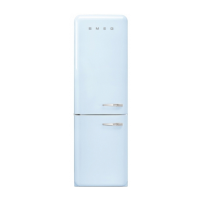
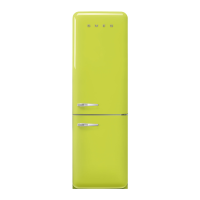
| Product colour | Green |
| Noise level | 38 dB |
| Number of Shelves | 3 |
| Number of shelves/baskets in fridge | 3 |
| Number of vegetable drawers | 1 |
| Number of shelves/baskets in freezer | 3 |
| Freezing capacity | 4 kg/24h |
| Built-in display | No |
| Hinge type | Right |
| Fridge interior light | Yes |
| Lamp type | LED |
| Egg balcony | Yes |
| Bottle rack | Yes |
| Ice cube tray | Yes |
| Dimensions (H x W x D) | 186 x 60 x 65 cm |
| Width | 600 mm |
| Weight | 70 kg |
| Climate class | SN-T |
| Cooling System | Static |
| Storage time during power failure | 18 hours |
| Depth | 650 mm |
| Energy efficiency class | E |
| Energy Rating | E |

 To Next Page