EasyManua.ls Logo

Smeg FAB30LRD5 - User Manual

Smeg FAB30LRD5
14 pages
Print Icon
To Next Page IconTo Next Page
Loading...
PRECAUTIONS - 19914779596/A
e
PRECAUTIONS 19
General safety instructions 19
For this appliance 21
Appliance purpose 22
This user manual 22
Manufacturer’s liability 23
Technical Support. 23
Identification plate 23
Energy label 23
Disposal 23
Information for control bodies 23
To save energy 23
How to read the user manual 24
DESCRIPTION 24
General Description 24
Accessories 25
USE 25
Preliminary operations 25
First use 26
Temperature setting 26
Alarm for door open 26
Using the accessories 26
Ventilation 27
Using the refrigerator compartment 27
Using the freezer compartment 27
Noises during operation 28
Heated front surface 28
Turning the appliance off 28
Storage advice 28
CLEANING AND MAINTENANCE 29
Cleaning the appliance 29
Defrosting 29
Interior lighting 29
What to do if... 29
INSTALLATION 30
Electrical connection 30
Positioning 30
We advise you to read this manual carefully, which contains all the instructions for maintaining the
appliance’s aesthetic and functional qualities. For further information on the product: www.smeg.com
PRECAUTIONS
General safety instructions
Risk of personal injury
According to current
regulations, children between 3
and 8 years of age can take or
load food from the appliance,
but it is highly discouraged to
allow children under 8 years of
age to perform these
operations and in general to
use the appliance.
Keep children under the age of
eight at a safe distance unless
they are constantly supervised
and make sure that they do not
play with the appliance.
Never try to put out a fire or
flames with water: turn off the
appliance and smother the
flames with a fire blanket.
Do not touch the heating
elements on the outside of the
appliance.
Cleaning and maintenance that
should be performed by the
user must not be carried out by
unsupervised children.
Do not modify this appliance.
Do not insert pointed metal
objects (cutlery or utensils) into
the slots in the appliance.
Do not touch (especially with
wet hands) frozen products or
put them in your mouth directly.
Do not store inflammable,
explosive or volatile

Question and Answer IconNeed help?

Do you have a question about the Smeg FAB30LRD5 and is the answer not in the manual?

Overview

This document provides a comprehensive guide for the installation, use, and maintenance of a refrigerator-freezer appliance.

Function Description

The appliance is a refrigerator-freezer designed for the refrigeration and conservation of fresh and frozen foods in a domestic or similar environment. It features a compression system for cooling, with separate compartments for refrigeration and freezing.

Key components and their functions:

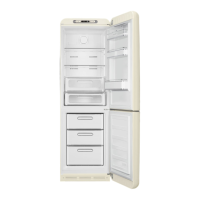
  • Freezer compartment (1): Used for storing frozen foods, freezing fresh foods, and producing ice cubes.
  • Fan (2): Distributes temperature evenly and reduces condensation on shelves and other surfaces.
  • Interior lighting (3): Illuminates the interior when the door is opened.
  • Refrigerator compartment (4): Designed for storing fresh foods.
  • Super-cold drawer (5): Maintains freshness and flavor of delicate foods like meat, fish, and lightly frozen items, keeping temperatures between -2°C and +3°C. It is not for freezing food or making ice.
  • Fruit and vegetable drawer (6): Located at the bottom of the refrigerator compartment, covered by a glass shelf, to maintain constant humidity for optimal storage of fresh produce.
  • Freezer door (7): Provides access to the freezer compartment.
  • Thermostat (8): Used to set the desired temperature for both the refrigerator and freezer compartments.
  • Fridge door (9): Provides access to the refrigerator compartment.

Accessories:

  • Shelves: Adjustable in height within the refrigerator compartment for flexible storage. They have a safety fitting to prevent accidental removal.
  • Door balconies and shelves: Suitable for storing eggs, butter, dairy products, conserves, small food packages, and bottles. The lower part is specifically designed for bottles.
  • Freezer drawers: For storing frozen foods and foods to be frozen.

Important Technical Specifications

  • Climate Class: The appliance's climate class (SN, N, ST, T) is indicated on the nameplate and determines the suitable room temperature range for operation:
    • SN (Subnormal): +10°C to +32°C
    • N (Normal): +16°C to +32°C
    • ST (Subtropical): +18°C to +38°C
    • T (Tropical): +18°C to +43°C
  • Refrigerant: The appliance contains a small quantity of isobutane (R600a). Care must be taken not to damage the cooling circuit during transport, installation, and cleaning.
  • Altitude: Can be used up to a maximum altitude of 4,000 meters above sea level.
  • Dimensions (mm):
    • Width: 601 mm
    • Depth: 768 mm (with door closed), 926 mm (with fridge door open at 110°), 764 mm (with freezer door open at 90°)
    • Height: 1720 mm (adjustable between 1715-1730 mm)
    • Minimum distance from other refrigerators/freezers: 2 cm.
    • Minimum clearance from rear wall: 25-40 mm (for spacers).
    • Minimum clearance under wall units: 5 cm.
  • Electrical Connection: Must be connected to ground in compliance with electrical safety standards. The power supply cable should not be caught or damaged during positioning. If damaged, it must be replaced by technical support.
  • Spare Parts Availability: Original spare parts remain available for 10 years after the last production of the model. These include electronic boards, thermostats, temperature sensors, hinges, lamps, and door handles, available only to authorized repair technicians.

Usage Features

  • First Use: After installation or repositioning, wait at least two hours before activating. Ensure it's connected to an electrical outlet.
  • Temperature Setting: Adjust using the thermostat knob from position (minimum) to 5 (maximum). Increasing the setting decreases the temperature in the refrigerator compartment.
  • Door Open Alarm: A sound and visual signal (flashing interior lights) will activate if the door is left open for an extended period, prompting the user to close it.
  • Food Arrangement:
    • Food should be wrapped and covered hermetically to preserve flavor, moisture, and freshness, prevent contamination, and control humidity.
    • Hot foods and drinks must cool to room temperature before being placed in the appliance.
    • Perishable foods should be placed on the rear part of the shelves where the temperature is lower.
    • Raw meat and fish should be stored in suitable containers to prevent contact with other food or dripping.
  • Freezer Use:
    • Pack fruit and vegetables in portions of no more than 1 kg; meat and fish in portions of up to 2 kg for quick freezing.
    • Package foods in hermetically sealed packages, expelling as much air as possible.
    • Use suitable freezer bags/containers, not paper or shopping bags.
    • Avoid frozen food coming into contact with fresh food to be frozen.
  • Storage Advice:
    • Always check food packaging expiry dates.
    • Store foodstuffs in closed or pre-packaged containers to prevent moisture and odor transfer.
    • Remove perishable products if going away for a long period.
    • Refrigerator compartment door: Eggs, butter, cheese in upper/central parts; drinks, bottles, cans in lower part.
    • Refrigerator compartment: Conserves, wine, biscuits in upper part; dairy products, ready meals, pastries, fruit juices, beer in central part; meats, cold cuts in lower part; fresh and tropical fruit, vegetables, carrots, potatoes, onions in fruit/vegetable drawer.
    • Freezer compartment: Mark food type, quantity, and freezing date. Use small, cold containers.
    • Defrost frozen food in the refrigerator compartment to utilize stored cold.
  • Turning Off: For long periods of disuse, unplug, empty compartments, defrost freezer, dry residual moisture, and leave the door ajar to prevent odors.

Maintenance Features

  • Cleaning the Appliance:
    • Outside: Clean with water or alcohol-based liquid detergents (e.g., window cleaner). Avoid aggressive detergents and rough sponges. Use a soft brush to remove dust from the condenser at the rear. Clean the tank above the compressor.
    • Inside: Clean with diluted liquid detergent and warm water, with a little vinegar.
    • Removable parts: Door balconies and shelves can be removed by tapping them upwards.
    • Ice removal: Remove ice thicker than 3-5 mm. Do not use sharp objects or spray products.
  • Defrosting:
    • Refrigerator compartment: Automatic defrosting. Melted water is channeled to a dedicated pan at the back, where it evaporates using compressor heat.
    • Freezer compartment: Occasional frost is normal. Do not use electrical appliances (e.g., hair dryers) or sprays for defrosting, as plastic parts can be damaged.
  • Ventilation: The forced recirculation air system cools food rapidly and maintains homogeneous refrigeration. Clean the condenser periodically to maintain efficiency.
  • Door Seals: Ensure they close hermetically, especially at the corners, to prevent air leakage and maintain temperature. Clean or replace if damaged or dirty.
  • Interior Lighting: If damaged, must be repaired by Technical Service only.
  • Troubleshooting (What to do if...):
    • Appliance not working: Check if plugged in and main switch is on.
    • Compressor runs too often/continuously: Room temperature too high, door opened too often/long, door not sealing properly, freezer overloaded with fresh food, insufficient air circulation around sensor, condenser dirty.
    • Excessive ice/condensation in refrigerator: Door opened too often/long, hot foods placed inside, foodstuffs touching rear wall, damaged/dirty door seal.
    • Refrigerator not cold enough: Thermostat set too high, door opened too often/long, door not sealing properly, room temperature too high.
    • Refrigerator too cold/food freezing: Thermostat set too low, foodstuffs not in suitable containers/bags, wet fruit/vegetables, foodstuffs against rear wall.
    • Freezer not cold enough: Thermostat set too high, door opened too often/long, door not sealing properly, hot foods placed inside, food to be frozen contains large sugar quantities.
    • Excessive ice in freezer: Thermostat set too low, room temperature too high.
    • Doors hard to open after closing: Due to vacuum created by cooling warm air.
    • Doors misaligned: Check if appliance is level; adjust feet.
  • Installation:
    • Position on a firm, level surface.
    • Use two small wheels at the back for easier movement.
    • Adjust front feet for leveling.
    • Lean slightly towards the rear to facilitate proper door closure.
    • Install at least 3 cm from electrical/gas cookers and 30 cm from combustion heaters/radiators.
    • If near heat sources, use suitable insulation.
    • Leave at least 5 cm clearance under wall units.
    • Ensure sufficient space for door opening and drawer/shelf removal.
    • Use provided plastic spacers at the rear to ensure proper condenser cooling and distance from the wall.
    • Do not press, tear, or detach the door seal during installation.

Smeg FAB30LRD5 Specifications

General IconGeneral
BrandSmeg
ModelFAB30LRD5
CategoryRefrigerator
LanguageEnglish

Related product manuals