26
GPP ELECTROFISHER
USER’S MANUAL
2016
boom is used as the anode and
the other as the cathode. The
boat operator guides the boat
while the electrofishing crew
activates the electrofisher when
approaching likely habitat.
NIGHT FISHING
Electrofishing at night with lights
is five to ten times more effective
than daytime fishing, especially
in lakes. In streams the reflection
of the spotlight on the ruffled
surface makes the fish difficult to
see. Boats have flood lights on the
bow to attract the fish and to help
locate stunned fish.
SURPRISE
Collecting can be enhanced
by introducing the element of
surprise through intermittent
fishing. The intensity of the
anode’s peripheral field often
frightens fish, causing them to
bolt and hide. Do not work with
the power on continuously, but
turn it on only in likely habitats.
Fish can be enticed from under
areas of heavy cover or ice by
inserting a portable anode,
turning the power on, and
withdrawing the anode slowly
and smoothly. Fish will follow the
anode, under the influence of
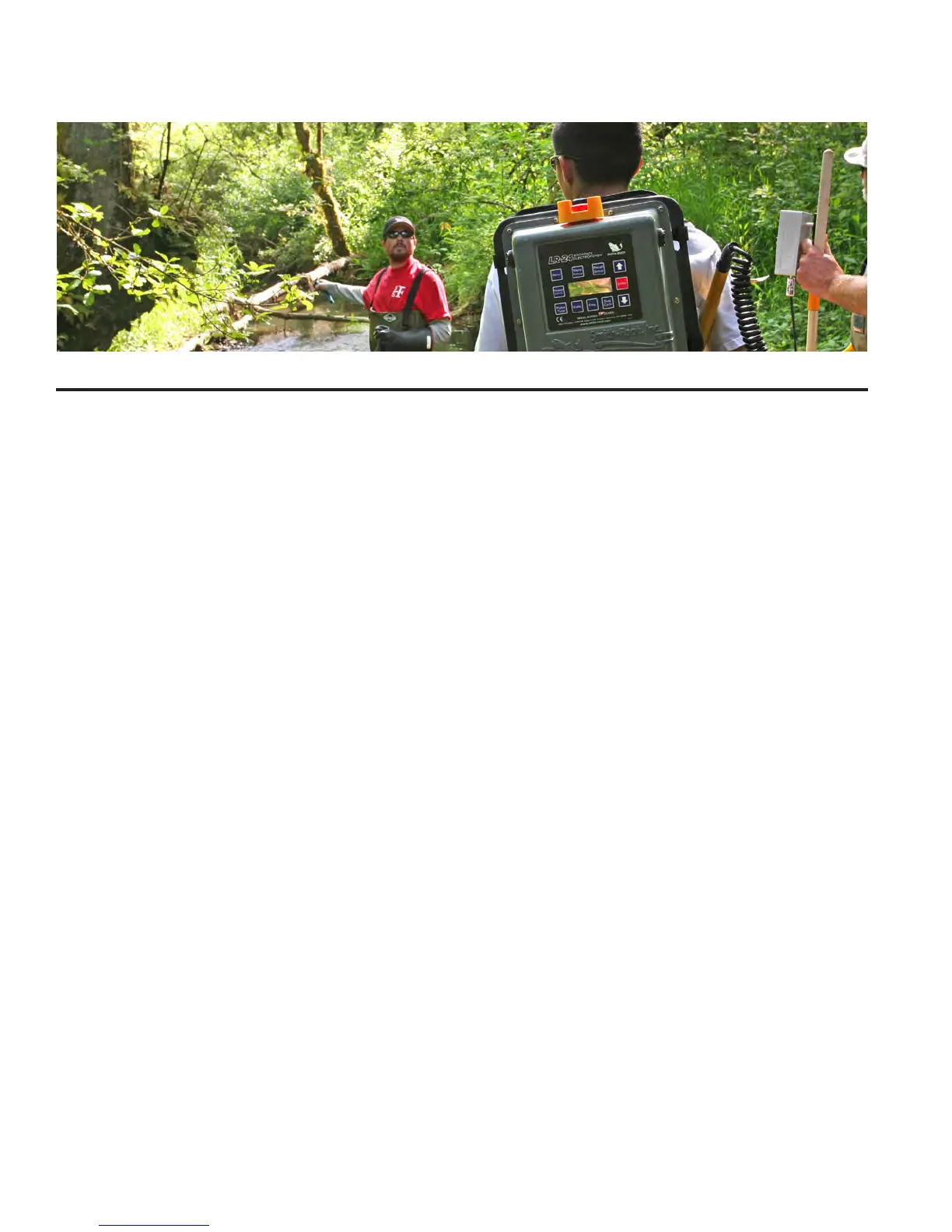
An operator engaged in
electrofishing must wade or float,
depending upon the depth and
swiftness of the water.
WADING
In shallow slow-moving waters
the operators can wade and
probe the anode into likely
fish habitat. Wading upstream
eliminates the effects of turbidity
caused by bottom sediment.
Furthermore, if collections are
for food habitat study, stunned
prey are not swept downstream
and consumed by predators.
Fish that manage to escape are
often captured a short distance
downstream. Closing a stream
with seine nets at each end of the
study area helps prevent the loss
of stunned and frightened fish.
BOATS
Boat electrofishers are used in
lakes and in streams that are too
deep or swift to wade. Boats
have the advantage of being able
to carry large generators and
holding tanks for the stunned
fish. Electrofishing boats typically
have two insulated booms
extending from the bow. From
the end of the booms electrodes
hang into the water. Usually one
galvanotaxis, into the open where
they can be netted.
CLARITY AND DEPTH
Clarity of the water limits the
ease of capturing fish. The length
of the dip net handles and the
visibility of the fish limit the depth
of effective electrofishing. In
general, waters over ten feet deep
cannot be sampled effectively.
For daytime fishing polarized
sunglasses help in locating
stunned fish.
VEGETATION
Aquatic vegetation grows better
from certain substrates and can
hinder electrofishing by fouling
electrodes and entangling
stunned fish.
WATER VELOCITY
Electrofishing in flowing water is
not as effective as in still water,
since fish are swept away from the
electric field and netting is more
difficult. Also, it is more difficult
to see a fish in fast flowing water,
and operators can loose their
footing. Flows greater than 5 feet
per second usually produce poor
electrofishing efficiencies.
FIELD TECHNIQUES


 To Next Page