2
Introduction
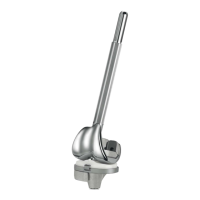
Unicompartmental knee arthroplasty
(UKA) has been shown to be an
effective treatment for isolated
osteoarthritis affecting the medial
or lateral compartment.
The MIS
™
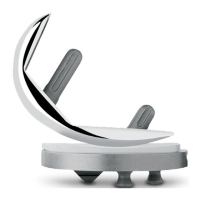
Instruments for the ZUK
Unicompartmental High Flex Knee
are designed to provide accurate,
reproducible results using a
minimally invasive technique.
The goals of a minimally invasive
surgical procedure are to:
• Facilitate the patient’s recovery
• Provide less pain
• Provide earlier mobilization
• Provide shorter hospital stay
• Provide quicker rehabilitation
This instrumentation allows the –
surgeon to operate without everting
the patella. The system offers three
MIS instrumentation options:
• Spacer Block
• Intramedullary Instrumentation
System (IM)
• Extramedullary Instrumentation
System (EM)
The same tibial assembly is used for
all three options. However, the distal
femoral resection instruments are
unique to each of the three techniques.
This guide to the surgical technique
is a step-by step procedure written
for a medial compartment UKA.
Many of the same principles can be
applied to the lateral compartment
but it may be necessary to extend the
incision a few centimeters given the
proximity of the patella to the lateral
condyle. Combined with surgeon
judgment, proper patient selection,
and appropriate use of the device,
this guide offers a comprehensive
technique that discusses the
procedure for component selection,
bone preparation, trial reduction,
cementing techniques, and
component implantation. It is strongly
recommended that the surgeon read
the complete procedure for details,
notes, and technique tips.
Intramedullary (IM) Surgical Procedure


 To Next Page