XA 90
ps
Rear Panel
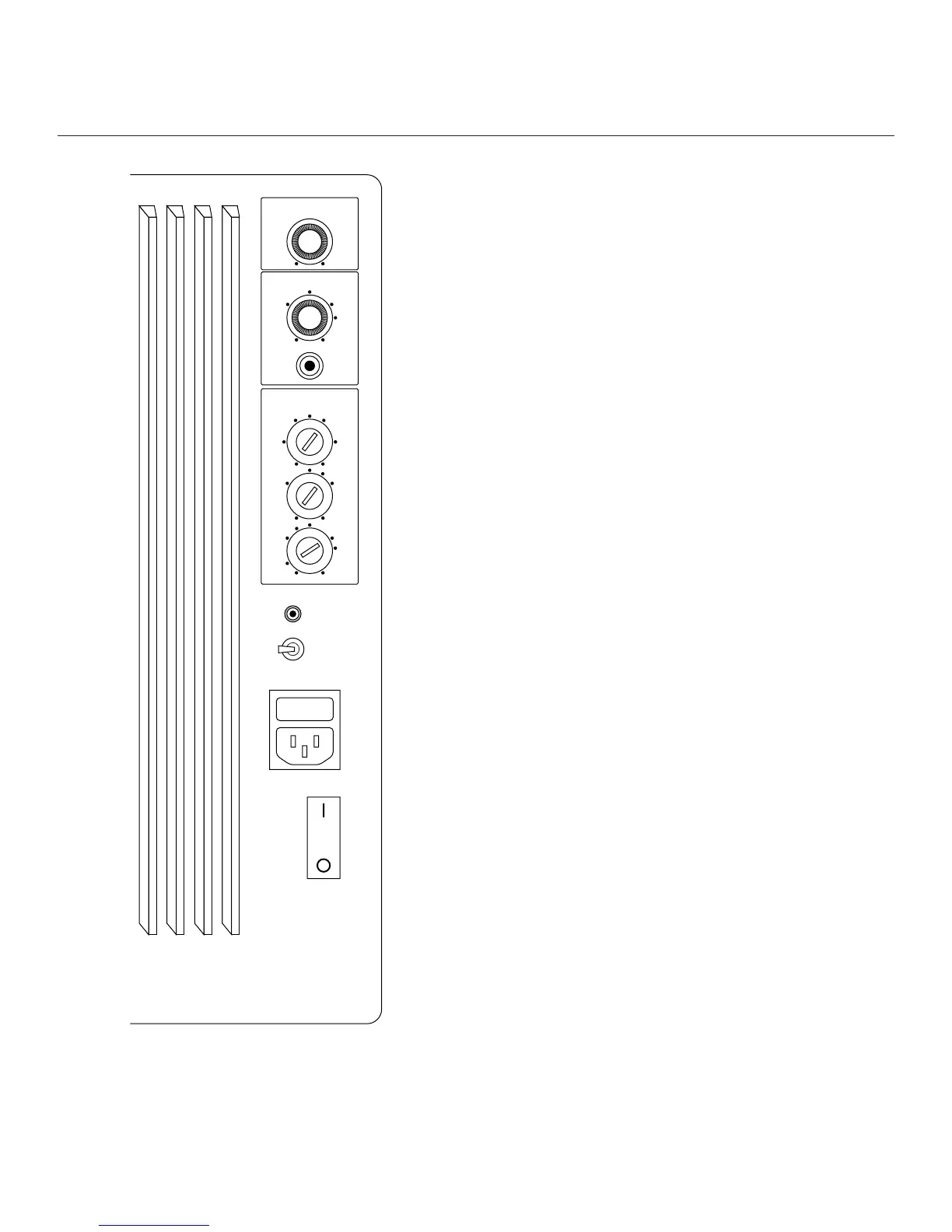
Subwoofer Amplifier Settings
The amplifier of your XA Towers contains a number of rear panel
controls, some of which should be set upon installation and
then generally left alone. The remote control (XA 90
ps
) contains
additional controls for user adjustment according to taste or
program material.
It is best if a qualified installer aids in this initial setup, hopefully
with a
1
⁄
3
-octave real-time spectrum analyzer and a pair of good
ears.
Overall Bass Level
This control sets gain for the bass amplifier that determines bass
level for the normal (speaker level) input and also the LFE line-
level input. Note: In the XA 90
ps
, overall bass level is a combina-
tion of the levels set by this knob and by the remote control.
Use the remote control to set the amplifier to the 0 position.
Adjust the bass level to give a solid but not overblown bass level.
Confirm this on a variety of program material. If using a spec-
trum analyzer, set to a level so that frequencies below 100Hz
are flat (or up to 3dB up from flat). The remote control (XA 90
ps
)
will then give a range of
±
6dB in 2dB steps from this central
position.
Parametric Equalizer (XA 90
ps
only)
The XA 90
ps
is unique in including a bass parametric equalizer.
Through several years of experience with the amazing RCS1000
digital equalizer, we have learned firsthand the damaging effects
of the room on bass reproduction, and how careful equalization
can greatly reduce these effects. The dimensions and materials of
a room create “standing waves.” The locations of speakers and lis-
tener relative to these standing waves create uneven bass response.
The parametric equalizer of the XA 90
ps
allows you to pick the
room’s dominant bass problem and correct it. The end result is bass
response that will be more even, more musical, and less “resonant.”
The term parametric equalizer stems from the fact that all parame-
ters of an equalizer section are adjustable. This includes bandwidth
(also called Q), frequency, and level. With the parametric equalizer,
you have the option of making broad effects (more or less low
bass; more or less mid-bass) or tackling narrow band effects, such
as notching out a room resonance at 70Hz.


 To Next Page