8
PLACEMENT OF YOUR SPEAKER SYSTEM
of any of them. Moving your listening position may affect the
sound as much as moving the speakers. If practical, try different
listening locations as well as speaker locations. Bass level con-
trols (XA 75
ps
) will allow you to help improve the bass balance at
whatever final location you choose. Additionally, the parametric
equalizer of the XA 90
ps
will allow you to electronically correct
one major bass aberration per speaker, thus making placement
even less critical. (See ”Optimizing the Sound” section).
Boundary Effects
Large surfaces near your speakers will affect the level of upper-
bass and lower-midrange frequencies. This can make voices
sound unnatural. A feature to counteract this is the ”Bass
Loading” switch, with positions for ”Normal” or ”Boundary.”
Refer to the switch on the input terminal plate.
Normal or Freestanding placement refers to a situation in which
the XA Tower has at least a 12-inch (30cm) clearance on all four
sides.
¤ Away from large furniture
¤ Not close to walls
¤ Set Boundary switch to Freestanding
Boundary placement refers to a situation in which the XA Tower
is bounded on at least one side by a large object.
Set Boundary switch to Boundary if:
¤ Placed beside a TV
¤ Placed beside a bookshelf or an audio/video
cabinet
¤ Placed next to a wall
See the section entitled “Optimizing the Sound” for more on
adjustments related to these placements.
XA Towers
The XA Towers are designed for either freestanding or boundary
placement.
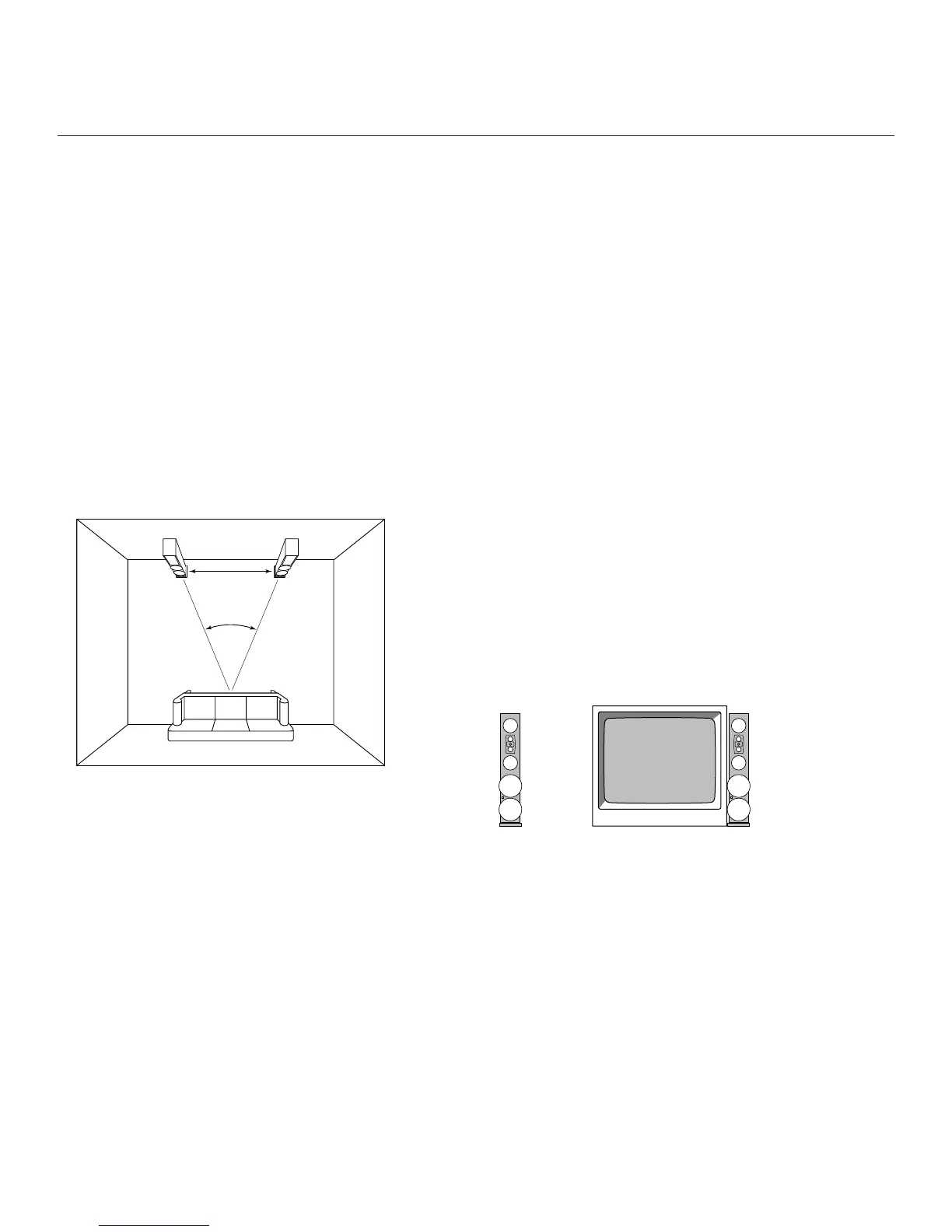
Stereo Image
The distance between the speakers determines the width of the
stereo image. If the speakers are placed too close together, the
image will be too narrow; too far apart and the blend will suffer,
creating a hole in the middle. When properly placed, your speak-
ers will create a continuum of “virtual images” from left to right,
with an illusion of sound outside, in front, and behind the
speaker systems.
¤ We recommend an angular separation between 45° and 60°
(when viewed from above).
This is equivalent to a separation between the speaker systems
that is about 85% of the distance to either of the speakers.
Creation of sounds between the speakers requires some precise
placement. The distance from the left speaker, right speaker, and
center channel to the listener location should all be as equal as
possible. We advise using a tape measure to equalize these two
distances to the primary listening position. The payoff will be
well worth the time and effort.
Room-Related Bass Effects
Experiment until you find the best overall sound for your room.
Choose a source with a heavy and continuous bass line, repeat a
short section until you have a firm impression of it in your mind,
and then try another speaker location. Repeat this process until
you are content with the bass response you are getting. Aim for
even reproduction of each bass note without undue prominence


 To Next Page