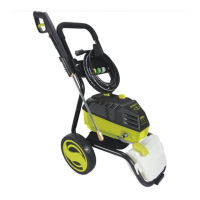
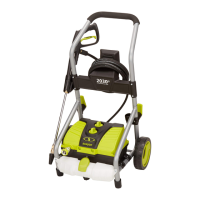
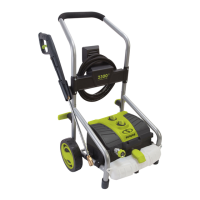
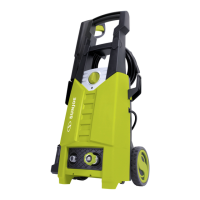
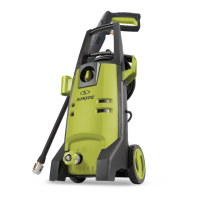
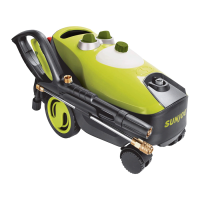
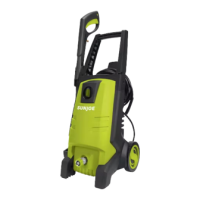
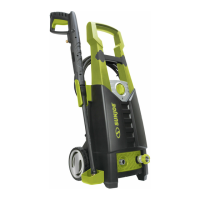
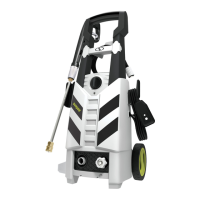
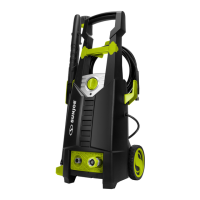
This document describes the Sun Joe SPX4600-MAX-RM Electric Pressure Washer, a remanufactured product designed for residential use. It is intended for medium-to-heavy duty cleaning tasks on various surfaces and items such as boats, motorcycles, RVs, ATVs, trailers, decks, barbecues, siding, and patio furniture.
Function Description
The electric pressure washer operates by pumping cold water at high pressure through a spray wand and nozzle to remove dirt and grime. It features a pump encased in a shock-absorbing housing, and a non-slip handle grip for optimal working position. The unit is equipped with a Total Stop System (TSS), which senses water flow in the pump. When the trigger gun is released, water stops flowing through the pump, and the TSS automatically turns the motor off. This mechanism protects the pump from overheating, saves energy, and prolongs pump life.
The pressure washer is designed to be used with cleaning agents recommended by the manufacturer. It includes a detergent tank and a detergent dial to adjust the suction volume of the detergent solution, allowing for more effective dirt removal for most cleaning tasks.
Safety features are integrated into the design, including a ground fault circuit interrupter (GFCI) built into the power cord plug to protect against electric shock. A thermal sensor protects the motor from overloading, automatically cutting off power if activated and restarting once the motor cools. The spray gun also has a locking device to prevent unintentional operation.
The unit utilizes Quick-Connect nozzles, which are easily interchangeable to provide different spray patterns for various cleaning needs. These include a 0° intense-jet nozzle for heavy dirt deposits and hard-to-reach areas, a 15° fan-tip nozzle for intense cleaning jobs on hard surfaces, a 25° fan-tip nozzle for general cleaning of home siding, patios, and driveways, a 40° wide-spray tip nozzle for cleaning items like cars and patio furniture, and a soap nozzle for low-pressure detergent application. Additionally, a heavy-duty turbo nozzle is included, which spins a zero-degree spray in a circle to quickly break down caked-on dirt and grime, potentially cutting cleaning time by up to 40%.
Usage Features
To operate the pressure washer, it should be positioned as close as possible to the water supply on a secure and stable surface. Before plugging in, ensure the unit is switched off and that the electrical supply voltage and frequency match the rating plate specifications. The GFCI may need to be reset upon initial plug-in. The water supply tap must be turned on completely, and the safety lock on the trigger gun should be disengaged. Pressing the trigger for a few seconds allows air to escape and discharges residual pressure in the hose, ensuring steady water flow. The ON/OFF switch is then turned to the ON/I position to start the pressure washer. When restarting the motor, the trigger should always be kept pressed.
For cleaning with detergents, the cap is removed from the detergent tank, and the tank is filled with a manufacturer-recommended detergent solution. The soap nozzle (black) is then installed on the spray wand. After turning on the pressure washer and pulling the trigger, the liquid detergent automatically mixes with water and is discharged. The detergent dial allows for adjustment of the detergent solution's suction volume. It is recommended to apply detergent from the bottom to the top of the dry surface and allow it to remain for a short time before rinsing, without letting it dry on the surface. After detergent application, the tank should be detached and cleaned, and clean water should be run through the detergent tube to remove any remaining detergent.
For rinsing, the pressure washer is turned off, the water supply is shut off, and the trigger is pulled to release pressure. The safety lock on the trigger handle is engaged, and the soap nozzle is removed. The appropriate Quick-Connect nozzle is then selected and snapped onto the spray wand. Rinsing should start at the top of the area and work downwards, overlapping strokes.
When taking a break of two minutes or more, the gun safety lock should be engaged, the switch turned to OFF/0, and the power cord unplugged.
Maintenance Features
Regular maintenance is crucial for the longevity and performance of the pressure washer. Before any maintenance task, the unit must be disconnected from the electrical power supply.
The adapter filter should be checked and cleaned regularly to prevent foreign matter from clogging the pump. This involves removing the filter and rinsing it with warm water. The nozzle should also be cleaned using the provided needle clean-out tool to remove any dirt from the nozzle hole, followed by rinsing.
For storage, the pressure washer must always be kept in a location where the temperature will not fall below 32°F (0°C), as the pump is susceptible to permanent damage from freezing, which is not covered by the warranty. It should be stored indoors in a dry, covered area, protected from adverse weather conditions. All water must be emptied from the hoses and the pump before storage.
For winterizing and long-term storage in freezing temperatures, specific steps should be followed:
- Disconnect all water connections.
- Turn on the pressure washer for a few seconds to allow remaining water to exit the pump, then turn it off immediately.
- Ensure the high-pressure hose does not become kinked.
- Store the machine and accessories in a room that does not reach freezing temperatures, and not near heat sources that could dry out pump seals.
- Operate the pressure washer with a non-corrosive/non-toxic anti-freeze, pump saver, or pump protector before storing for the winter. Before reusing, the unit must be completely flushed out with clear water to prevent anti-freeze products from damaging paintwork.
The power cord insulation should be inspected regularly for damage or signs of wear and tear. If damaged, the pressure washer should not be used, and the customer service center should be contacted. High-pressure hoses, fittings, and couplings should also be checked regularly for damage and replaced if necessary. Only original replacement parts or manufacturer-approved parts should be used to ensure appliance safety.


 To Next Page
 General