Using the chainsaw
ENGLISH 15
10. Using the chainsaw
10.1 Application areas
The chainsaw must only be used to cut wood and
objects made of wood.
Any loose wooden objects must be safely secured (e.g.
on a sawhorse). When cutting down overgrown trees
and branches please refer also to the notes on cutting
down trees and removing branches.
The chainsaw must not be used for any other purpose,
for example to cut plastics or metals.
10.2 Sawing
Always follow the safety instructions when performing
any kind of work with the saw. Always hold the
chainsaw firmly with both hands. Position your right
hand on the rear handle and your left handle on the
front handle.
Cutting to length:
Make sure that you have a secure footing.
Clean the area which is to be cut of any foreign bodies
like sand, stones, nails etc. Foreign bodies can cause
dangerous kickback.
Loose wooden objects must be firmly
secured, ideally with a sawhorse. The
wood must nut be held in place with a
foot or by another person. Round
timber must be secured so that they
cannot rotate.
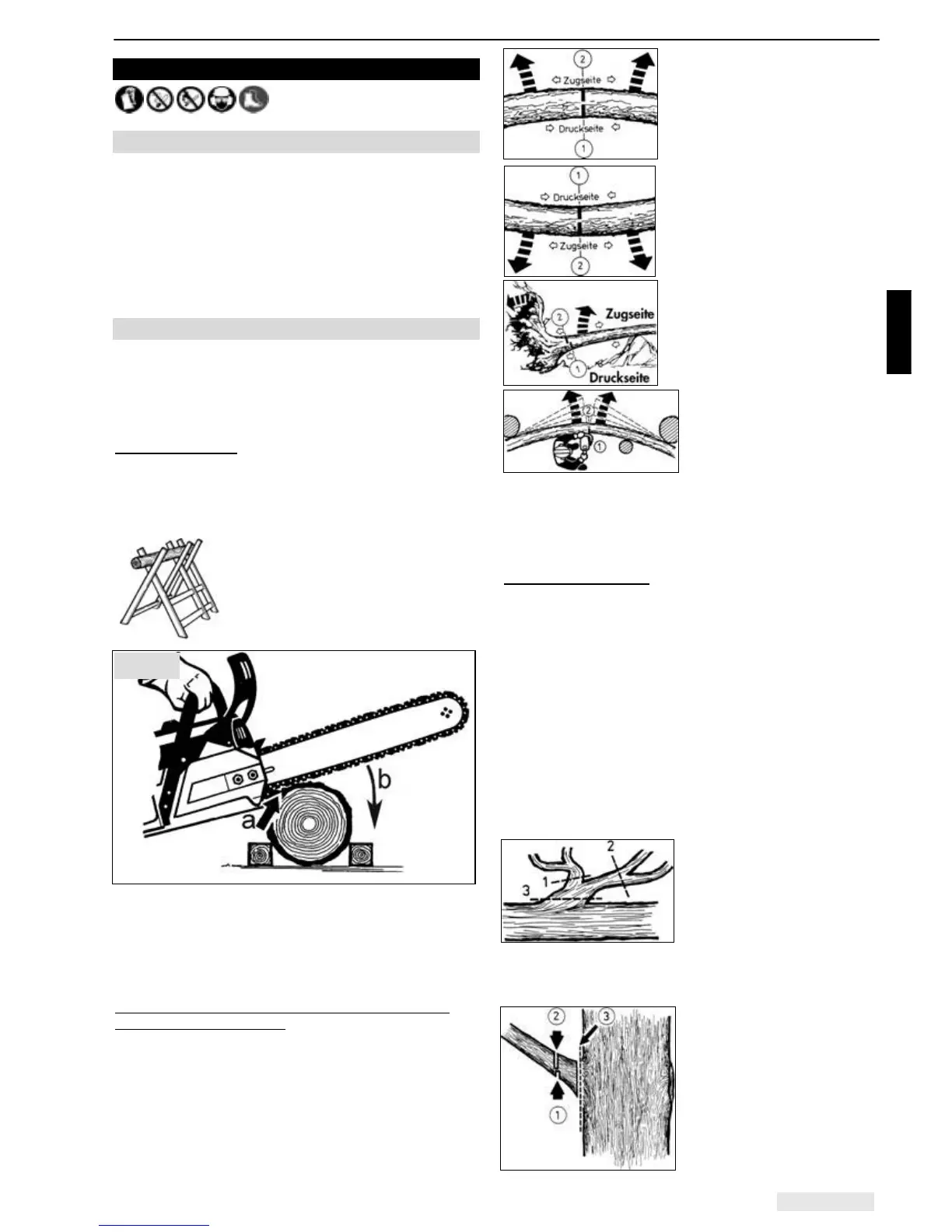
Apply full throttle and move the chainsaw close to the
cutting point, position and press the bumper spikes onto
the object you wish to saw (a), then – and not before –
use a pivoting movement (around the point at which the
bumper spikes have been positioned) to move the
guide bar downwards (b) and start the cut.
Important note on cutting branches which are under
tension (e.g. in the forest):
• Always make the first cut on the compression side
", but be careful as there is a risk of pinching.
• Then proceed carefully and make a cut at the
tension side.
#
• On thick trunks which are under a lot of tension
offset the cut to one side.
Trunk under tension on the
upper side.
Danger: The tree will spring
back in an upward direction.
Trunk under tension on the
underside:
Danger: The tree will spring
back in a downward direction
Thick trunks and high tension:
Danger: The tree will spring
back suddenly and with
considerable force. Also watch
out for the root clump tipping
back.
Trunk under lateral tension:
Danger: The tree will spring
back to one side
Note: Always stand on the compression side if the tree
is under lateral tension.
If the saw becomes pinched in the cut, stop the engine
and lift the trunk with a bar or other lever, or change its
position to open up the cutting gap.
Removing branches:
Do not cut through free-hanging branches from
underneath.
Do not remove branches while standing on the trunk.
Remove any obstructing branches before you start
sawing.
If you change your standing point, remember that the
guide bar must always be on the side of the trunk facing
away from your body.
Always keep an eye on tree and branch movement –
plan ahead and proceed with care!
When removing branches on thick hardwood trees,
follow the correct procedure described below to prevent
the chainsaw from becoming pinched:
1. Remove any obstructing
branches.
2. Cut off any branches
which are creating tension.
3. Cut off the main branch
(note which side is the
compression side and which the tension side).
If it is important that the wood does not tear, make a
relieving cut.
Start this cut on the
compression side ", then
finish the cut from the
tension side #.
The remainder of the branch
which is left standing is now
no longer under tension and
can be cut off close to the
trunk $.
Fig. 13



 To Next Page