EasyManua.ls Logo

Sony CRF-230B - Page 6

Sony CRF-230B
60 pages
Print Icon
To Next Page IconTo Next Page
To Previous Page IconTo Previous Page
Loading...
|
CRF-230B
1-3
TECHNICAL
FEATURES
The
SONY
Model
CRF-230B
is
a
high-perform-
aruc:
radio
receiver
having
many
features
found
in
cOmrmunication
receivers.
Among
them
are
the
fo
lbwing:
e
4
total
of
23
bands
covering
the
broadcast
fre-
quencies
of
any
country
in
the
world.
Included
we
2
fm
bands,
19
sw
bands,
a
mw
band
and
alw
band.
e
(ET
(Field
Effect
Transistor)
front
ends
in
fm
and
sw
bands
provide
superior
sensitivity,
image
rejection,
and
stability.
e
fasy-to-tune
sw
bands
due
to
a
dual-conversion
system
providing
a
uniform
600
kHz
tuning
range
on
each
band.
e
?roduct
detector
for
receiving
ssb
signals.
e
An
fm
i-f
circuit
employing
ceramic
filters.
An
am
i-f
circuit
employing
two
ceramic
filters
with
two-step
adjustable
selectivity.
e
Individual
tuning
knobs
for
sw2~
19
bands,
swl/mw/lw
bands
and
fm
bands.
Preset-tuning
of
three
stations
is
available.
e
The
power
supply
will
operate
from
household
current
in
any
country
of
the
world
(via
built-in
voltage
selector),
internal
battery,
or
car
battery.
e
Stable,
noise-free
fm
tuning
by
means
of
AFC
and
a
muting
system.
e
ANL
(Automatic
Noise
Limiter)
to
minimize
noise.
e
Up
to
4
watts
of
undistorted
audio
power
output
with
two
built-in
speakers
or
external
speakers.
TO
MUTING
CIRCUIT
1-4.
CIRCUIT
EXPLANATIONS
AFC
(Automatic
Frequency
Control)
Available
for
Both
FM
Bands
In
the
Model
CRF-230B,
the
local
oscillator
frequency
is
above
the
signal
frequency
for
the
FM2
band,
but
below
the
signal
frequency
for
the
FM1
band.
Because
of
this,
oscillator
drift
produces
a
detector
dc
output-voltage
change
of
different
polarity
on
the
FM1
band
than
on
the
FM2
band.
Therefore,
dc
control
voltages
taken
directly
from
the
detector
output
can
not
be
used
to
stabilize
the
frequency
of
the
local
oscillator.
To
get
around
this
problem,
a
comparator
circuit
with
selectable
output
polarity
is
used
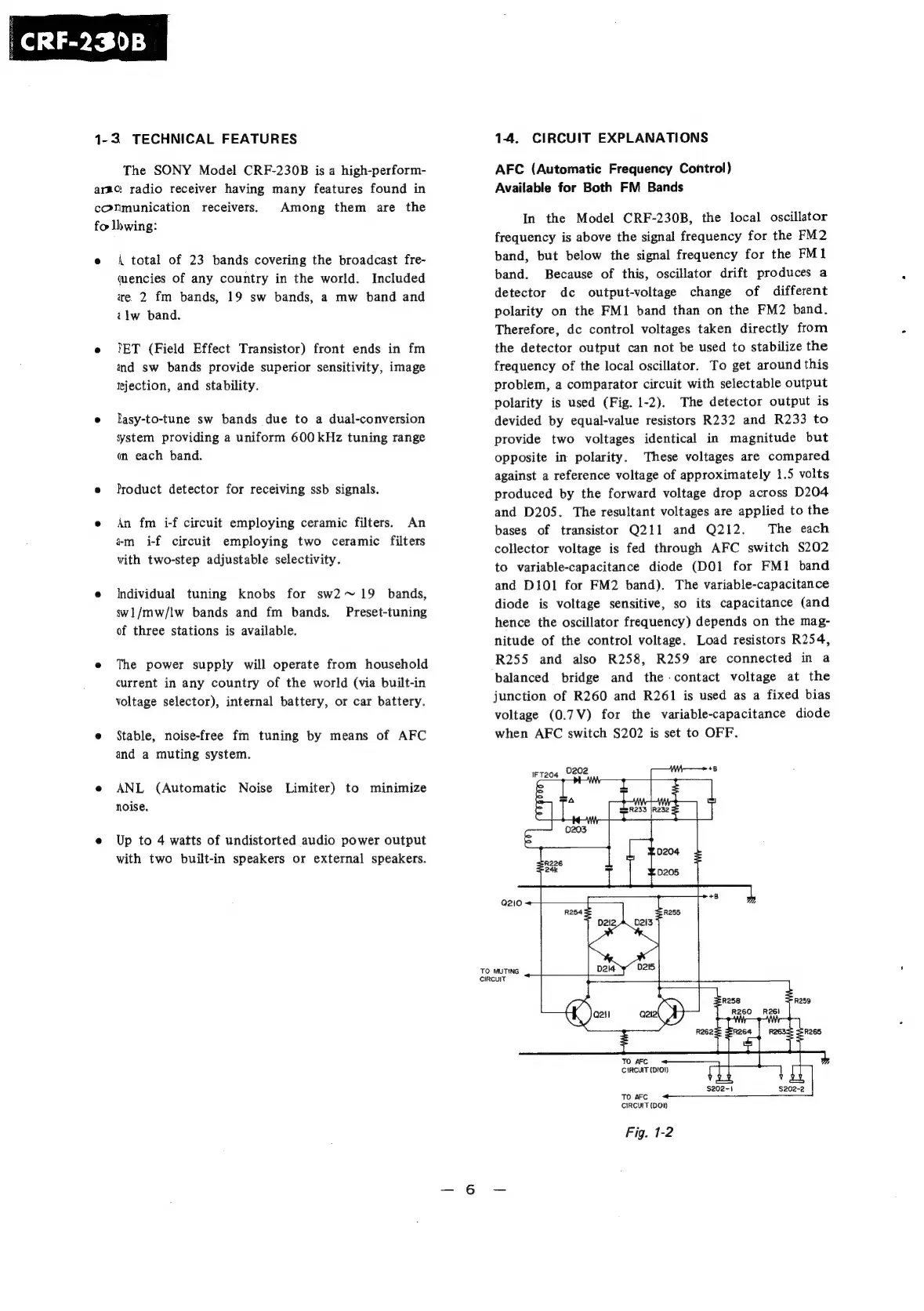
(Fig.
1-2).
The
detector
output
is
devided
by
equal-value
resistors
R232
and
R233
to
provide
two
voltages
identical
in
magnitude
but
opposite
in
polarity.
These
voltages
are
compared
against
a
reference
voltage
of
approximately
1.5
volts
produced
by
the
forward
voltage
drop
across
D204
and
D205.
The
resultant
voltages
are
applied
to
the
bases
of
transistor
Q211
and
Q212.
The
each
collector
voltage
is
fed
through
AFC
switch
$202
to
variable-capacitance
diode
(DO1
for
FM1
band
and
D101
for
FM2
band).
The
variable-capacitance
diode
is
voltage
sensitive,
so
its
capacitance
(and
hence
the
oscillator
frequency)
depends
on
the
mag-
nitude
of
the
control
voltage.
Load
resistors
R254,
R255
and
also
R258,
R259
are
connected
in
a
balanced
bridge
and
the
contact
voltage
at
the
junction
of
R260
and
R261
is
used
as
a
fixed
bias
voltage
(0.7V)
for the
variable-capacitance
diode
when
AFC
switch
S202
is
set
to
OFF.
IF
T204
nee
a
ie
c
circa
(DIO!)
TO
AFC
CIRCUIT
(DON
Fig.
1-2

Related product manuals