EasyManua.ls Logo

Sony ICF-6800W - Page 13

Sony ICF-6800W
60 pages
Print Icon
To Next Page IconTo Next Page
To Previous Page IconTo Previous Page
Loading...
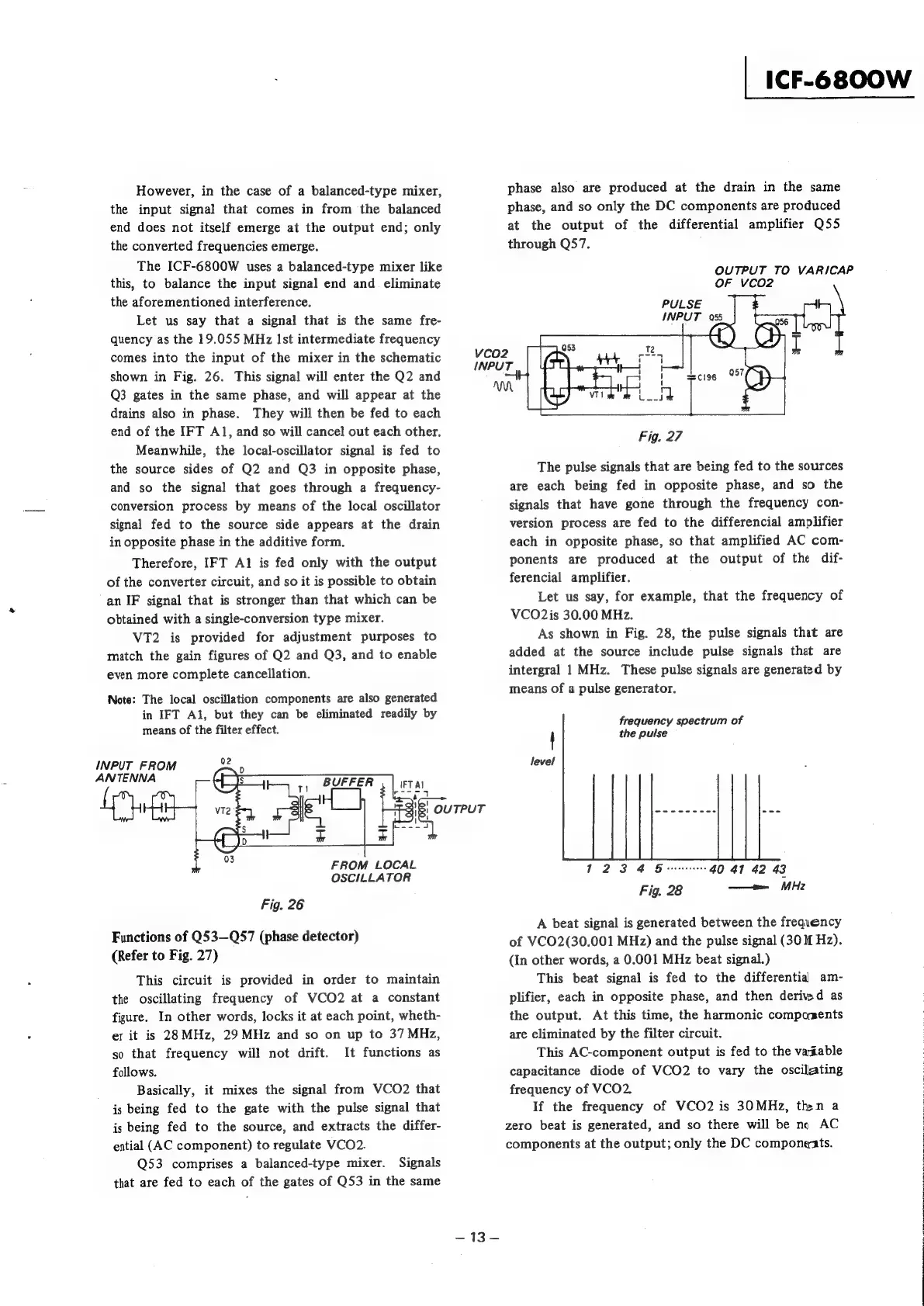
However,
in
the
case
of
a
balanced-type
mixer,
the
input
signal
that
comes
in
from
the
balanced
end
does
not
itself
emerge
at
the
output
end;
only
the
converted
frequencies
emerge.
The
ICF-6800W
uses
a
balanced-type
mixer
like
this,
to
balance
the
input
signal
end
and
eliminate
the
aforementioned
interference.
Let
us
say
that
a
signal
that
is
the
same
fre-
quency
as
the
19.055
MHz
Ist
intermediate
frequency
comes
into
the
input
of
the
mixer
in
the
schematic
shown
in
Fig.
26.
This
signal
will
enter
the
Q2
and
Q3
gates
in
the
same
phase,
and
will
appear
at
the
drains
also
in
phase.
They
will
then
be
fed
to
each
end
of
the
IFT
A1,
and
so
will
cancel
out
each
other.
Meanwhile,
the
local-oscillator
signal
is
fed
to
the
source
sides
of
Q2
and
Q3
in
opposite
phase,
and
so
the
signal
that
goes
through
a
frequency-
conversion
process
by
means
of
the
local
oscillator
signal
fed
to
the
source
side
appears
at
the
drain
in
opposite
phase
in
the
additive
form.
Therefore,
IFT
Al
is
fed
only
with
the
output
of
the
converter
circuit,
and
so
it
is
possible
to
obtain
an
IF
signal
that
is
stronger
than
that
which
can
be
obtained
with
a
single-conversion
type
mixer.
VT2
is
provided
for
adjustment
purposes
to
match
the
gain
figures
of
Q2
and
Q3,
and
to
enable
even
more
complete
cancellation.
Note:
The
local
oscillation
components
are
also
generated
in
IFT
Al,
but
they
can
be
eliminated
readily
by
means
of
the
filter
effect.
INPUT
FROM
ae
ANTENNA
Lf
FROM
LOCAL
OSCILLATOR
Fig.
26
Functions
of
Q53—Q57
(phase
detector)
(Refer
to
Fig.
27)
This
circuit
is
provided
in
order
to
maintain
the
oscillating
frequency
of
VCO2
at
a
constant
figure.
In
other
words,
locks
it
at
each
point,
wheth-
er
it
is
28
MHz,
29
MHz
and
so
on
up
to
37
MHz,
so
that
frequency
will
not
drift.
It
functions
as
follows.
Basically,
it
mixes
the
signal
from
VCO2
that
is
being
fed
to
the
gate
with
the
pulse
signal
that
is
being
fed
to
the
source,
and
extracts
the
differ-
ential
(AC
component)
to
regulate
VCO2.
Q53
comprises
a
balanced-type
mixer.
Signals
that
are
fed
to
each
of
the
gates
of
Q53
in
the
same
vco2
INPUT
—-13-—
ICF-6800W
phase
also
are
produced
at
the
drain
in
the
same
phase,
and
so
only
the
DC
components
are
produced
at
the
output
of
the
differential
amplifier
Q55
through
Q57.
OUTPUT
TO
VARICAP
OF
vCO2
PULSE
INPUT
055
Fig.
27
The
pulse
signals
that
are
being
fed
to
the
sources
are
each
being
fed
in
opposite
phase,
and
so
the
signals
that
have
gone
through
the
frequency
con-
version
process
are
fed
to
the
differencial
amplifier
each
in
opposite
phase,
so
that
amplified
AC
com-
ponents
are
produced
at
the
output
of
the
dif-
ferencial
amplifier.
Let
us
say,
for
example,
that
the
frequency
of
VCO2is
30.00
MHz.
As
shown
in
Fig.
28,
the
pulse
signals
that
are
added
at
the
source
include
pulse
signals
that
are
intergral
1
MHz.
These
pulse
signals
are
generated
by
means
of
a
pulse
generator.
frequency
spectrum
of
\
the
pulse
level
|
ee
Se
40
41
42
43
—a
MHz
A
beat
signal
is
generated
between
the
frequency
of
VCO2(30.001
MHz)
and
the
pulse
signal
(30
M
Hz).
(In
other
words,
a
0.001
MHz
beat
signal.)
This
beat
signal
is
fed
to
the
differential
am-
plifier,
each
in
opposite
phase,
and
then
derived
as
the
output.
At
this
time,
the
harmonic
components
are
eliminated
by
the
filter
circuit.
This
AC-component
output
is
fed
to
the
vagable
capacitance
diode
of
VCO2
to
vary
the
oscilating
frequency
of
VCO2,
If
the
frequency
of
VCO2
is
30MHz,
then
a
zero
beat
is
generated,
and
so
there
will
be
no
AC
components
at
the
output;
only
the
DC
compongsts.

Other manuals for Sony ICF-6800W

Related product manuals